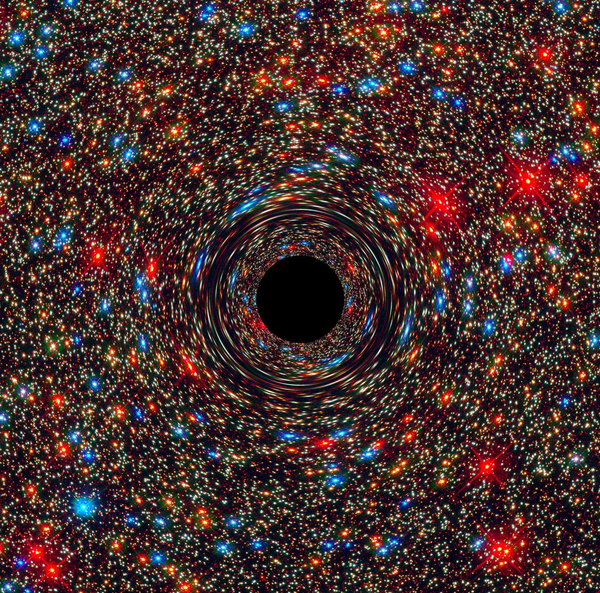
Does the Universe Rotate? Gödel's Spinning Cosmos
Episode 1: The Universe Is Shaped Like a Donut. Probably.
I like science that leaves room to imagine. When things that seemed unrelated turn out to share a hidden pattern — that moment feels like finding one of the world's secrets. Which opens a door I didn't know was there. Which leads somewhere unexpected. Which eventually leads back to me.
You've spun around before. Maybe as a kid, arms out, laughing, until the world tilted and you had to sit down on the grass. And even after you stopped, the spinning didn't stop. The sky kept sliding. The trees leaned. Your own body lied to you for a few seconds about which way was up.
That feeling — that's your inner ear catching you in a rotation you can no longer see [1]. Your eyes say "still." Your body says "moving." And for a moment you don't know which one to believe.
Here's a strange thing. You've never really stopped moving.
Right now, sitting in your chair, feeling perfectly still, you are spinning. The Earth turns under you at hundreds of meters per second [2]. You don't feel it, because everything around you turns with it — the walls, the coffee, the air. But you're moving. Fast.
And the Earth isn't just spinning. It's falling around the Sun, a whole lap every year, at about thirty kilometers a second [3]. The Sun is dragging you along too, circling the center of our galaxy at something like 230 kilometers per second [4]. That trip takes roughly 230 million years to complete once [5]. The last time your patch of the galaxy was in this exact spot, dinosaurs hadn't shown up yet.
So you are spinning, inside a bigger spin, inside a bigger spin. Layers of motion, stacked, all of them invisible to you because you're inside them. Like the kid on the grass, you can't feel the rotation. You can only feel it stop.
Now here's the question that got me. The one I can't put down.
Everything spins. The Earth spins. The Sun spins. The galaxy spins. Moons, planets, stars, whole galaxies — the universe is full of things turning around other things, and every one of them is rotating around something bigger.
So what's the biggest thing?
Does it spin too?
I mean the whole universe. Everything there is. All the galaxies, all the light, all the empty space between. Is the entire thing turning — very slowly, once every unimaginable stretch of time — around some center we can't point to?
You might think that's an easy question. Just look. See if the sky is drifting one way, like the trees did after you spun. But there's a problem, and it's the same problem the kid on the grass had. You're inside it. There's no ground to sit down on. There's nothing outside the universe to compare your motion against. If everything is spinning together, how would you ever know?
This isn't a silly question dreamed up bysomeone with too much time. It's a real one, and one of the smartest people who ever lived took it seriously enough to do the math.
His name was Kurt Gödel — a logician, a friend of Einstein's, a man famous for proving that some things can be true and yet impossible to prove [6]. In 1949 he handed Einstein a birthday present. Not a card. A whole universe [7].
Gödel had worked out that a spinning universe was allowed. Not forbidden by the rules. The equations of general relativity — Einstein's own theory of gravity, space, and time — would happily describe a cosmos that turns [7]. And in that turning universe, Gödel found something that must have made Einstein put his coffee down.
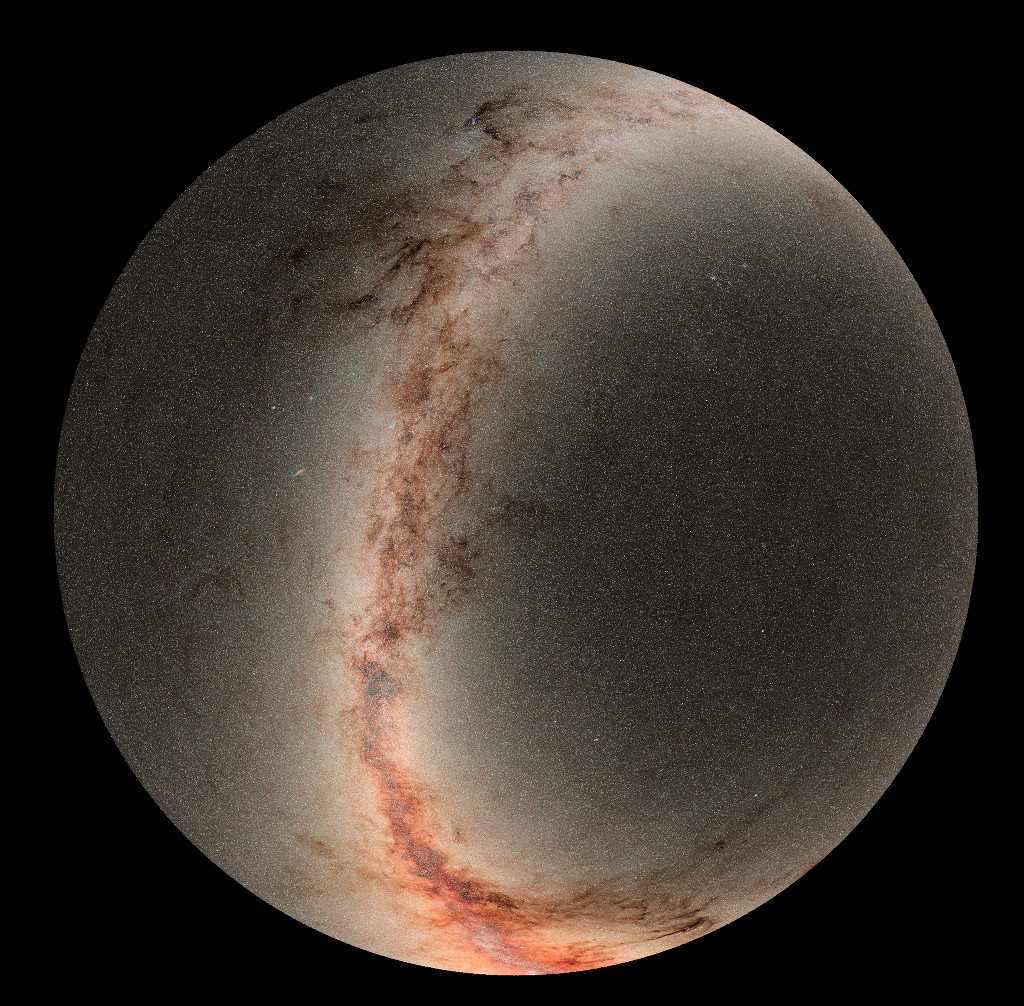
📷 Pan-STARRS Across the Sky — NASA/ESA (NASA APOD, Public Domain)
If the universe spins the right way, you could travel into your own past [8].
Not as a metaphor. As a route. Follow a certain path through a rotating cosmos and you'd come back to a moment before you left. You could meet yourself. You could, in principle, walk up to yesterday and knock on the door.
We'll get to why that's a nightmare later. For now just sit with the fact that a rotating universe isn't science fiction. It's a solution to the same equations that run your GPS and bend starlight around the Sun [9]. Somebody has to check whether we live in one.
And that's the part I keep circling back to. Someone actually looked. Someone pointed instruments at the oldest light in existence and asked the whole sky a simple, enormous question: are you turning?
You'd think the answer would be obvious. It isn't.
What would spinning even look like, if you were trapped inside the thing that spins?
Here's a strange thing about that dizziness. You could tell you were spinning without opening your eyes. Your body knew. There's a fluid in your inner ear, and when you spin, it swirls and pushes on tiny hairs, and those hairs scream "we are turning" to your brain [1]. You don't need a window. You don't need a landmark. The rotation announces itself from the inside.
Now hold that thought, because a man named Kurt Gödel had a wild idea in 1949, and it starts with the same question your inner ear answers every time you get off a merry-go-round: can you tell you're spinning when there's nothing to spin against?
Think about what "spinning" even means. You spin relative to something. The room. The ground. The stars. When you were a kid on the grass, the whole sky was your reference point — you turned, and the world appeared to turn the other way. Easy. But now zoom out. Way out. Past the trees, past the sky, past the galaxy. Imagine the entire universe. Everything there is. And ask: is it spinning?
Spinning relative to what? There's nothing outside the universe to compare it to. No bigger room. No cosmic grass to lie down on. By definition, the universe is all of it. So the question sounds like nonsense. Like asking what's north of the North Pole.
Except it isn't nonsense. Because of your inner ear.
Here's the trick. Rotation doesn't only reveal itself by comparison to a landmark. It reveals itself through what physicists call inertial effects *1 — the forces you feel from the inside. The push against the car door when you take a sharp turn. The way water climbs the walls of a bucket you swing in a circle. You feel these even with your eyes closed. Even in the dark. Even, in principle, if there were nothing else in the universe at all.
So a spinning universe could give itself away. Not by turning against some outside backdrop — there isn't one — but by leaving fingerprints inside itself. The whole thing would have a subtle swirl baked into its geometry, like the grain in a piece of wood.
Now picture this. Take a record player — a flat disc turning slowly around its center. Drop a marble on it and the marble doesn't roll straight. It curves. It gets flung outward. The record isn't pushing the marble sideways with a hand; the marble is just trying to go straight while the floor beneath it rotates. To anyone living on that record, straight lines would look bent. Their whole world would have a built-in twist they couldnever quite point away from.
That's Gödel's universe. He did the math and found that Einstein's equations — the rules that govern gravity and the shape of space itself — allow a universe that rotates [2]. Not around a point in space. The whole thing, turning, with no center and no edge, every galaxy carried along like a speck of dust on that vast invisible record.
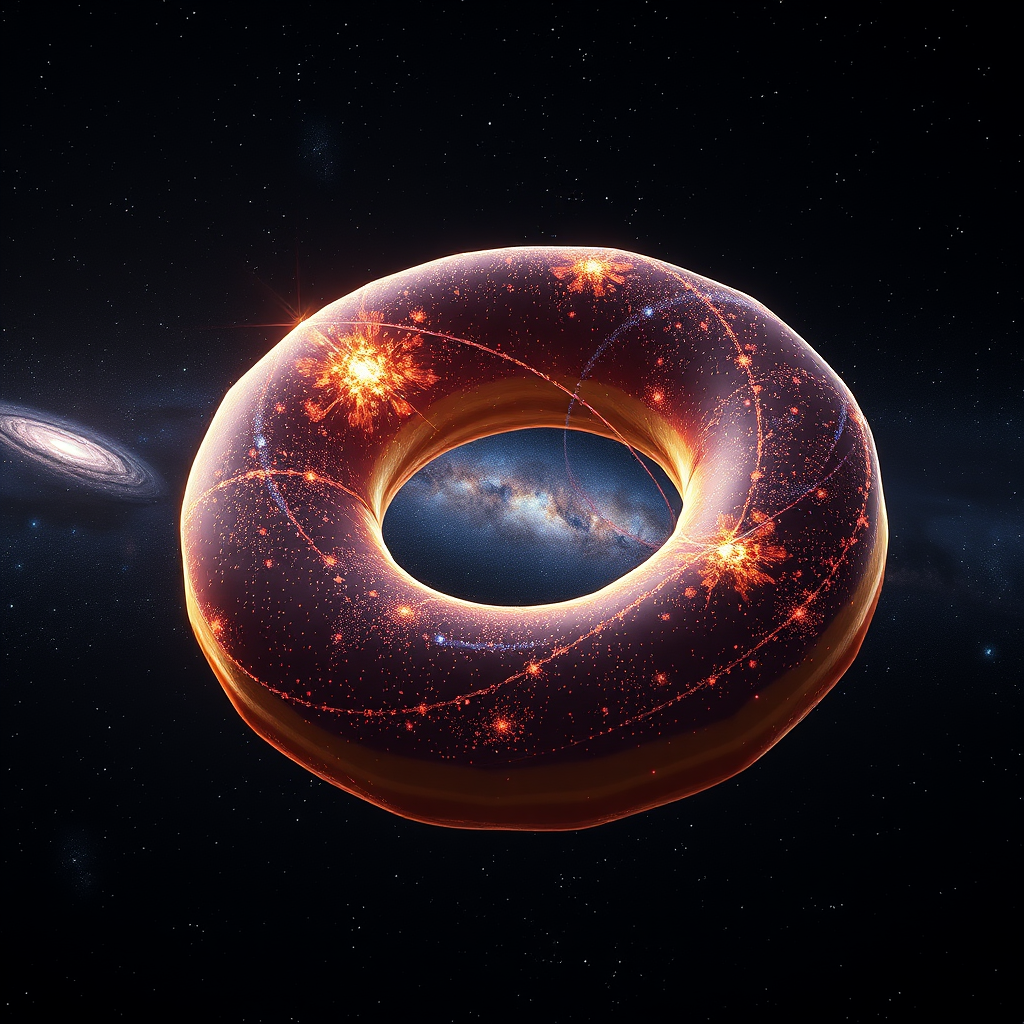
AI-generated image — a conceptual visualization
And in a rotating universe, straight lines misbehave in a spectacular way. On the record player, the marble just curves. In Gödel's cosmos, if you fly far enough in what feels like a perfectly straight line, you don't just curve — you come back to your own past [2]. The twist in the geometry loops time itself into a circle. You could, in theory, travel forward and arrive before you left. Gödel, a shy logician who ate almost nothing and trusted almost no one, handed this to Einstein as a birthday present [3]. A universe where you can visit yesterday. Happy birthday.
Einstein was not thrilled. He admitted the solution was valid but said it "disturbed" him, and he hoped it could be ruled out on physical grounds [3]. Which is a very polite way of saying: please, no.
But here's why the record-player picture matters for you, sitting there reading this. Because it turns the impossible question into a checkable one. You can't step outside the universe to see if it spins. But if you're standing on a spinning record, you don't need to. You look at how things move around you. You look for the curve. The swirl. The stuff being flung a little sideways.
Imagine you're the marble, and you've never been told the record is turning. You just notice that everything drifts. Every ball you roll bends the same way. Every path leans. You'd start to suspect the floor. And that's exactly what astronomers do with the sky — they look for a preferred direction, a cosmic lean, some sign that the universe as a whole is quietly turning under our feet.
Think of the two kids again. One spins in the yard and feels dizzy. That's rotation you can see — there's grass, there's sky, there's a before and after. The other kid is the universe itself, and there's no yard, no sky, nothing outside to spin against. And yet Gödel showed the second kid could still, in principle, feel dizzy. The rotation would live in the geometry, in the way light and matter and time all lean together, whether or not anyone is watching.
So the donut is coming. Hold on. Because a spinning record and a shape that loops back on itself are cousins, and the shape of the universe is wherethis whole thing has been quietly heading.
But before we get there, sit with the strangeness of what Gödel actually did. He didn't build a telescope. He didn't discover a new particle. He sat with a pencil and Einstein's equations and found a universe hiding inside the math — one nobody had asked for and nobody wanted. A universe where the past isn't safely behind you. Where "later" can curl around into "earlier." Where the record turns and time turns with it.
And the unsettling part isn't that this universe exists. It probably doesn't; our best measurements say the real universe barely spins at all, if it spins [4]. The unsettling part is that the equations allowed it. The same rules that keep your coffee in the cup and hold the planets in their orbits also permit a world where you could shake your own hand from yesterday. The math doesn't forbid it. Something else has to.
That's the quiet lesson of the record player. Rotation reveals itself from the inside. You don't need a window onto the outside — you never did. Your inner ear proved that on the grass when you were six. Gödel proved it for the entire cosmos. The universe, if it's spinning, is telling on itself right now, in the drift of light and the lean of galaxies, in a signal so faint we've spent decades straining to hear it.
So the question stops being "spinning relative to what?" and becomes something you can actually chase. Not with philosophy. With telescopes. With patience. With the willingness to be the marble that finally looks down and wonders about the floor.
Which leaves one thing to figure out. If the universe isn't a spinning record — and it seems not to be — then what shape is it? What's the floor actually made of? And why, of all things, might it be a donut?
Gödel's idea was this: what if the whole universe is the swirling fluid? What if everything is turning, all at once, and we're the tiny hairs trying to feel it?
Kurt Gödel wasn't a cosmologist. He was a logician — probably the greatest one who ever lived. In 1931 he'd proved that any system of mathematics big enough to be useful will always contain true statements it can't prove [2]. He broke math a little, and it never fully recovered. Then he moved to Princeton, became close friends with Albert Einstein, and the two of them took long walks home together, talking about time [3].
For Einstein's seventieth birthday in 1949, Gödel gave him a present. Not a cake. A universe.
AI-generated image — a conceptual visualization
He found a solution to Einstein's equations of general relativity — the equations that describe how gravity bends space and time *1 — that nobody had noticed before. In Gödel's solution, the entire universe is rotating [4]. Not around a center, exactly. There's no special point it spins around. Every observer, anywhere, would see the distant matter of the cosmos turning around them, like they were standing at the still eye of an infinite carousel [4].
That's already strange. But it's not the part that bothered Einstein.
Here's the part that bothered Einstein. In a rotating universe, you can travel into your own past [4].
Let that sit for a second. Gödel showed that if the universe spins, spacetime itself gets dragged along, twisted, until the "future" and the "past" bend into a loop. Follow the loop far enough and you come back to a moment that already happened. Physicists call these closed timelike curves *2. Gödel called it a proof that time, as we normally think of it, might not be real at all.
He wrote: "In every such world, and in every possible experience which each individual might have within it, a definite lapse of time would be found... Nevertheless these worlds exclude the possibility of an objective lapse of time" [5]. Translation: everyone feels time passing, and yet time as a universal river flowing forward doesn't exist. It's a local illusion.
Einstein's response was polite and deeply uncomfortable. He admitted Gödel's solution was a genuine problem, and said the question of whether it could be "excluded on physical grounds" would need looking into [6]. In plain terms: I don't like this, and I hope reality doesn't allow it.
So does reality allow it?
This is where it gets good, because we can actually check. If the universe rotates, it leaves fingerprints. And unlike most cosmic mysteries, this one is measurable.
Here's the reasoning. If everything is spinning, that spin picks out a direction — an axis, like the axis of a top. And a preferred axis would leave marks. The oldest light in the universe, the afterglow of the Big Bang, would look slightly different depending on which way you looked [7]. This light is called the cosmic microwave background *3 — it's the heat left over from when the universe was young and hot, now cooled to a faint hum coming from every direction of the sky. If the universe rotated, that hum would be lopsided. Warmer here, cooler there, twisted in a pattern a spinning cosmos would draw.
So people went looking.
In 2016, a team led by Daniela Saadeh at University College London ran the numbers hard [8]. They took the map of that ancient light — the one made by the Planck satellite, which spent years photographing the whole sky in microwave heat [9] — and they compared it against every way the universe could be lopsided. Rotating. Stretched. Twisted. Every version of "not the same in all directions."
Their verdict was blunt. Saadeh put it plainly: "You can never rule it out entirely, but we now calculate the odds that the universe prefers one direction over another at just 1 in 121,000" [10]. In other words: as far as we can measure, the universe is not spinning. It looks the same whichever way you turn your head, to a staggering degree of precision [8].
That's one of the cleanest "no" answers in all of cosmology. Gödel's universe is mathematically real — the equations permit it — but our universe doesn't seem to be that one. Einstein got his wish.
But — and there's always a but — the story didn't quite end there.
Because "the whole universe rotates" and "some things rotate" are different claims. And some astronomers keep finding hints that things at the largest scales aren't as randomly arranged as they should be. In 2020, Lior Shamir at Kansas State University looked at the spin directions of more than 200,000 spiral galaxies and reported that they weren't evenly split [11]. Slightly more spun one way than the other, in a pattern that seemed to have a shape across the sky [11]. Shamir suggested this could hint at a universe with some large-scale rotation or structure [11].
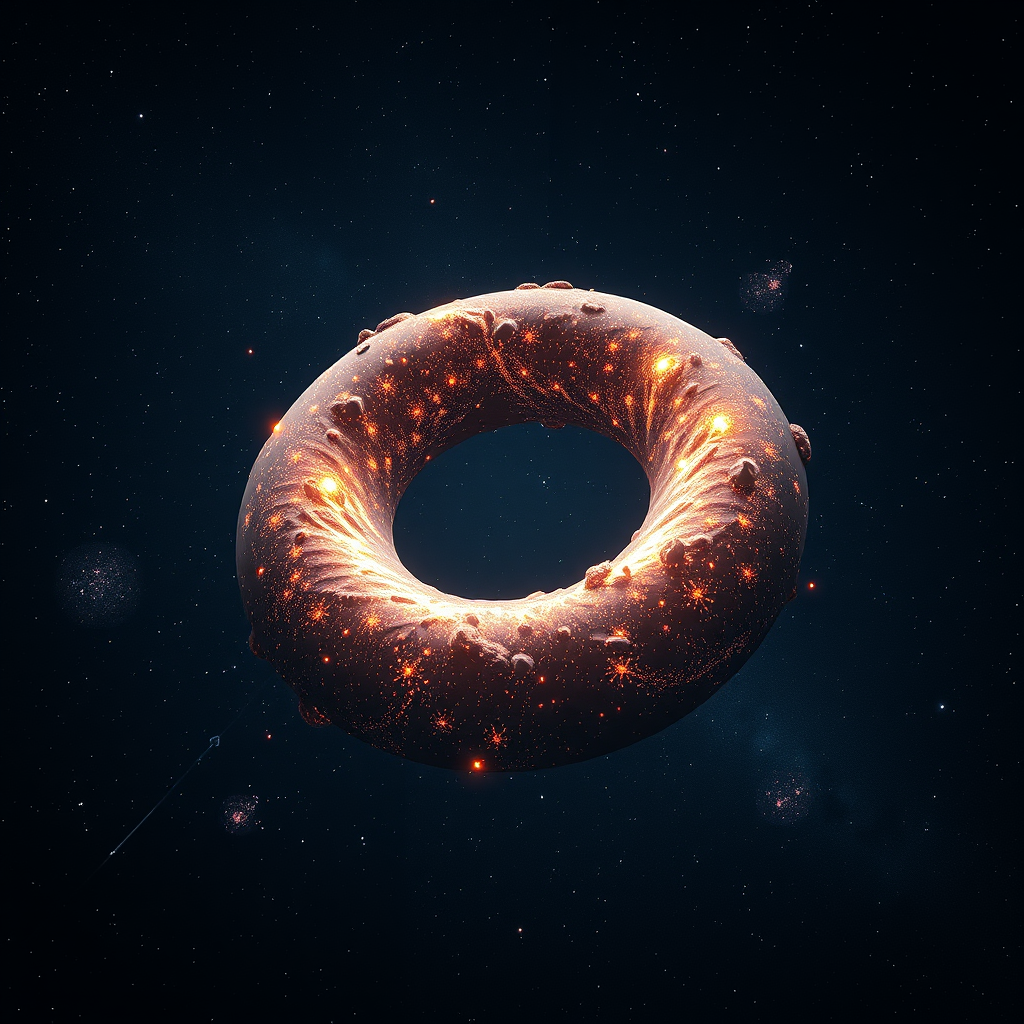
AI-generated image — a conceptual visualization
That result is contested. Hard. Other astronomers argue it's a bias in how we photograph galaxies, or in how humans and algorithms label a'clockwise' versus 'counterclockwise' spiral — because which way a galaxy appears to turn depends partly on which side of it you're standing [12]. Flip the image and the spin flips too. Little systematic errors like that can fake a cosmic pattern out of pure noise [12]. Nobody has agreed on whether Shamir found something real or found a smudge on the lens.
So the honest state of things is this. The universe, taken as a whole, almost certainly does not rotate the way Gödel imagined — the ancient light says no, at odds of 121,000 to 1 [10]. But whether there's some subtler large-scale twist, some faint leftover swirl from the very beginning, is still an open argument [11][12]. We're back to the inner ear. Something might be turning, very slowly, and we're straining to feel it.
Here's what I find hard to shake, though. Gödel didn't really care whether the universe spins. He cared about time. The rotation was just the tool. He was using Einstein's own equations to make a point Einstein hated: that if the universe could be built to let you loop back into yesterday, then "yesterday" and "tomorrow" aren't fundamental features of reality — they're just how it feels from the inside [5]. The river of time you feel flowing past you might be as much of an illusion as the spinning sky after you stop twirling.
The physicist Wolfgang Rindler, writing about Gödel's model decades later, called it "the most striking rotating universe" ever found, precisely because of these time loops — and noted that it forced physicists to take seriously the idea that general relativity permits time travel at all [13]. Before Gödel, most people assumed the equations quietly forbade it. Gödel showed they don't. They just needed a universe strange enough to allow it. Ours, it turns out, probably isn't that strange. But it could have been. The equations didn't stop it. Reality did — for reasons we still can't fully explain.
That gap matters. There's a difference between "the math forbids it" and "the math allows it, but the universe chose not to." Gödel lived in that gap for the rest of his life. His friend Freeman Dyson said Gödel was the only person at Princeton who walked with Einstein as an equal, and the only one still genuinely troubled by these questions long after everyone else had moved on [14]. Gödel kept asking whether astronomical observations could confirm the universe's non-rotation, checking the data himself, well into the 1950s [15]. He w
So did Gödel break the universe too? Not quite. He found a solution to Einstein's equations — a mathematical universe that spins, and inside it, something impossible happens [3]. If you traveled far enough in the right way, you could arrive in your own past [3]. A loop in time. You could, in principle, meet yourself before you left.
Einstein was troubled by this [4]. He'd built the equations. Gödel used them, followed the math honestly, and out popped a world where time eats its own tail. Einstein admitted the problem "disturbed him" [4]. He hoped it could be ruled out on physical grounds. That's a polite way of saying he really wanted it to not be true.
Here's the honest part. We don't know if we live in a spinning universe. And this is the frustrating thing — Gödel's math is fine. His universe is a real solution. The question isn't whether it can exist on paper. The question is whether it describes us.
So people went looking. Not with a giant gyroscope, because there isn't a wall of the universe to spin against. They looked at light instead. If the whole cosmos were rotating, it would leave a fingerprint — a slight lopsidedness in the oldest light we can see, the faint glow left over from the Big Bang [5]. A spinning universe should look a little different depending on which way you point your telescope. A twist baked into the sky.
They found nothing. The measurements say that if the universe rotates at all, it turns unbelievably slowly — slower than one full turn in the entire age of the cosmos, by a huge margin [5]. Not zero. Just very, very close to it. Which is a strange result to sit with. We can't prove it doesn't spin. We can only say: if it does, it's the calmest spin imaginable.
And notice what that means. Gödel's universe isn't just "slow." It's a different kind of universe entirely — one where the rotation is fast enough and the geometry strange enough to bend time into circles [3]. Our universe doesn't seem to be that one. The time loops probably aren't waiting for us out there. Probably.
But "probably" is doing a lot of work in that sentence, and I want to be honest about why. We measure the universe from inside a single galaxy, in a single moment, with instruments that can only see so far [6]. There is a horizon beyond which no light has had time to reach us [6]. Whatever is past it — we can't check. A rotation so slow, so vast, so gentle that its wheel is bigger than everything we can observe? We have noway to rule it out. Absence of a fingerprint isn't proof there's no hand.
And there's a deeper hole. Gödel's universe doesn't expand [3]. Ours does [7]. His stays the same size forever, spinning quietly. So even before we point a single telescope, we know his exact model isn't our home. But that's not the interesting part. The interesting part is that he proved a spinning universe was allowed at all. He showed that Einstein's equations — the best description of space and time we have — don't forbid a world where the past is a place you can visit [3]. They permit it. They just don't require it.
That gap between "permitted" and "actual" is where all the mystery lives. Physics tells us what's possible. It doesn't always tell us what's real. Gödel handed us a universe that shouldn't be able to work, and the math shrugged and said, sure, why not. It fell to observation — to us, squinting at old light — to say "not here." And even that answer came back as a whisper, not a shout.
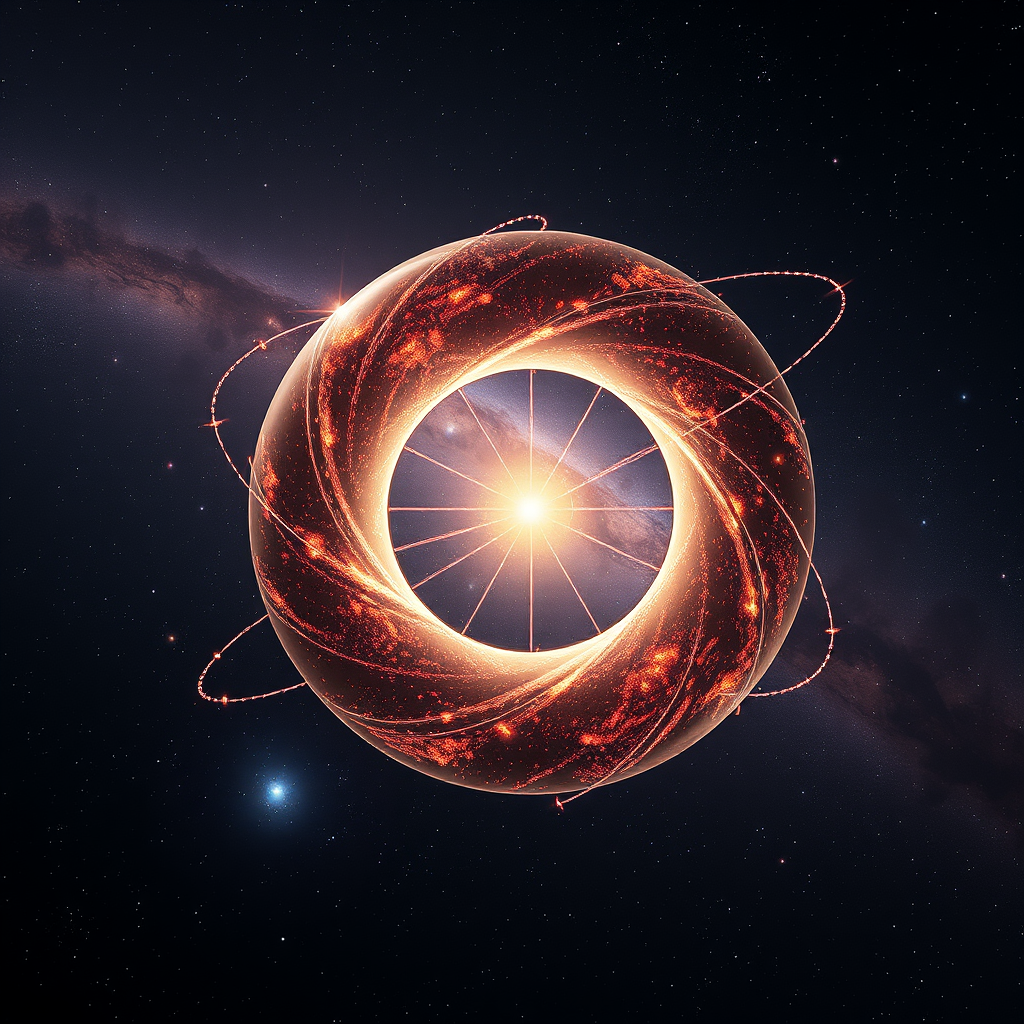
AI-generated image — a conceptual visualization
So what does this leave you with, right now, reading this?
It leaves you spinning, maybe, without knowing it. You are sitting on a planet turning at a thousand miles an hour. That planet circles a star. That star swings around a galaxy. The galaxy drifts through a group of galaxies, and all of it moves through something we don't fully understand. You feel none of it. Your inner ear, so good at catching a childhood spin on the grass, feels perfectly still [1]. The biggest motions are the ones you can't sense.
And that's the thing Gödel really left us. Not an answer. A permission slip for doubt. Your body can lie about which way is up. Maybe the whole universe can too — quietly rotating, or not, on an axis no one will ever find, past a horizon no one will ever cross.
We looked. We saw almost nothing. Almost.
So here's what I can't stop turning over. If the universe were spinning slowly enough — slower than anything we could ever measure, its wheel wider than everything we can see — how would you, from the inside, ever tell the difference between a still universe and one that's already carried you all the way around?
Here's the part that should keep you up at night. Gödel's spinning universe wasn't just a doodle. It was a real solution to Einstein's equations — mathematically allowed, fully legal [3]. Which means our universe could have looked like that. There's no law of physics that forbids it. The question isn't "is this possible?" The question is "did nature choose it?"
So people went looking. If the whole universe spins, it should leave a mark — a slight lopsidedness in the oldest light, a preferred direction baked into the sky [5]. We have a map of that light. It's called the cosmic microwave background — the faint afterglow of the Big Bang, still arriving from every direction after almost fourteen billion years *1.
And the answer, so far, is no. If the universe rotates at all, it turns so slowly that we can't detect it [5]. Slower than a clock's hour hand by more than you can imagine. As far as we can measure, the cosmos is sitting perfectly still.
But "we can't detect it" is not the same as "it isn't there." That's the honest part nobody likes. Your inner ear can feel a spin without a window. The universe has no window — no outside, no landmark, nothing to spin relative to. So how would we ever know for sure? We're the tiny hairs, standing in the fluid, waiting for a push that may be too gentle to feel.
Here's what gets me. Gödel — the man who proved that math contains truths it can never reach — handed us a universe that might contain a rotation we can never measure. He did it twice. First to numbers. Then to everything. It's almost funny, like he had a hobby of finding the exact edge of what we're allowed to know and tapping on it.
And maybe that's the real gift buried in all of this. Not the time loops. Not the spinning. But the reminder that the universe doesn't owe you a shape you can picture. Round. Flat. Twisted like a donut. Spinning silently in a direction you'll never point to.
You spun as a kid and the world kept moving after you stopped.
What if it never stopped at all?
TERMS EXPLAINED
- *1General relativity: Einstein's description of gravity as the bending of space and time by mass and energy, rather than as a simple pulling force.
- *2Closed timelike curve: A path through space and time that loops back to its own starting moment — in plain terms, a route that lets you return to your own past.
- *3Solution (to the equations): A specific universe the math allows. The equations don't describe just one world; they describe a family of possible ones, and each valid answer is called a solution.
- *4Logician: Someone who studies the rules of reasoning and proof — what can and cannot be shown to be true using pure logic.
SOURCES & REFERENCES
- [1]Angelaki, D. E. & Cullen, K. E. (2008). "Vestibular System: The Many Facets of a Multimodal Sense." Annual Review of Neuroscience. — The inner ear detects rotation and produces the dizziness felt after spinning stops.
- [2]IERS (2010). "IERS Conventions." International Earth Rotation Service. — Earth's surface rotation speed reaches hundreds of meters per second near the equator.
- [3]Williams, D. R. (2020). "Earth Fact Sheet." NASA Goddard Space Flight Center. — Earth orbits the Sun at roughly 30 km/s.
- [4]Reid, M. J. et al. (2014). "Trigonometric Parallaxes of High Mass Star Forming Regions." Astrophysical Journal. — The Sun's orbital speed around the galactic center is about 230 km/s.
- [5]Kerr, F. J. & Lynden-Bell, D. (1986). "Review of Galactic Constants." Monthly Notices of the Royal Astronomical Society. — One orbit of the Sun around the galaxy takes roughly 230 million years.
- [6]Gödel, K. (1931). "Über formal unentscheidbare Sätze der Principia Mathematica und verwandter Systeme." Monatshefte für Mathematik. — Gödel proved that consistent formal systems contain true statements that cannot be proven within them.
- [7]Gödel, K. (1949). "An Example of a New Type of Cosmological Solutions of Einstein's Field Equations of Gravitation." Reviews of Modern Physics. — Gödel's rotating universe is a valid solution to general relativity, presented around Einstein's birthday.
- [8]Gödel, K. (1949). "An Example of a New Type of Cosmological Solutions of Einstein's Field Equations of Gravitation." Reviews of Modern Physics. — In Gödel's rotating cosmos, closed timelike curves allow travel into one's own past.
- [9]Ashby, N. (2003). "Relativity in the Global Positioning System." Living Reviews in Relativity. — General relativity is used in GPS timing corrections and describes the bending of light by mass.
Inline citations [N] correspond to numbered references above.
A weekly journey from the present universe back to the Big Bang — and to what it means for us.
![[Deep Dive] Scale-free localization in pseudo-Hermitian quantum walk](/content/images/size/w600/2026/10/deep_dive_thumb-9.png)