[Deep Dive] Transport theory for a generic two-arm co-propagating Majorana interferometer with Majorana fermion and edge vortex tunneling
Transport theory for a generic two-arm co-propagating Majorana interferometer with Majorana fermion and edge vortex tunneling
Nanoscience • October 04, 2026
Reading time: ~12 minutes
📑 Contents
📊 Executive Summary
Chiral Majorana physics has had a rough decade. The 2017 claim of half-quantized conductance in a quantum anomalous Hall (QAH) and superconductor stack was retracted in 2022, and follow-up device studies found no supporting evidence. The theory side kept moving anyway. A new arXiv preprint (2610.01402, posted 1 October 2026) by Domenico Giuliano, Andrea Nava and Fabian Hassler builds a transport theory for a generic two-arm interferometer in which two co-propagating chiral Majorana edge modes interfere. The model includes both Majorana fermion tunneling and edge vortex tunneling, the second being the ingredient that turns these edges into candidates for flying non-Abelian Ising anyons. The authors bosonize the problem with an added replica sector, which lets them treat fully asymmetric arms instead of the idealized symmetric geometry that earlier work relied on. The practical implication is modest and real: experimentalists now have a framework that tolerates the messy asymmetries actual devices will have.
A transport theory that survives asymmetric arms is the difference between predictions for an ideal device and predictions for the device someone will actually fabricate. The catch is that nobody has yet fabricated one that works.
🔬 Technical Deep Dive
Current State
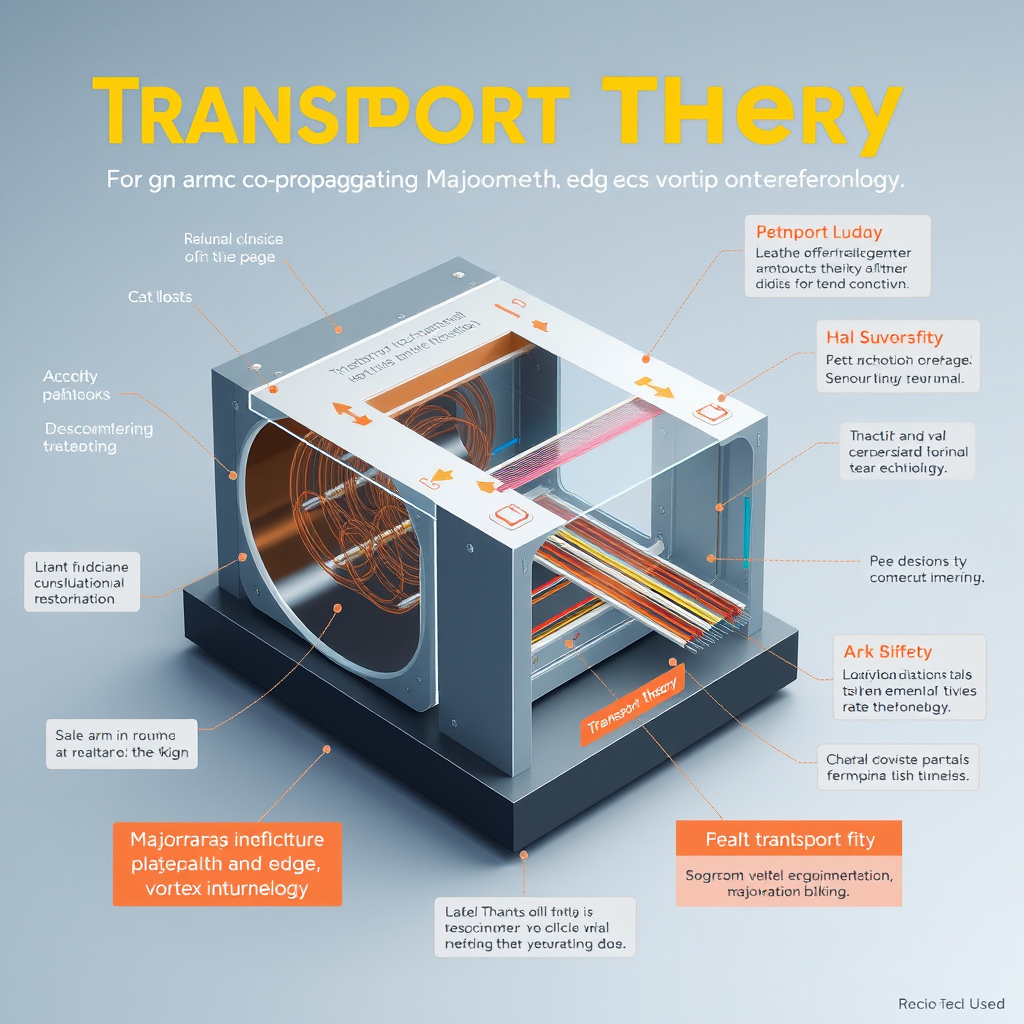
Start with the hardware picture. A QAH insulator with Chern number 1 carries a single chiral, charged edge channel, the same object you see as a quantized e^2/h Hall plateau. Put a superconductor on top and that charged channel can split into two chiral Majorana modes, each of them half of a Dirac fermion. In the two-arm geometry these two Majoranas travel along separate paths, for example the two boundaries of a proximitized region, and they recombine downstream into a charged channel that an ordinary lead can measure. Whether an incoming electron leaves as an electron or as a hole depends on the relative phase picked up along the two arms. Every superconducting vortex enclosed between the arms adds a pi shift. That interference is what makes the setup fully electrical: you read neutral Majorana physics as a charge current.
The co-propagating twist matters. Both Majorana modes move in the same direction, so there is no backscattering loop to worry about, and an edge vortex injected at the entrance travels with the modes toward the exit. Beenakker and collaborators showed in 2019 that a voltage pulse across a Josephson junction can deterministically create pairs of these edge vortices, each carrying a pi phase defect and a Majorana zero mode. Fusing them at the outlet turns non-Abelian braiding statistics into a measurable charge signal.
Previous transport treatments mostly assumed symmetric arms. Real devices will not cooperate. The new preprint drops that assumption.
| Aspect | Earlier symmetric treatments (2009 to 2020) | Giuliano, Nava, Hassler generalized model (2026) |
|---|---|---|
| Arm geometry | Equal lengths and velocities, or small perturbative mismatch | Fully asymmetric arms allowed |
| Tunneling processes | Usually Majorana fermion tunneling, or idealized vortex injection treated separately | Majorana fermion tunneling and edge vortex tunneling handled in one framework |
| Mathematical method | Scattering matrix or bosonization that pairs the two physical Majoranas into one Dirac fermion | Bosonization with an added replica sector, so each arm can be bosonized independently |
| Readout | Charge current and shot noise at the drain | Charge transport from interference of the Majorana pair, extended to asymmetric cases |
| Relevance to real devices | Clean predictions, fragile against fabrication imperfection | Closer to what a fabricated QAH and superconductor device will actually look like |
Recent Breakthroughs
The replica trick is the core methodological move. In the symmetric case you can glue the two physical Majorana modes together into one complex fermion and bosonize that. Once the arms differ in length or velocity, that gluing breaks: the two Majoranas no longer live on a common coordinate. Adding a replica sector gives each physical Majorana an auxiliary partner, so every arm becomes its own Dirac fermion that can be bosonized on its own terms. You pay with extra bookkeeping, and the replica degrees of freedom must drop out of physical observables at the end, but you gain a model that does not collapse the moment the geometry stops being pretty.
The second contribution is putting edge vortex tunneling into the same Hamiltonian as Majorana fermion tunneling. Vortex tunneling is awkward for fermionic methods because a pi phase defect acts like a twist field that changes the boundary conditions of the Majorana modes. In bosonized language, operators like this become vertex operators, which is exactly where bosonization tends to beat scattering-matrix approaches. Treating both processes together is what lets the authors talk about the regime Hassler and colleagues care about: the flying anyon picture, where vortices move along the edge and their fusion is detected electrically.
Fabian Hassler's group at RWTH Aachen has a track record here. He co-authored the 2020 SciPost Physics paper on time-resolved electrical detection of edge vortex braiding. Domenico Giuliano has long worked on bosonization and boundary field theory in junctions of one-dimensional systems. The combination fits the problem. I could only work from the abstract and the preprint listing, so I am not going to claim specific conductance formulas from it. The scope, though, is clear: asymmetric arms, two tunneling channels, transport observables.
Remaining Challenges
The elephant in the cleanroom is materials. Chiral Majorana edge modes in QAH and superconductor heterostructures have no undisputed experimental confirmation. The 2017 Science report of a half-quantized e^2/2h plateau in magnetic topological insulator films with niobium was retracted in 2022, and a 2020 Science study from Kayyalha and coworkers found that similar features could come from the superconductor shorting the film. The QAH effect itself still typically requires temperatures well below 1 kelvin in magnetically doped (Bi,Sb)2Te3 films, which squeezes the window where superconductivity and QAH coexist.
Edge vortex injection requires fast, well-controlled flux pulses across a Josephson junction. Timing jitter, quasiparticle poisoning and heating during those pulses are all unmodeled in a clean transport theory. Velocity mismatch between arms, the very asymmetry this paper accommodates, also introduces energy-dependent phase shifts that smear interference at finite temperature and bias. The theory can tell you how much smearing to expect. It cannot make it go away.
Here is the honest limitation of my own read: without hardware data, any transport framework for this system is a map of a territory nobody has fully surveyed yet. Its value depends on a device that does not reliably exist.
Expert Perspectives
The field has split into camps since 2022. One group, influenced by the retraction and by the Kayyalha null result, argues that QAH and superconductor hybrids need a decisive, unambiguous signature before more theory gets layered on top. Interferometric signatures such as flux-periodic conductance oscillations sensitive to vortex parity are exactly that kind of discriminator, which is why generalized interferometer theory is useful even to skeptics: it defines what a positive result should look like in an imperfect device.
The Beenakker and Hassler line of work takes the opposite emphasis. Their position, laid out in the 2019 PRL and 2020 SciPost papers, is that co-propagating geometries with electrical fusion readout are the cleanest route to observing non-Abelian statistics in motion, since they avoid the need for local zero-mode measurements that have dogged nanowire platforms. Microsoft's February 2025 Nature paper on interferometric parity measurement in InAs and aluminum devices drew public pushback from several condensed matter physicists who noted that the data did not by themselves prove topological protection. That debate makes theorists more careful, and it shows in the move toward models that include realistic asymmetry.
🏢 Market Landscape
Key Players
There is no commercial market for chiral Majorana interferometers. The relevant landscape is the broader race to topological and fault-tolerant qubits, plus the academic groups supplying the theory and materials.
Microsoft is the only large company betting its quantum roadmap on Majorana physics. Its Station Q effort produced the Majorana 1 chip announcement on 19 February 2025, claiming eight topological qubits on an InAs and aluminum "topoconductor" with a stated design path to one million qubits. Microsoft uses nanowire zero modes, not chiral edges, but any experimental validation of non-Abelian Ising anyon physics helps the whole topological thesis. DARPA selected Microsoft, alongside PsiQuantum, for the final phase of its US2QC program in early 2025.
Nokia Bell Labs has a long-running topological program focused on fractional quantum Hall interferometry. Quantinuum demonstrated non-Abelian topological order on its trapped-ion H2 processor (Nature, 2024), which simulates anyons digitally instead of hosting them in a material. Google Quantum AI pursued similar simulations and, more importantly, showed below-threshold surface code error correction on its Willow chip in December 2024, raising the bar that any topological approach has to beat.
Academic players matter more than corporate ones for this specific topic: RWTH Aachen and Forschungszentrum Juelich (Hassler and the JARA quantum information institutes), Leiden (Beenakker), the University of Calabria (Giuliano), Penn State (Cui-Zu Chang's QAH materials group), UCLA and Stanford groups on magnetic topological insulators, and Tsinghua University, where the QAH effect was first observed in 2013.
Investment Trends
McKinsey's Quantum Technology Monitor 2025 counted roughly $2.0 billion of investment into quantum technology startups in 2024, about 50 percent more than in 2023, and projected that quantum technology overall could generate up to $97 billion in revenue by 2035, with quantum computing taking the largest slice. Public funding is larger still: governments have announced well over $40 billion in cumulative quantum commitments across the US, EU, UK, China, Japan and South Korea.
Private rounds in 2025 kept climbing. PsiQuantum announced a $1 billion raise in September 2025, and Quantinuum closed a roughly $600 million round at a reported $10 billion pre-money valuation the same month. None of that money is aimed at chiral Majorana edges. Funding for this physics flows mainly through national science agencies, the European Research Council, Germany's DFG cluster programs such as ML4Q, and the US Department of Energy and NSF materials programs.
Competitive Dynamics
Topological approaches compete against error-corrected conventional qubits on a deadline. Every year that superconducting transmons, trapped ions and neutral atoms improve logical error rates, the bar for a topological platform to justify itself goes up. Google's Willow results and Quantinuum's logical qubit demonstrations have shifted the conversation toward "good enough physical qubits plus overhead" as the default path.
Within topological physics, chiral edge platforms compete with nanowires (Microsoft), fractional quantum Hall states (Bell Labs, Purdue, and others studying the 5/2 state), and Kitaev spin liquid candidates. The edge vortex proposal has one distinct selling point: anyons that fly, so braiding happens by transport instead of by moving zero modes around with gates. That could simplify control wiring considerably if the materials ever work at practical temperatures.
Market Projections
Do not expect a revenue line for Majorana interferometry before 2035. The near-term commercial value sits in adjacent areas: dilution refrigerators (Bluefors, Oxford Instruments), cryogenic RF and pulse electronics (Zurich Instruments, Quantum Machines, Keysight), and thin-film growth tools for magnetic topological insulators (molecular beam epitaxy systems from Riber and others). These suppliers earn money whether chiral Majoranas pan out or not.
If a convincing interferometric signature of edge vortex fusion appeared between 2027 and 2030, the most likely market effect would be renewed venture interest in topological startups and a valuation boost for Microsoft's quantum narrative, not direct product revenue. A realistic projection: academic and government spending on QAH and superconductor hybrids in the tens of millions of dollars per year globally through 2030, with upside only if materials temperature limits improve.
📅 Timeline & Milestones
2026 Expectations
For the rest of 2026, expect follow-on theory more than hardware. The replica-sector framework from Giuliano, Nava and Hassler will likely be extended to finite-frequency noise and time-resolved signals, since that is where the edge vortex fusion signature becomes sharpest. On the materials side, groups at Penn State, Stanford, Tsinghua and elsewhere continue pushing QAH films to higher operating temperatures and testing cleaner superconducting interfaces that avoid the shorting artifacts flagged in 2020. Microsoft is expected to publish further data from its Majorana 1 line, and the community response will shape funding sentiment for all topological platforms. DARPA's Quantum Benchmarking Initiative evaluations should also produce public updates on which approaches advance.
2027-2030 Outlook
The critical milestone for this subfield is a reproducible, flux-periodic interference signal in a QAH and superconductor device that survives control experiments ruling out trivial superconducting paths. If that arrives, the next step is deterministic edge vortex injection using fast Josephson junction pulses, followed by a fusion readout consistent with Ising anyon statistics. Asymmetric-arm theory becomes directly useful at this stage because fabricated arms will never match. In parallel, error-corrected conventional qubits should reach dozens of logical qubits, which will define the performance threshold topological approaches must clear. A realistic expectation is one or two groups claiming interferometric signatures by 2029, with replication taking another year or more.
Beyond 2030
After 2030, flying Ising anyons could serve as a component in hybrid architectures, for example as a topologically protected transport bus or a parity readout element, rather than as a complete universal computer. Ising anyons alone cannot perform universal quantum computation through braiding, so any practical system would still need magic-state injection or non-topological gates. The long-term outcome depends on two dependencies that are both uncertain: QAH materials that work at or above roughly 1 kelvin with clean superconducting proximity, and control electronics capable of picosecond-scale flux pulses without heating the device. Miss either and the platform stays a physics experiment.
💰 Investment Perspective
Opportunities
Nobody can buy exposure to chiral Majorana interferometers directly. The investable angle is the topological quantum thesis and the infrastructure under all quantum hardware. Microsoft (MSFT) is the only listed mega-cap where a Majorana breakthrough would move the narrative, though quantum remains a rounding error in its revenue. Cryogenic and measurement suppliers benefit across every qubit modality: Oxford Instruments (OXIG on the London Stock Exchange) through its NanoScience unit, and Keysight (KEYS) through quantum control and measurement tools. Diversified exposure is available through the Defiance Quantum ETF (QTUM), which holds a basket of quantum, semiconductor and computing names.
Risk Factors
The scientific risk is high and specific. The flagship experimental claim for chiral Majoranas was retracted, and Microsoft's 2025 results drew public skepticism from physicists. Theory papers, including this one, do not reduce that risk; they sharpen the test. Pure-play quantum stocks such as IonQ (IONQ), Rigetti (RGTI) and D-Wave (QBTS) have traded at very high revenue multiples with sharp drawdowns, and none of them pursue topological qubits, so they offer no exposure to this physics anyway. Timeline risk is severe: a correct physical picture could still take more than a decade to matter commercially, while competing error-corrected platforms keep improving.
Recommendations
Treat this as a signal to monitor, not a trade. For investors who want quantum exposure, a small position in QTUM or in infrastructure names like KEYS gives diversified upside without betting on one qubit modality. MSFT holders already own the topological option at no extra cost. Track three indicators: replication of any interferometric chiral Majorana signal in peer-reviewed journals, QAH operating temperature records, and Microsoft's follow-up topological qubit data. Avoid buying pure-play quantum stocks on topological headlines, since those companies do not work on this platform.
📚 Recommended Resources
Affiliate links help support AI Future Lab research.
💡 Key Takeaways
The October 2026 preprint by Giuliano, Nava and Hassler extends Majorana interferometer transport theory to fully asymmetric two-arm geometries, which is what fabricated devices will actually look like.
Adding a replica sector during bosonization lets each arm be treated independently, and edge vortex tunneling gets handled alongside Majorana fermion tunneling in one model.
Edge vortices carrying a pi phase defect are the proposed flying non-Abelian Ising anyons, detected purely electrically through fusion at the interferometer outlet.
Experimental confirmation of chiral Majorana edge modes is still missing after the 2022 retraction of the e^2/2h claim, so this theory serves as a sharper test, not as validation.
Microsoft remains the only major company publicly betting on Majorana-based qubits, using nanowires instead of QAH edges; its results set the sentiment for the whole topological field.
Watch for flux-periodic interference signals in QAH and superconductor devices with strong control experiments; that is the milestone that would make this framework immediately practical.
For investors, the reliable exposure is in cryogenic and measurement infrastructure, not in pure-play quantum stocks, none of which work on topological qubits.
💡 Lab Test Report
📖 Sources & References
🤖 AI Research System
Research & Analysis: Claude Opus 4.7
Infographics: Flux.1-schnell (로컬)
Published: October 04, 2026
Word Count: ~2,500-3,000 words
Next Deep Dive: Next Sunday