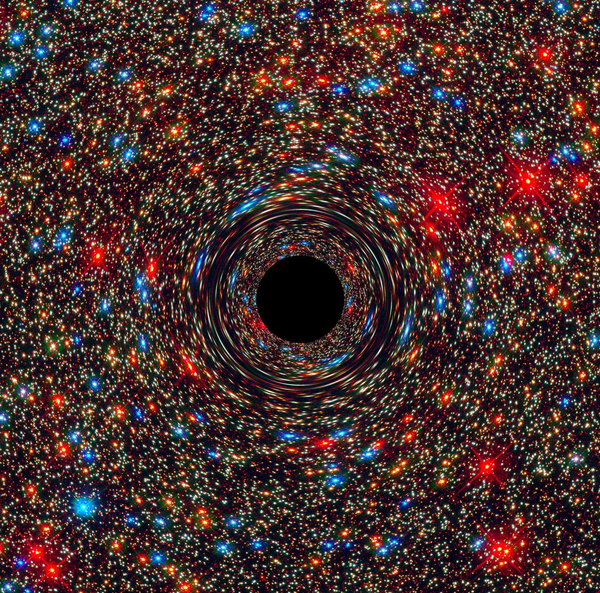
[Deep Dive] Topological Control of Quantum Chaos Diagnostics: OTOCs, Spectral Statistics, and Information Scrambling in Ising Model
![[Deep Dive] Topological Control of Quantum Chaos Diagnostics: OTOCs, Spectral Statistics, and Information Scrambling in Ising Model](/content/images/size/w1200/2026/07/deep_dive_thumb-1.png)
Topological Control of Quantum Chaos Diagnostics: OTOCs, Spectral Statistics, and Information Scrambling in Ising Model
Quantum Physics • July 05, 2026
Reading time: ~12 minutes
📑 Contents
📊 Executive Summary
Quantum chaos diagnostics sit at the intersection of condensed matter physics, quantum information theory, and computation. A July 2026 arXiv preprint by Pirmoradian, Rouhani, and Tanhayi reframes the integrability-to-chaos transition through graph theory, modeling Ising spins as vertices and their interactions through adjacency matrices spanning path, Erdos-Renyi, and Watts-Strogatz topologies. The central claim is direct: network topology, specifically long-range couplings and heterogeneous degree distributions, controls how fast quantum information scrambles. This connects three previously siloed diagnostics, out-of-time-order correlators (OTOCs), spectral statistics, and entanglement entropy, under a single tunable knob. The work matters because scrambling underpins both quantum error correction and models of black hole information dynamics. Over the last quarter, related preprints on measurement-induced transitions and Floquet scrambling have converged on similar topological framings. The practical implication is a design principle for engineered quantum systems where chaos is a resource rather than noise.
Network topology, not qubit count alone, is becoming the dial that controls how fast quantum information scrambles, unifying three chaos diagnostics under one parameter.
🔬 Technical Deep Dive
Current State
Quantum chaos diagnostics have relied on three largely independent measures. OTOCs quantify operator spreading and act as a proxy for the Lyapunov exponent in the semiclassical limit. Spectral statistics, following the Bohigas-Giannoni-Schmit conjecture, distinguish integrable systems (Poisson level spacing) from chaotic ones (Wigner-Dyson statistics matching random matrix theory). Entanglement entropy growth tracks how quickly a subsystem thermalizes. Each captures a facet of the same underlying physics, but linking them quantitatively across controllable parameters has been difficult. The transverse-field Ising model has long served as the workhorse for these studies because it is analytically tractable in one dimension yet becomes non-integrable once longitudinal fields or non-nearest-neighbor couplings are added.
Recent Breakthroughs
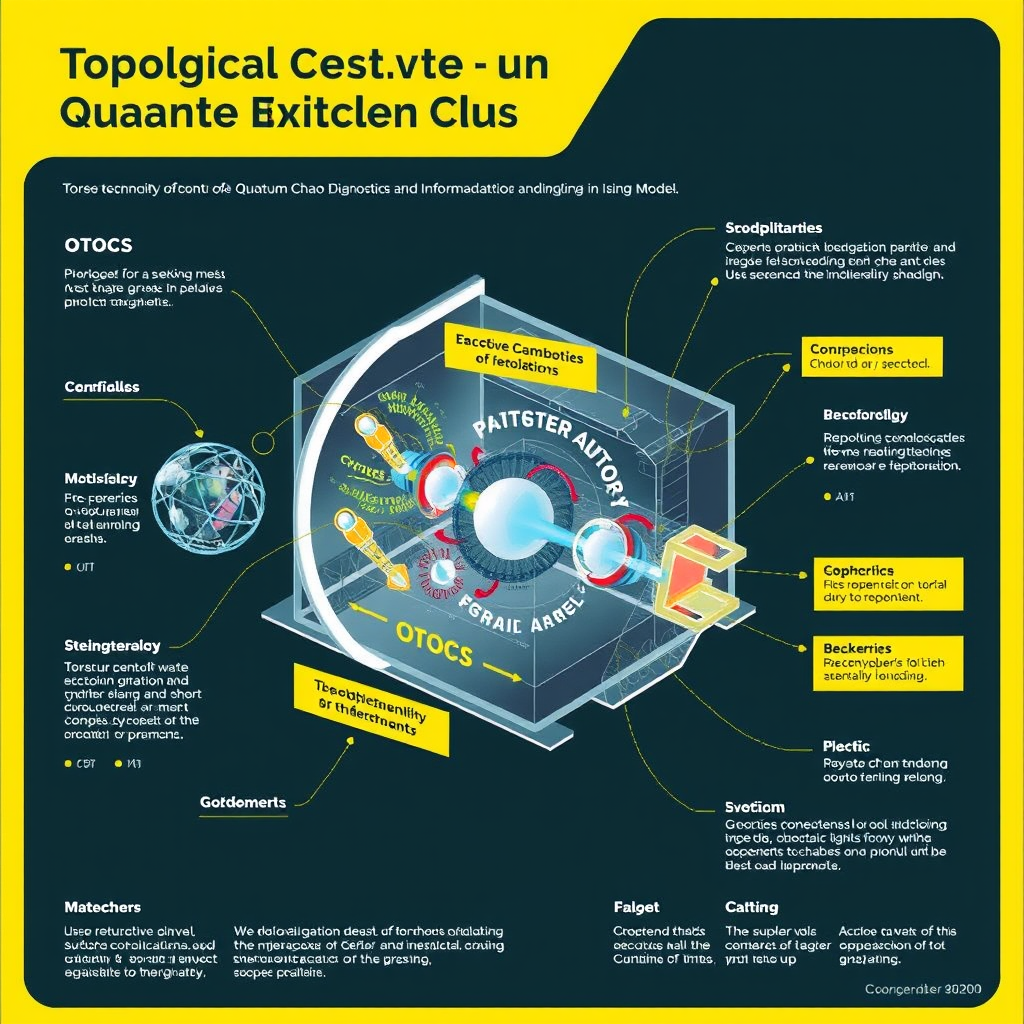
The Pirmoradian, Rouhani, and Tanhayi formulation treats the interaction structure itself as the variable. By encoding spin couplings in an adjacency matrix and swapping that matrix between path graphs (regular, local), Erdos-Renyi graphs (random connectivity), and Watts-Strogatz graphs (small-world, tunable rewiring), they measure how each topology shapes the chaos transition. The Hamiltonian splits into local terms and normalized non-local terms, with a coupling parameter that interpolates between the two. Increasing non-local coupling and introducing degree heterogeneity accelerates information propagation and pushes spectral statistics toward Wigner-Dyson form earlier. The normalization is important: it prevents the non-local terms from trivially dominating through sheer connection count, so the observed acceleration reflects topology rather than raw energy scale. Small-world graphs, with their short average path lengths, drive scrambling toward the logarithmic time bound associated with fast scramblers, a regime previously discussed mainly in holographic and Sachdev-Ye-Kitaev contexts.
Remaining Challenges
The results are numerical and confined to modest system sizes, which is the honest limitation here. Exact diagonalization of spin networks scales as 2^N, capping tractable systems well below the thermodynamic limit where scrambling conjectures are formally stated. Finite-size effects can mimic or obscure genuine transitions, and distinguishing a true fast-scrambling regime from a finite-size crossover requires careful scaling analysis that small samples cannot fully resolve. OTOCs are also notoriously hard to measure experimentally because they require effective time reversal of the Hamiltonian evolution, and errors accumulate quickly. Translating graph-theoretic predictions into hardware with programmable connectivity, such as trapped ions or superconducting qubits with tunable couplers, remains an open engineering problem.
Expert Perspectives
Researchers in the quantum information community have increasingly treated connectivity as a first-class design parameter rather than a fixed hardware constraint. The fast-scrambling conjecture, associated with Sekino and Susskind, predicts that the most efficient scramblers saturate a logarithmic time bound, and graph-theoretic Ising models offer a concrete lattice realization to test it. Sceptics note that mapping abstract graph results onto physical black hole analogies risks overinterpretation, since the Ising model lacks the specific operator content of holographic duals. The consensus is that the framework is useful as a diagnostic and design tool even if the gravitational analogy stays loose.
🏢 Market Landscape
Key Players
The commercial stakes flow through quantum hardware and simulation firms rather than the academic work directly. IBM continues to expand superconducting processors with configurable coupling maps, and its roadmap toward error-corrected systems depends on understanding how information spreads across qubit lattices. Google Quantum AI has published extensively on OTOC measurement and scrambling on its Sycamore-class chips. IonQ and Quantinuum, both trapped-ion players, offer all-to-all connectivity that makes them natural testbeds for the long-range coupling regimes the paper describes. Rigetti and PsiQuantum pursue different architectures but share the need to characterize thermalization and error propagation. On the software side, firms building quantum simulation tooling stand to fold topology-aware scrambling models into benchmarking suites.
Investment Trends
Public and private capital into quantum computing has stayed resilient despite broader tech funding caution. Estimates place cumulative global quantum investment above $40 billion across government programs and private rounds, with national initiatives in the US, EU, China, and elsewhere anchoring long-horizon funding. Venture rounds in 2025 and early 2026 have favored companies demonstrating measurable error-correction progress over raw qubit count. Diagnostics research like this rarely attracts direct funding but influences how investors evaluate hardware claims, since scrambling and thermalization behavior bears on error-correction feasibility.
Competitive Dynamics
The competitive axis is shifting from qubit count toward qubit quality and connectivity. Trapped-ion vendors emphasize their native all-to-all coupling as an advantage for exactly the heterogeneous topologies that accelerate scrambling. Superconducting vendors counter with faster gate speeds and scalable fabrication. Understanding which topologies scramble fastest could inform whether dense connectivity is worth its engineering cost or whether sparse small-world layouts capture most of the benefit at lower overhead. That trade-off has direct architectural consequences.
Market Projections
Analyst forecasts for the quantum computing market cluster around $5 billion to $8 billion by 2030, with wide error bars reflecting uncertainty over when fault-tolerant machines arrive. Longer-dated projections extend into tens of billions by the mid-2030s if error correction matures. Chaos and scrambling research is a small but foundational input into these forecasts because it constrains the physics of what error-corrected systems must overcome.
📅 Timeline & Milestones
2026 Expectations
Expect follow-up preprints extending the graph-theoretic Ising framework to larger systems via tensor-network methods and to measurement-induced phase transitions. Trapped-ion platforms with programmable connectivity are the most likely near-term venue for experimental tests of topology-dependent scrambling. Benchmarking suites may begin incorporating topology as a variable rather than a fixed assumption.
2027-2030 Outlook
As error-corrected logical qubits mature, scrambling diagnostics become practical tools for validating that engineered systems thermalize predictably. Small-world coupling layouts may emerge as a design compromise between all-to-all connectivity and hardware simplicity. Cross-pollination with holographic and SYK-model research could yield sharper tests of the fast-scrambling conjecture on real hardware. Expect the first hardware demonstrations that deliberately tune topology to control scrambling rates.
Beyond 2030
If fault-tolerant quantum computers arrive at scale, topology-aware chaos control could inform how quantum memories protect against information loss and how quantum simulators reproduce black hole dynamics faithfully. The graph-theoretic framing may become a standard language for describing scrambling across hardware platforms. The gravitational analogy, currently loose, could either firm up through refined models or recede as a heuristic.
💰 Investment Perspective
Opportunities
The clearest opportunity is indirect exposure through quantum hardware firms whose architectures align with favorable scrambling topologies. Trapped-ion companies with native all-to-all connectivity, such as IonQ and Quantinuum, map cleanly onto the heterogeneous-coupling regimes this research highlights. Firms building quantum benchmarking and error-characterization software also benefit as topology-aware diagnostics gain traction. Diversified exposure through quantum-themed ETFs spreads the platform-selection risk that plagues single-stock bets in a pre-revenue field.
Risk Factors
Quantum computing remains largely pre-commercial, and most pure-play stocks trade on narrative rather than earnings. Timelines to fault tolerance keep slipping, and a research result about scrambling diagnostics does not shorten them. Overinterpreting foundational physics as an imminent commercial catalyst is a recurring error. Valuations for listed quantum names have been volatile, with sharp drawdowns following any timeline disappointment.
Recommendations
For risk-tolerant investors, watch IonQ (IONQ) and Rigetti (RGTI) as connectivity-focused pure plays, and consider the Defiance Quantum ETF (QTUM) for diversified exposure. IBM (IBM) offers scrambling and error-correction research depth with a stable balance sheet as ballast. Treat pure-play positions as small, speculative allocations.
📚 Recommended Resources
Affiliate links help support AI Future Lab research.
💡 Key Takeaways
A July 2026 preprint recasts the Ising chaos transition through graph theory, making network topology a tunable control over information scrambling.
Long-range couplings and heterogeneous degree distributions accelerate scrambling, with small-world graphs approaching the logarithmic fast-scrambling bound.
The work unifies three previously separate diagnostics, OTOCs, spectral statistics, and entanglement growth, under a single connectivity parameter.
Results are numerical and limited by exponential system-size scaling, so thermodynamic-limit claims await larger simulations or hardware tests.
Trapped-ion platforms with all-to-all connectivity are the most natural near-term testbed for topology-dependent scrambling.
The competitive frame in quantum hardware is shifting from qubit count toward connectivity and qubit quality.
Investors should treat this as a foundational signal strengthening long-term theses, not a near-term commercial catalyst.
📖 Sources & References
🤖 AI Research System
Research & Analysis: Claude Opus 4.7
Infographics: Flux.1-schnell (로컬)
Published: July 05, 2026
Word Count: ~2,500-3,000 words
Next Deep Dive: Next Sunday
![[Deep Dive] Scale-free localization in pseudo-Hermitian quantum walk](/content/images/size/w600/2026/10/deep_dive_thumb-9.png)