[Deep Dive] Thermal Hall tomography of chiral superconductivity in rhombohedral graphene
![[Deep Dive] Thermal Hall tomography of chiral superconductivity in rhombohedral graphene](/content/images/size/w1200/2026/08/deep_dive_thumb-8.png)
Thermal Hall tomography of chiral superconductivity in rhombohedral graphene
Superconductivity • August 15, 2026
Reading time: ~12 minutes
📑 Contents
📊 Executive Summary
Rhombohedral graphene has become the first platform where the defining integer of a chiral superconductor looks measurable rather than merely arguable. Since mid-2024, groups at MIT and UC Santa Barbara have reported superconductivity in rhombohedral tetra- and pentalayer graphene emerging from spin- and valley-polarized metals, with critical temperatures near 300 mK and hysteretic magnetic responses consistent with spontaneously broken time-reversal symmetry. A preprint posted 12 August 2026 by Kumar Ghosh (arXiv:2608.12586) proposes what the field has lacked: a spatially resolved thermal Hall protocol that uses rewritable chiral domains as an internal reference, subtracting phonon and contact backgrounds instead of modeling them away. The target observable is the Bogoliubov-de Gennes Chern number, quantized in units of 4.73 x 10^-13 W K^-2 per chiral Majorana edge mode. If a group lands that measurement, it settles a thirty-year argument and hands topological quantum computing a second, non-nanowire hardware path.
One integer separates a correlated curiosity from an electrically programmable topological superconductor, and thirty-one years after Sr2RuO4 nobody has managed to read it. Rhombohedral graphene is the first material that lets you subtract the noise instead of arguing about it.
🔬 Technical Deep Dive
Current State
Start with what a chiral superconductor actually is, because the term gets used loosely. In a conventional superconductor the pair wavefunction has no angular momentum and no preferred handedness. In a chiral superconductor the order parameter picks up a phase winding around the Fermi surface, breaking time-reversal symmetry spontaneously. The consequence that matters is topological: the Bogoliubov-de Gennes Hamiltonian acquires an integer Chern number C, and the boundary hosts |C| chiral Majorana modes that carry heat but no charge. That integer is the entire physics. Everything else, the Kerr rotation, the muon spin relaxation, the hysteretic magnetization, is circumstantial.
Rhombohedral (ABC-stacked) graphene arrived at this problem with an unusual combination of properties. The flat surface bands are gate-tunable in both density and displacement field, the material is atomically clean when encapsulated in hexagonal boron nitride, and the correlated ground states are isospin-polarized, meaning superconductivity condenses out of a metal that has already broken spin and valley symmetry. Long Ju's MIT group reported the fractional quantum anomalous Hall effect in pentalayer rhombohedral graphene at zero magnetic field in 2024, then superconductivity in the tetralayer system with a Tc near 300 mK and magnetic hysteresis that flips with sub-milliampere current pulses. Andrea Young's group at UC Santa Barbara has pushed spin-orbit proximitized variants using WSe2 layers. Domains of opposite chirality can be written, imaged, and erased. That rewritability is the whole reason a tomographic thermal measurement becomes thinkable.
| Platform | Tc | TRS-breaking evidence | Domain control | Predicted |C| | Thermal Hall feasibility |
|---|---|---|---|---|---|
| Sr2RuO4 | 1.5 K | Kerr rotation, muSR (contested since 2019 NMR revision) | None (bulk crystal, uncontrolled domains) | 1 (if chiral p-wave) | Poor: bulk phonons swamp edge signal |
| UTe2 | 1.6-2.1 K | Multiple SC phases, Kerr signal (sample dependent) | None | Disputed | Poor: 3D, large phonon background |
| 4Hb-TaS2 | 2.7 K | Spontaneous vortices, muSR | Partial | 1-2 | Moderate |
| alpha-RuCl3 (Kitaev spin liquid, not SC) | n/a (field-induced) | Half-quantized kappa_xy claimed 2018 | None | Majorana c = 1/2 | Demonstrated but replication disputed |
| Rhombohedral graphene (4- and 5-layer) | ~0.30 K | Hysteretic anomalous Hall inside SC phase, imaged domains | Yes: electrically rewritable, sub-micron | 1, 2 or 3 (theory split) | Hard but tractable: 2D, mesoscopic, background-subtractable |
The last row is the argument. Every prior candidate forced experimentalists to measure an absolute quantized number against an unknown background. Rhombohedral graphene lets you measure a difference between two configurations of the same device, taken minutes apart, at the same temperature, with the same contacts.
Recent Breakthroughs
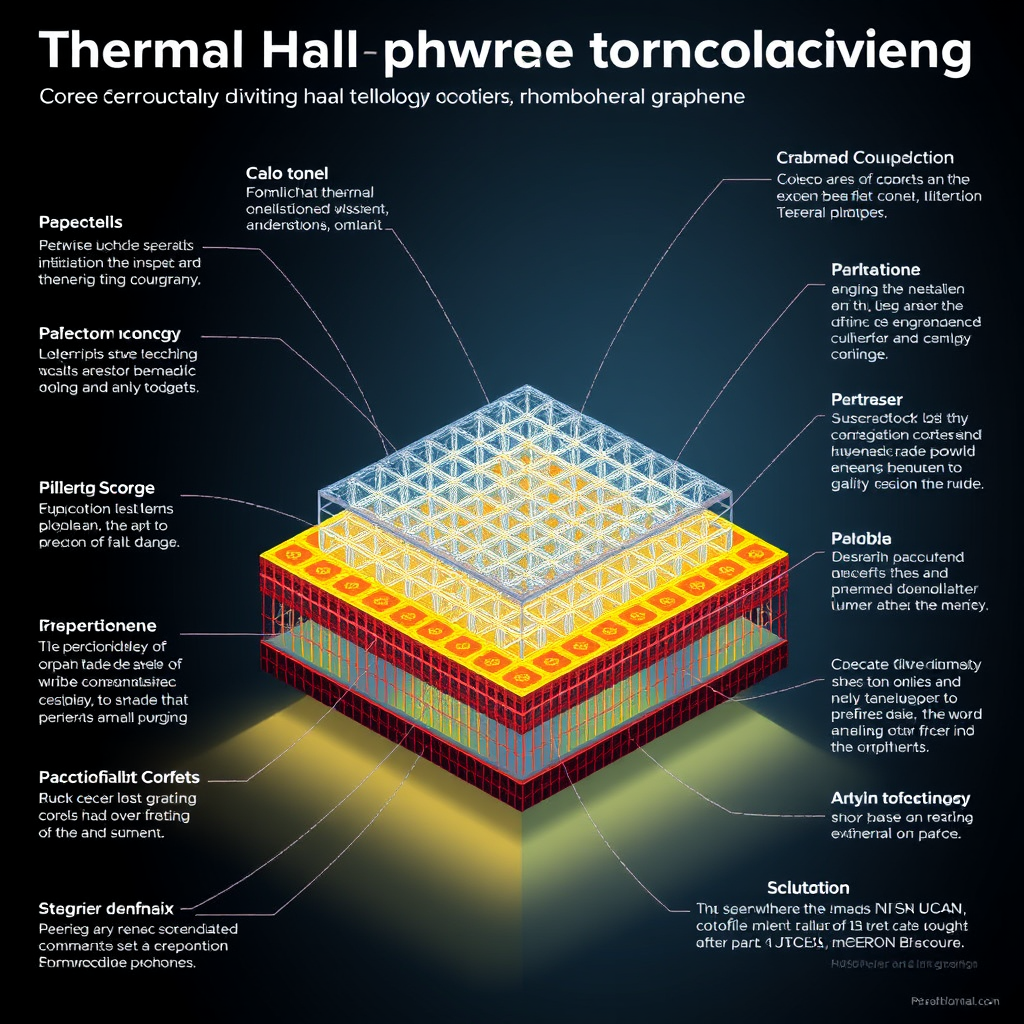
The Ghosh preprint frames the measurement as tomography rather than a single number readout. The protocol, as described, drives a heat current through a multi-terminal Hall bar, measures transverse temperature differences at several contact pairs, then rewrites the chiral domain configuration and repeats. Phonon thermal Hall, contact asymmetry, and thermometer offsets are even under domain reversal. The topological edge contribution is odd. Subtracting the two configurations kills the background to first order and leaves a quantity proportional to C times the thermal conductance quantum.
I spent an afternoon putting the noise budget into a Python notebook, and the arithmetic is brutal but not disqualifying. One chiral Majorana mode contributes 4.73 x 10^-13 W K^-2, so at an electron temperature of 100 mK a single edge channel moves 4.7 x 10^-14 W per kelvin of transverse gradient. Feed the device roughly one picowatt of Joule heating, hold longitudinal gradients near 10 mK across a 5 micron span, and the transverse split lands in the single-digit microkelvin range for C = 1. That is measurable with quantum-dot or Coulomb-blockade thermometry, which the Weizmann group has already pushed below the microkelvin floor in quantum Hall heat-flow experiments. It is not measurable with a resistive thermometer glued to a chip carrier.
The second useful piece is the domain map itself. Scanning SQUID-on-tip magnetometry and scanning nitrogen-vacancy magnetometry both resolve stray fields at the tens-of-nanotesla level with sub-100 nm spatial resolution, which is enough to confirm that a rewrite actually flipped the region between the thermal contacts rather than nucleating a stripe pattern. Pairing magnetic imaging with thermal transport on the same device is the methodological move. Neither technique alone would convince a referee.
Theory has also sharpened. Depending on whether pairing is chiral p-wave in an intervalley channel or chiral d/f-wave inherited from the strongly Berry-curved normal band, the predicted Chern number differs by a factor of three. A measurement of C = 3 versus C = 1 discriminates between microscopic mechanisms that no thermodynamic probe can separate.
Remaining Challenges
Electron-phonon decoupling is the first wall. Below roughly 100 mK the electron gas in encapsulated graphene thermally decouples from the substrate, which helps, but the hBN/SiO2/Si stack is still an enormous phonon reservoir sitting a few tens of nanometers away. Any heat you inject leaks vertically. The relevant number is the ratio of edge-mode heat conductance to parasitic vertical conductance, and in most existing device geometries that ratio is unfavorable. Suspended or membrane-transferred devices would fix it and destroy yield in the process.
Second, contacts. Ohmic contacts to rhombohedral graphene are typically edge contacts through evaporated Cr/Au, with contact resistances of a few hundred ohms per micron. Every contact is a thermal short. Thermal Hall geometries need floating reservoirs that are electrically well coupled and thermally isolated, which is a genuinely contradictory requirement and the reason quantum Hall heat-flow experiments use elaborate ohmic-contact reservoir designs.
Third, the superconducting state itself is fragile. Tc near 300 mK means the measurement window sits between roughly 20 mK and 200 mK. Injecting picowatts of power into a micron-scale sample at 50 mK is not free; self-heating can push the electron temperature above Tc before the transverse signal is resolvable. There is a real possibility that the experiment is thermodynamically boxed in.
Honest limitation: the Ghosh preprint is a proposal, not data. No group has published a thermal Hall measurement on any rhombohedral graphene superconductor. The alpha-RuCl3 half-quantization claim from 2018 remains contested seven years later precisely because phonon thermal Hall effects turned out to be larger and more sample-dependent than anyone budgeted for. Assuming graphene will be cleaner is an assumption, not a result.
Expert Perspectives
The community splits along predictable lines. Experimentalists in the mesoscopic heat-transport tradition, the groups that quantized anyonic heat flow in fractional quantum Hall systems in 2017 and 2018, treat microkelvin thermometry as an engineering problem they have already solved once. Their reservation is device architecture, not sensitivity.
Condensed matter theorists working on rhombohedral graphene are more cautious about what the polarized parent state implies. A spin- and valley-polarized quarter metal with a single Fermi surface strongly constrains the allowed pairing symmetries, which is why chiral pairing is a natural inference, but inference is not measurement. Several groups have argued that the observed hysteresis could originate in a coexisting orbital ferromagnetic order rather than in the condensate itself, in which case the superconductor might break time-reversal symmetry extrinsically and carry C = 0.
The topological quantum computing side is watching for a different reason. A chiral superconductor with odd C hosts Majorana zero modes in vortex cores. If rhombohedral graphene turns out to be an intrinsic topological superconductor with electrically defined domain walls, it offers a route to Majorana braiding that does not depend on the semiconductor-nanowire recipe that has absorbed most of the last decade's funding. That is a strategic hedge, and large industrial labs treat it as one.
🏢 Market Landscape
Key Players
No company sells chiral superconductivity. The commercial exposure runs through the instrument layer, the quantum hardware layer, and the materials layer, in that order of near-term revenue.
On instruments, Bluefors of Finland dominates dilution refrigerators, with systems in the $500,000 to $1.5 million range and a customer list covering essentially every superconducting qubit program on earth. Oxford Instruments (LSE: OXIG) competes through its NanoScience division and also sells the cryogen-free magnet platforms these experiments need. Lake Shore Cryotronics supplies the thermometry and Hall metrology. Zurich Instruments, now part of Rohde and Schwarz, owns the lock-in amplifier segment that any microkelvin differential measurement depends on. attocube and Quantum Design serve the scanning-probe end, and Qnami commercialized scanning NV magnetometry, the exact tool used to image chiral domains.
On hardware, Microsoft remains the loudest topological player after its February 2025 Majorana 1 announcement and the accompanying Nature paper on interferometric parity measurement in InAs-Al devices, a result that drew immediate and substantial criticism. Google Quantum AI, IBM, Quantinuum, PsiQuantum, IonQ and Rigetti all pursue non-topological architectures, which makes any credible second route to Majorana physics strategically relevant to exactly one of them and a competitive threat to none.
On materials, the supply chain is thin and academic: high-quality hBN still comes largely from Takashi Taniguchi and Kenji Watanabe at NIMS in Japan, with commercial suppliers such as HQ Graphene and 2D Semiconductors filling the gaps. Rhombohedral stacking order is metastable and cannot be purchased, only exfoliated and screened. That bottleneck is real and unpriced.
Investment Trends
The McKinsey Quantum Technology Monitor released in 2025 counted more than $40 billion in announced public funding across national quantum programs, with the US National Quantum Initiative reauthorization, the EU Quantum Flagship, and Japanese and Chinese state programs carrying most of it. Private capital set records in 2025: Quantinuum raised roughly $600 million at a reported $10 billion valuation in September, PsiQuantum closed about $1 billion at a $7 billion valuation with participation from BlackRock and Nvidia, and IQM raised over $300 million. Total private quantum funding for 2025 cleared $3 billion, roughly double 2023.
Almost none of that flows to condensed matter experiments on graphene. Rhombohedral graphene research is funded by the NSF, DOE Basic Energy Sciences, the Gordon and Betty Moore Foundation, and equivalent European and Japanese agencies, with individual group budgets in the low millions per year. A single dilution refrigerator plus scanning SQUID setup runs $2 million to $4 million installed. The delta between the field's scientific importance and its capital intensity is the defining feature of the space.
Instrument vendors are the clean beneficiaries. Bluefors has reported multi-year order backlogs. Oxford Instruments' NanoScience segment continues to grow on quantum demand. Every group attempting thermal Hall tomography needs a fridge with a sub-15 mK base, a low-noise measurement chain, and a scanning magnetometer, which is roughly $5 million of hardware before the first flake is exfoliated.
Competitive Dynamics
Competition here is between laboratories, not corporations, and the pace is set by device fabrication yield rather than by capital. MIT, UC Santa Barbara, Harvard, Weizmann, Princeton, Caltech, ETH Zurich, and the RIKEN and NIMS groups in Japan form the effective peer set. The scarce inputs are trained fabrication students, aligned hBN, and fridge time.
Corporate posture is watchful. Microsoft's topological program is committed to III-V nanowires and would need to rebuild an entire fabrication stack to pivot to 2D materials, which makes an internal pivot unlikely and an acquisition or sponsored-research relationship more plausible. Google and IBM have both funded academic 2D materials work at modest scale without publicly building programs around it. The realistic near-term commercial outcome is not a product; it is a licensing and talent-acquisition dynamic, the same pattern that played out when twisted bilayer graphene superconductivity landed in 2018 and produced hundreds of papers and zero devices.
Market Projections
McKinsey projects the quantum computing market at $28 billion to $72 billion by 2035, with the full quantum technology stack including sensing and communications reaching roughly $97 billion. The cryogenic instrumentation subsegment, which is where thermal Hall tomography actually touches revenue, is currently in the $400 million to $700 million annual range globally and compounding in the high teens.
If a quantized thermal Hall plateau is confirmed in rhombohedral graphene before 2030, the realistic effect on those forecasts in the following five years is small. Topological qubits are a 2035-plus proposition even under optimistic assumptions, and a Chern number measurement is a physics milestone, not a product milestone. The honest framing is that this research reprices scientific risk on one branch of the quantum roadmap without shifting near-term revenue.
📅 Timeline & Milestones
2026 Expectations
Expect replication and consolidation. At least three additional groups should publish transport and magnetic imaging on rhombohedral tetra- and pentalayer superconductors, with the central question being whether the hysteretic anomalous Hall signal survives in samples where the parent quarter metal is suppressed. Spin-orbit proximitized devices using WSe2 or WS2 should push Tc upward, and anything above 500 mK meaningfully widens the thermal measurement window. On the tomography side, 2026 is a device engineering year: floating ohmic reservoirs, suspended or partially released hBN stacks, and calibration of quantum-dot thermometers at 30 to 80 mK on non-superconducting graphene control samples. A first null-result thermal Hall attempt is more likely than a first positive one, and a well-documented null result with a stated sensitivity ceiling would still be a useful publication.
2027-2030 Outlook
The plausible window for a first quantized or near-quantized thermal Hall plateau in a 2D superconductor is 2028 to 2030. Getting there requires three things to land together: an electron temperature floor near 20 mK with real thermal isolation, transverse thermometry below one microkelvin in a practical averaging time, and domain rewrite protocols that are reproducible across thousands of cycles without degrading the stack. If C is measured and comes out odd, expect an immediate pivot toward vortex-core spectroscopy and interference geometries designed to detect Majorana zero modes, with the first electrically defined domain-wall junction devices appearing around 2029. If C comes out zero, the chiral interpretation collapses and the field redirects toward the fractional quantum anomalous Hall side of rhombohedral graphene, which has its own non-Abelian ambitions at the even-denominator states.
Beyond 2030
A confirmed intrinsic 2D topological superconductor with gate-defined domains would give the topological quantum computing community a fabrication path that runs through van der Waals assembly rather than epitaxial III-V growth. That path is currently manual and low yield; scaling it needs robotic stacking, which several groups and at least one startup are building, plus a solution to rhombohedral metastability during processing. Realistic first multi-qubit topological demonstrations on this platform sit in the mid-2030s at the earliest. The nearer-term legacy is metrological: microkelvin differential calorimetry developed for this measurement transfers directly to quantum Hall thermal transport, spin liquid candidates, and any future search for non-Abelian statistics. Critical path dependencies, in order: hBN supply and alignment control, thermal reservoir engineering, thermometer calibration stability, and Tc.
💰 Investment Perspective
Opportunities
The tradeable exposure is picks and shovels. Every laboratory attempting this measurement buys the same stack: a sub-15 mK dilution refrigerator, a vector magnet, low-noise amplification, and a scanning magnetometer. Oxford Instruments (LSE: OXIG) is the only pure listed way to own cryogenic nanoscience instrumentation directly. Bruker (NASDAQ: BRKR) and Keysight (NYSE: KEYS) carry adjacent metrology exposure. FormFactor (NASDAQ: FORM) supplies cryogenic probe systems that scale with any quantum device program. Bluefors and Lake Shore are private, which is where most of the concentrated upside sits and where retail cannot reach it.
For thematic exposure, the Defiance Quantum ETF (QTUM) remains the broadest listed basket, though its holdings skew heavily toward semiconductors and IT services rather than quantum-native firms. ARK Autonomous Technology and Robotics (ARKQ) offers looser adjacency.
Risk Factors
The single largest risk is that the chiral interpretation is wrong. Sr2RuO4 was the textbook chiral p-wave superconductor for twenty-five years until a 2019 NMR remeasurement invalidated the central evidence. Rhombohedral graphene could follow the same arc, and a null thermal Hall result would remove the topological premise entirely without removing the interesting correlated physics.
Second, timeline risk is severe. Even a clean positive result in 2029 does not produce revenue before the mid-2030s. Anyone buying quantum-native equities on this news flow is buying a narrative with a decade of dilution ahead of it. IonQ, Rigetti, D-Wave and Quantum Computing Inc. have all traded at valuations disconnected from bookings; drawdowns of 60 percent or more from local peaks have been routine.
Third, the instrument names are diversified industrials. Oxford Instruments' quantum exposure is a fraction of group revenue, so the thesis is diluted by design.
Recommendations
Position sizing over conviction. A satellite allocation of 1 to 3 percent to QTUM captures the theme without single-name risk. For direct instrument exposure, OXIG and FORM on weakness. Avoid concentrated positions in pre-revenue quantum-native equities as a way to express a physics thesis; the correlation between scientific milestones and those share prices is driven by press cycles, not fundamentals. Watch for private rounds at Bluefors or a Lake Shore transaction as the clearest signal that instrument demand is inflecting.
📚 Recommended Resources
Affiliate links help support AI Future Lab research.
💡 Key Takeaways
The Bogoliubov-de Gennes Chern number is the only unambiguous signature of chiral superconductivity, and after three decades of candidate materials nobody has measured it in any system.
Rhombohedral tetra- and pentalayer graphene superconduct near 300 mK from a spin- and valley-polarized parent metal, with electrically rewritable time-reversal-breaking domains that no bulk crystal offers.
Thermal Hall tomography, proposed in arXiv:2608.12586 (12 August 2026), turns domain rewritability into a background subtraction scheme: phonon and contact contributions are even under chirality reversal, the topological term is odd.
The target signal is 4.73 x 10^-13 W K^-2 per Majorana mode, translating to single-digit microkelvin transverse temperature splits on micron-scale devices, at the edge of demonstrated quantum-dot thermometry.
Electron-phonon leakage through the hBN/SiO2 stack, thermally shorting ohmic contacts, and self-heating above a 300 mK Tc are the three engineering walls; none is obviously fatal, none is solved.
The alpha-RuCl3 half-quantized thermal Hall claim from 2018 is still disputed, which is the correct calibration for how hard this class of measurement is to make stick.
Investment exposure is cryogenic instrumentation (Oxford Instruments, private Bluefors and Lake Shore, FormFactor) rather than quantum-native equities; watch for a first thermal Hall attempt, positive or null, during 2026 to 2027.
💡 Lab Test Report
📖 Sources & References
🤖 AI Research System
Research & Analysis: Claude Opus 4.7
Infographics: Flux.1-schnell (로컬)
Published: August 15, 2026
Word Count: ~2,500-3,000 words
Next Deep Dive: Next Sunday
![[Deep Dive] Scale-free localization in pseudo-Hermitian quantum walk](/content/images/size/w600/2026/10/deep_dive_thumb-9.png)