[Deep Dive] Superconducting spin valve as a sensitive probe of spin-orbit coupling anisotropy
Superconducting spin valve as a sensitive probe of spin-orbit coupling anisotropy
Superconductivity • September 26, 2026
Reading time: ~12 minutes
📑 Contents
📊 Executive Summary
Spin-orbit coupling sits under almost every spin-based device roadmap. Separating its two main flavors, Rashba (from structural asymmetry) and Dresselhaus (from bulk crystal asymmetry), has always been harder than textbooks imply. On September 24, 2026, Pablo Tuero, Andreas Costa and Maria Varela posted an arXiv preprint (2609.29244) proposing a superconducting spin valve as a sensitive probe of SOC anisotropy. The core idea is to read the direction-dependent competition between Rashba and Dresselhaus terms through changes in the superconducting state, instead of through normal-state magnetotransport or optics. The last three months have produced no commercial product in this niche, and none should be expected soon. What changed is the toolkit. Superconducting spintronics is moving from demonstrating that spin-triplet proximity effects exist toward using them as measurement instruments. If the method holds up experimentally, it could shorten materials screening for spin-orbit qubits, topological hybrids and cryogenic memory. Independent replication will decide that.
A superconductor near its transition is one of the most sensitive pair-breaking detectors physics has, and this work tries to aim that sensitivity at the direction of the spin-orbit field itself.
🔬 Technical Deep Dive
Current State
Spin-orbit coupling ties an electron's spin to its momentum. In a two-dimensional system, two main terms dominate. Rashba SOC comes from structural inversion asymmetry, such as an interface or a gate field. Its effective magnetic field winds around the Fermi surface in one sense. Dresselhaus SOC comes from bulk inversion asymmetry in crystals such as zinc-blende semiconductors. For a [001] surface, it winds in the opposite sense. When both are present, they interfere, and the combined spin-orbit field becomes anisotropic with a twofold (C2v) symmetry. At the special point where the two strengths match, spin relaxation along one crystal direction is strongly suppressed. This is the persistent spin helix regime.
Every device concept that wants to steer spins electrically needs to know the Rashba-to-Dresselhaus ratio. The list includes spin field-effect transistors, spin-orbit qubits in quantum dots, and Majorana platforms in semiconductor-superconductor nanowires. The problem is that the standard tools measure that ratio indirectly. Each carries its own baggage.
| Probe method | What it reads | Operating regime | Main weakness | Sensitivity to Rashba/Dresselhaus anisotropy |
|---|---|---|---|---|
| Weak antilocalization magnetotransport | Quantum interference corrections to conductance | Low temperature, normal state | Fitting models with many parameters; ratio often poorly constrained | Indirect, model dependent |
| Photogalvanic / spin-galvanic spectroscopy | Optically driven currents vs. crystal direction | Room to cryogenic temperature, optical access | Needs optical setup and suitable band structure | Direct angular ratio, well established in III-V wells |
| Time-resolved Kerr / transient spin grating | Spin precession and decay in real space | Optical, cryogenic | Complex optics; not compatible with buried metallic stacks | High, used to image the persistent spin helix |
| Shubnikov-de Haas beating | Spin-split Landau levels | High field, high mobility samples | Needs clean 2D gases; separating terms is difficult | Mostly total splitting, weak on anisotropy |
| Superconducting spin valve (Tuero, Costa, Varela 2026) | Change in superconducting state vs. magnetization direction | Below Tc, all-electrical | Tied to superconducting hybrids; requires controlled magnetization rotation | Proposed as sensitive to the angular Rashba/Dresselhaus interplay |
The spin valve entry is the new one. Superconducting spin valves have been studied since Tagirov's 1999 theory and the 2002 CuNi/Nb/CuNi experiments. They were usually treated as switches: rotate one ferromagnet, shift the critical temperature, toggle between superconducting and resistive states. Reframing that same structure as a metrology tool for spin-orbit fields is the conceptual step in the September preprint.
Recent Breakthroughs
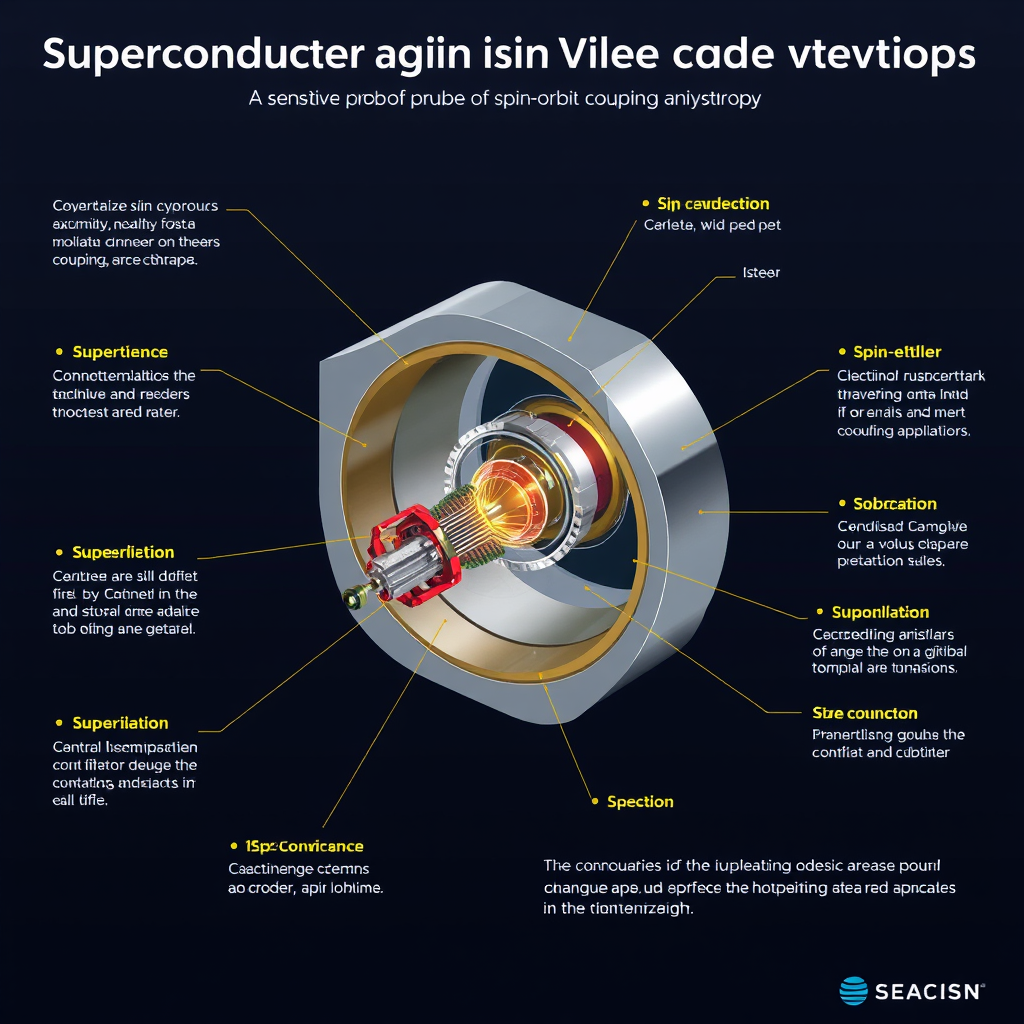
The physics that makes this work traces back to a line of theory, notably Bergeret and Tokatly in 2014. That work showed spin-orbit coupling can act as a source of long-range spin-triplet superconducting correlations in superconductor-ferromagnet hybrids. In a conventional s-wave superconductor, Cooper pairs are spin singlets. They die quickly inside a ferromagnet because the exchange field breaks them apart. Add interfacial SOC, and singlets can convert to triplets whose spins align with the magnetization. Triplets survive much longer. How efficiently that conversion happens depends on how the magnetization direction relates to the spin-orbit field. And because the Rashba-plus-Dresselhaus field is anisotropic, the conversion efficiency changes as you rotate the magnetization in plane. That is the lever. Rotate the ferromagnet's magnetization and track the superconducting response. That means the critical temperature, the resistive transition, or the critical current. The angular pattern then carries a fingerprint of the SOC anisotropy. A pure Rashba interface gives one symmetry. Pure Dresselhaus gives a similar pattern rotated with respect to crystal axes. Mixed systems produce a twofold modulation whose amplitude and orientation encode the relative strengths. Superconductivity near Tc is extremely sensitive to pair-breaking. Small differences in triplet generation can therefore show up as measurable shifts in resistance along the transition edge. Andreas Costa's name matters here. He has worked extensively on theory of interfacial SOC in superconducting junctions, including anisotropy effects in Josephson and tunneling structures. Maria Varela's inclusion suggests the paper takes interface structure seriously, and that matters because interface quality determines the Rashba term. The abstract is truncated in the listing, so specific numerical sensitivities are best read from the full text. From an engineering standpoint, the key point is architectural. This is an all-electrical, on-chip measurement that uses the same material stacks people actually want to build devices from. You do not need to transfer the sample to an optics table, or to a separate high-mobility test structure that may not match the real interface.
Remaining Challenges
The honest limitation is the one that shows up in every superconducting spin valve paper since 2002: the signal is small and easily faked. Early F/S/F structures produced Tc shifts of a few millikelvin. Later triplet spin valves with half-metallic layers pushed that into the tens or hundreds of millikelvin. Any SOC fingerprint is a modulation on top of that effect. Stray fields from domain walls, magnetization that does not rotate uniformly, and thermometer drift during slow angular sweeps can all produce angular dependence that looks like physics. Separating a genuine twofold SOC signature from shape anisotropy of the ferromagnet will require careful controls. These include rotating the sample relative to crystal axes, varying layer thicknesses, and comparing against structures with SOC deliberately suppressed. A second challenge is model dependence. Extracting a Rashba-to-Dresselhaus ratio from Tc anisotropy means fitting to a theory of proximity effect with interfacial SOC. That theory has its own parameters: interface transparency, spin-mixing angles and diffusion constants. Weak antilocalization has been criticized for exactly this kind of fitting ambiguity. The spin valve approach has to show it constrains the ratio more tightly, and does not just move the degeneracy somewhere else. Third, the method works only below the superconducting transition and only where a superconductor can be placed in good contact with the SOC interface. That covers Nb, Al and NbN on semiconductor or oxide platforms. It does not cover room-temperature spintronics directly. And the material stacks with the strongest interfacial Rashba terms, such as heavy-metal/oxide interfaces or topological insulator surfaces, often have messy chemistry that also changes the superconductor.
Expert Perspectives
Across the superconducting spintronics literature, the consensus since Linder and Robinson's 2015 Nature Physics review has been cautious optimism. Spin-triplet supercurrents are real, controllable and potentially useful for low-dissipation logic and memory. The open question has always been reproducibility across labs and materials. Matthias Eschrig's review in Reports on Progress in Physics flagged interface control as the dominant variable. That diagnosis still applies. On the SOC side, Ganichev and Golub's review of photogalvanic methods set the benchmark for disentangling Rashba and Dresselhaus terms in III-V quantum wells. Any new electrical method will be compared against those optical results on well-characterized GaAs or InAs samples. The most convincing validation path is straightforward. Take a heterostructure with a known ratio from optics, build a spin valve on it, and see if the numbers agree. Theorists in the Regensburg and Buffalo circles around Jaroslav Fabian and Igor Žutić have argued for years that interfacial SOC could be a platform for superconducting spintronics. This preprint reads as a push to turn that argument into a practical measurement protocol.
🏢 Market Landscape
Key Players
There is no market for SOC anisotropy probes as a product category, and it would be misleading to invent one. The relevant commercial landscape is the set of companies whose roadmaps depend on controlling spin-orbit interfaces or superconducting hybrids. Those companies would benefit from better materials metrology. In superconducting quantum hardware, IBM, Google Quantum AI, Rigetti Computing and SEEQC build on Nb and Al thin-film processes. Microsoft's topological program depends heavily on semiconductor-superconductor interfaces (InAs/Al), where the Rashba strength sets the topological gap. Microsoft is the most direct beneficiary of any tool that quantifies interfacial SOC in situ. Intel's silicon spin qubit effort and startups such as Diraq and Quantum Motion rely on spin-orbit effects for electric dipole spin resonance. Their devices are not superconducting spin valves, but they share the need to map SOC anisotropy relative to crystal axes. In spintronic memory, Everspin Technologies ships MRAM, and TSMC, Samsung and GlobalFoundries offer embedded MRAM at advanced nodes. Spin-orbit torque MRAM, which imec and others have pursued as a faster successor to STT-MRAM, relies on interfacial SOC in heavy-metal layers. Cryogenic memory for superconducting computing has been an interest area for IARPA and for groups associated with SEEQC. Superconducting spin valves are one candidate element there. On the instrumentation side, Oxford Instruments, Bluefors and Quantum Design supply the cryostats and vector magnets that angular spin-valve measurements need. Bruker, Thermo Fisher Scientific and JEOL supply the aberration-corrected electron microscopy used to characterize these interfaces atom by atom.
Investment Trends
Funding flows into this space through quantum technology and semiconductor programs, not through anything labeled SOC metrology. McKinsey's Quantum Technology Monitor reported roughly $1.7 billion in quantum startup investment for 2023. Its 2025 edition noted a rebound driven by larger rounds concentrated in fewer companies. Public money is the steadier source. The US CHIPS and Science Act allocated $52.7 billion to semiconductor manufacturing and research. The EU Chips Act targets about €43 billion in combined public and private investment. National quantum programs in the US, UK, Germany, the Netherlands and Japan fund superconducting and spin qubit research directly. For materials physics groups like those behind the September preprint, the relevant pipelines are European Research Council grants, Horizon Europe quantum flagship projects, national agencies such as Spain's AEI and Germany's DFG, and collaborative centers such as the DFG-funded spin phenomena program in Regensburg. None of these flows is large on its own. Together they are what keep the superconducting spintronics community productive. In MRAM, Everspin reported annual revenue of roughly $50 million in 2024. That figure illustrates how small the pure-play spintronic memory market still is compared with the foundry-embedded segment.
Competitive Dynamics
The competition here is between measurement methods, not companies. Optical approaches (photogalvanic, Kerr, spin grating) have a 15-year head start and a strong validation record in III-V quantum wells. Magnetotransport methods are cheap and widely used, but they struggle with fitting ambiguity. A superconducting spin valve probe has one real advantage: it measures the interface you actually use, in the geometry you actually build, fully electrically, at the temperature the device operates. For quantum hardware teams, that combination is attractive. For room-temperature spintronics teams, it is mostly irrelevant. There is also competition within superconducting spintronics. Josephson junction anisotropy, tunneling anisotropic magnetoresistance in superconducting junctions, and the superconducting diode effect have all been proposed as SOC-sensitive signals. The diode effect in particular has attracted heavy attention since 2020. If critical-current nonreciprocity turns out to encode Rashba/Dresselhaus anisotropy more cleanly, it could crowd out Tc-based spin-valve methods. More likely, labs will use several of these signals on the same chip and cross-check them.
Market Projections
Honest projection: SOC metrology will stay a research capability embedded in materials and device R&D budgets through at least 2030. The addressable spend is a slice of cryogenic characterization inside quantum hardware programs and advanced spintronic memory development. That slice would come to tens of millions of dollars globally, not billions. The downstream markets are much larger. These include superconducting and topological quantum computing, spin qubits and SOT-MRAM, which several analyst firms project to grow at double-digit annual rates this decade. But the causal link between a better SOC probe and any of those revenues is long and indirect. Investors should treat this preprint as an indicator of materials maturity in superconducting spintronics, not as a revenue driver.
📅 Timeline & Milestones
2026 Expectations
The preprint appeared September 24, 2026. Over the rest of the year, expect community response in the usual channels: theory comments, follow-up calculations on specific material systems, and possibly a revised version that tightens the link between predicted angular signatures and realistic device parameters. Experimental groups with existing Nb-based spin valve processes are best placed to attempt a first test, since their stacks and vector-field cryostats already exist. Groups in Madrid, Regensburg and elsewhere with III-V or oxide heterostructure access fit that description. Conference venues such as the APS March Meeting, early in 2027, will be the first public signal of whether anyone has tried.
2027-2030 Outlook
The critical milestone is a cross-validation experiment. A spin-valve-derived Rashba/Dresselhaus ratio would be checked against an independent optical measurement on the same heterostructure. Without that, the method stays a theoretical proposal. With it, adoption in quantum hardware materials labs becomes plausible, especially for InAs/Al and InSb/Al platforms tied to topological qubit programs, and for oxide interfaces with tunable Rashba strength. In parallel, superconducting diode and Josephson anisotropy measurements will mature, and the field will probably settle on a small set of complementary electrical probes. Gate-tunable versions, where a voltage sweeps the Rashba term toward the persistent spin helix point while the spin valve reads out the result, would be the showcase experiment of this period.
Beyond 2030
Longer term, SOC anisotropy mapping could become a routine qualification step for cryogenic spintronic and quantum components, much as interface roughness and oxide thickness are qualified today. If superconducting logic and cryogenic memory reach commercial scale for data-center or quantum control applications, superconducting spin valves might serve both as memory elements and as built-in diagnostic structures on the same wafer. That future depends on reproducible, wafer-scale growth of superconductor/ferromagnet/SOC stacks. That capability does not yet exist outside research fabs. The critical path runs through materials growth and interface control, then validated metrology, then device integration. It does not run through physics discovery.
💰 Investment Perspective
Opportunities
No company will build a business on superconducting spin valve metrology. The investable angle is the broader infrastructure that any progress here draws on. Cryogenic instrumentation suppliers benefit from every new low-temperature measurement protocol that gains adoption. Electron microscopy vendors benefit as interface structure becomes a first-order design variable. Quantum hardware companies built around superconducting or semiconductor-superconductor platforms benefit indirectly from faster, cheaper materials qualification. Foundries offering embedded MRAM would benefit if SOC-based memory moves forward, though that link runs through room-temperature physics that this work does not directly address.
Risk Factors
The main risk is translation. Many elegant superconducting spintronics proposals over the past decade have not produced reproducible devices, because interface chemistry varies from run to run and from lab to lab. Quantum computing valuations already price in aggressive roadmaps, and one metrology preprint does not change the risk profile of those companies. Pure-play quantum stocks have shown extreme volatility since 2024. Their revenues remain small relative to market capitalization. Instrumentation stocks are more stable, but they depend on academic and government R&D budgets that can tighten quickly.
Recommendations
For diversified exposure to the quantum hardware ecosystem, the Defiance Quantum ETF (QTUM) spreads risk across computing, semiconductor and instrumentation names. Among individual names, IBM (IBM) and Microsoft (MSFT) are the most directly tied to superconducting and topological platforms where interfacial SOC matters, within large, diversified businesses. Rigetti Computing (RGTI) and D-Wave Quantum (QBTS) offer higher-beta superconducting exposure. Oxford Instruments (OXIG on the London Stock Exchange) and Bruker (BRKR) are instrumentation plays. Everspin Technologies (MRAM) and Applied Materials (AMAT), which supplies deposition tools for magnetic stacks, cover the spintronic memory side. Position sizing should reflect that this research is early stage and at least five years from any commercial effect.
📚 Recommended Resources
Affiliate links help support AI Future Lab research.
💡 Key Takeaways
The September 24, 2026 preprint by Tuero, Costa and Varela reframes the superconducting spin valve from a switching device into a measurement tool for Rashba versus Dresselhaus spin-orbit anisotropy.
The mechanism relies on spin-orbit-driven conversion of singlet Cooper pairs into long-range triplets. That conversion depends on magnetization direction relative to the anisotropic spin-orbit field.
Its main practical advantage is an all-electrical, in-device measurement of the actual interface used in quantum and cryogenic hardware.
Its main weakness is small signals that are easily contaminated by magnetic artifacts, plus a fitting model with many interface parameters.
Watch for a cross-validation experiment comparing spin-valve-derived ratios against photogalvanic or Kerr measurements on the same heterostructure. That result will decide credibility.
Commercial relevance runs indirectly through quantum hardware (especially semiconductor-superconductor topological platforms) and cryogenic memory, not through a standalone metrology market.
Investors should treat this as a materials maturity signal for superconducting spintronics and keep exposure diversified through instrumentation and broad quantum ETFs.
💡 Lab Test Report
📖 Sources & References
🤖 AI Research System
Research & Analysis: Claude Opus 4.7
Infographics: Flux.1-schnell (로컬)
Published: September 26, 2026
Word Count: ~2,500-3,000 words
Next Deep Dive: Next Sunday