[Deep Dive] Single fission experiment maps excess gamma rays from more than a dozen unstable nuclei - Phys.org
![[Deep Dive] Single fission experiment maps excess gamma rays from more than a dozen unstable nuclei - Phys.org](/content/images/size/w1200/2026/07/deep_dive_thumb-7.png)
Single fission experiment maps excess gamma rays from more than a dozen unstable nuclei - Phys.org
Energy • July 19, 2026
Reading time: ~12 minutes
📑 Contents
📊 Executive Summary
Nuclear fission remains one of the least understood processes in physics despite nearly nine decades of study. The mechanism by which a heavy nucleus splits, distributes energy, and sheds excess angular momentum through gamma-ray emission still resists complete theoretical description. A new experiment reported in July 2026 measured excess high-energy gamma-ray emission from more than a dozen unstable, neutron-rich isotopes in a single measurement campaign. Previous studies typically characterized one or two isotopes at a time, making systematic comparison difficult. By combining isotope separation with high-resolution gamma spectroscopy, the team produced a comparative dataset across many fission fragments simultaneously. The implications reach into nuclear data libraries used for reactor design, medical isotope production, and stockpile stewardship. The work is basic research rather than a commercial product, so practical payoff will arrive indirectly through improved simulation accuracy and refined nuclear models over the coming decade.
For the first time within a single experiment, researchers collected data on high-energy gamma-ray emissions from more than a dozen heavy, unstable isotopes, turning isolated anomalies into a pattern theory must now explain.
🔬 Technical Deep Dive
Current State
Nuclear fission produces two lighter fragments, several neutrons, and a burst of gamma radiation. Most of that gamma energy is emitted within picoseconds as the excited fragments relax toward their ground states. Physicists have long modeled this de-excitation using statistical frameworks that treat the nucleus as a heated body cooling by emitting neutrons and photons. The models work reasonably well on average but consistently miss certain features. One persistent puzzle is an apparent excess of high-energy gamma rays beyond what statistical models predict. Understanding where that excess comes from requires measuring emission fragment by fragment, isotope by isotope, which is experimentally demanding because fission produces a mix of hundreds of different nuclei at once.
Recent Breakthroughs
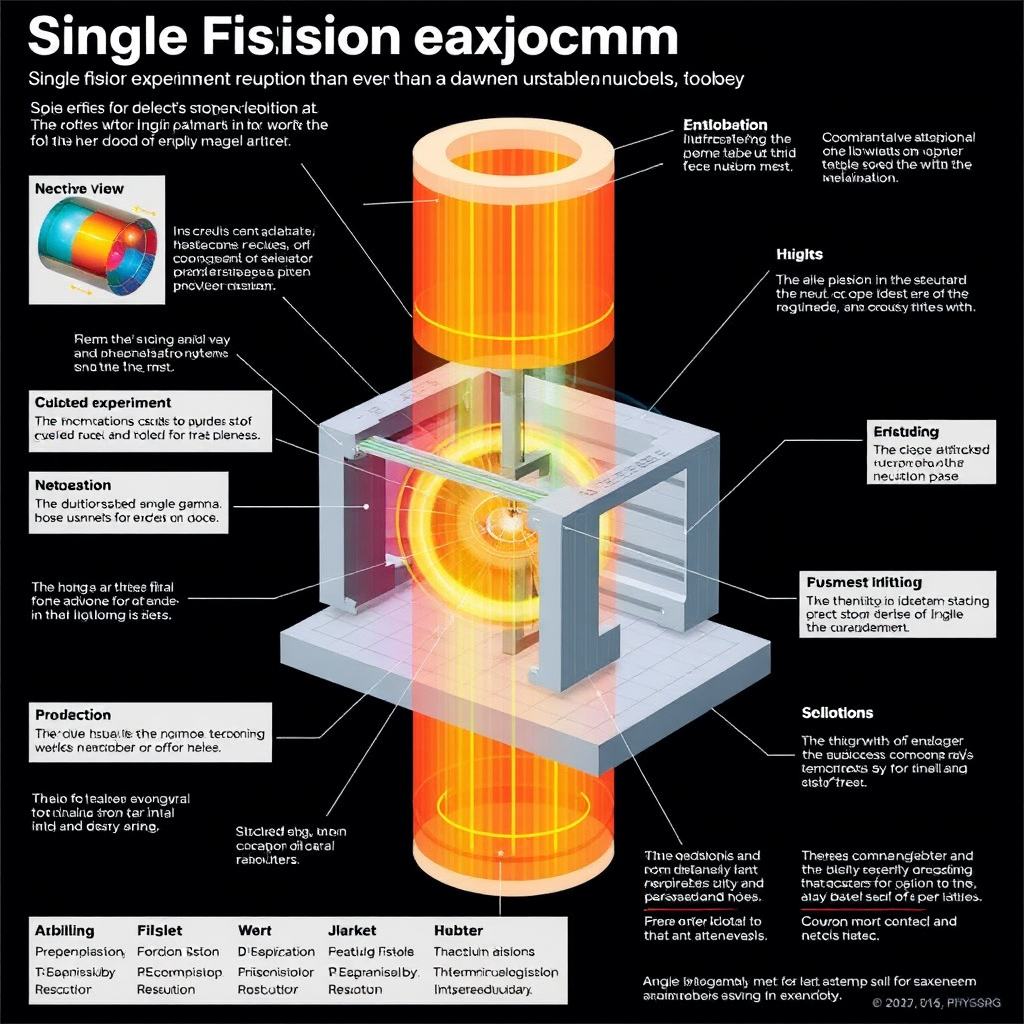
The reported advance is methodological. Rather than isolating a single fission fragment for study, the team combined isotope separation techniques with an array of gamma detectors capable of resolving emissions from many nuclei in parallel. This let them assemble a comparative map of excess gamma emission across more than a dozen heavy, unstable isotopes from a single experimental run. The comparative nature matters more than any single measurement. When you observe one isotope, an anomaly could be a quirk of that nucleus. When you observe a dozen and see systematic trends in how excess emission scales with proton number, neutron number, or angular momentum, you gain leverage to test which physical mechanism is responsible. The dataset gives theorists something they rarely have: a consistent set of measurements taken under identical conditions.
Remaining Challenges
Interpretation is the hard part. Excess gamma emission could reflect collective nuclear motion, incomplete thermalization of the fragments, or angular momentum generated during the neck rupture as the nucleus splits. Distinguishing these requires theoretical modeling that the experiment alone cannot settle. Detector efficiency corrections, background subtraction, and the challenge of unambiguously assigning each gamma ray to its parent isotope all introduce systematic uncertainty. The isotopes involved are short-lived and produced in small quantities, so statistics for the rarer species remain limited. Replication at independent facilities will be needed before the community treats the trends as established rather than suggestive.
Expert Perspectives
Nuclear structure specialists have welcomed comparative datasets of this kind because fission model validation has been starved of systematic data for decades. Researchers working on evaluated nuclear data libraries note that better gamma-emission characterization directly improves the accuracy of decay-heat calculations, which matter for reactor safety margins. Skeptics caution that a first result reported in a single paper should be read as a promising opening rather than a settled conclusion, and that the excess phenomenon has been debated in the literature for years without consensus on its origin.
🏢 Market Landscape
Key Players
This is fundamental physics carried out at large national and international facilities rather than a commercial market. Experiments of this type typically run at accelerator and reactor-based facilities such as those operated by the US Department of Energy national laboratories, the European CERN-affiliated ISOLDE program, Japan's RIKEN, France's GANIL, and the Facility for Rare Isotope Beams (FRIB) at Michigan State University. Detector technology suppliers form the nearest thing to a commercial layer. Companies such as Mirion Technologies, Kromek Group, and Ortec-branded products under AMETEK supply the high-purity germanium and scintillator detectors that make this spectroscopy possible.
Investment Trends
Public funding drives this domain. The US FRIB facility represents roughly a 730 million dollar construction investment, and the DOE Office of Science funds nuclear physics at over 700 million dollars annually. European rare-isotope programs and Japan's RIKEN receive comparable sustained government support. Private capital does not flow directly into basic fission research, but the radiation-detection instrumentation market that supports it is estimated in the low-single-digit billions of dollars annually and growing steadily.
Competitive Dynamics
Competition here is scientific rather than commercial, centered on which facility can produce the cleanest rare-isotope beams and the highest-resolution gamma arrays. FRIB, RIKEN, and European facilities each pursue overlapping physics programs, which creates healthy redundancy for eventual cross-validation. On the instrumentation side, detector vendors compete on energy resolution, cooling requirements, and array scalability.
Market Projections
The global radiation-detection and monitoring market is projected to grow at a mid-single-digit compound annual rate through 2030, driven by nuclear power, medical imaging, and homeland security demand rather than by fission research specifically. Improved nuclear data feeds into reactor design and the multi-billion-dollar medical radioisotope supply chain, so the downstream economic footprint is meaningful even though the research itself is publicly funded.
📅 Timeline & Milestones
2026 Expectations
Publication of first results and peer review of the initial dataset. Expect follow-up analysis papers interpreting the excess emission trends, and early attempts by theory groups to fit the data with competing angular-momentum and thermalization models. Independent groups may begin planning confirmation runs.
2027-2030 Outlook
Replication at FRIB, RIKEN, and European facilities should either confirm or challenge the reported systematic trends. Refined models incorporating the new data are likely to feed into updated evaluated nuclear data libraries such as ENDF and JEFF, improving decay-heat and delayed-gamma predictions used in reactor safety and isotope production planning.
Beyond 2030
If the excess emission mechanism is resolved, fission models used across reactor design, advanced reactor licensing, and stockpile stewardship gain accuracy. The practical benefit appears as reduced uncertainty margins rather than a single product launch, so the payoff is diffuse and long-term.
💰 Investment Perspective
Opportunities
Direct investment in fission research is not available to public-market investors. The nearest exposure lies in radiation-detection instrumentation and the broader nuclear ecosystem. Detector makers benefit from sustained government science funding and from parallel demand in medical imaging and security screening. The advanced-reactor sector, which relies on accurate nuclear data for licensing, represents a longer-dated adjacent play.
Risk Factors
The primary risk is that the reported excess trends fail to replicate or that the phenomenon is explained by mundane systematic effects rather than new physics. Government funding for basic nuclear physics is subject to political budget cycles. The instrumentation market is niche and cyclical, tied to facility construction schedules and government procurement.
Recommendations
Investors seeking indirect exposure might watch AMETEK (parent of Ortec detector products), Mirion Technologies (ticker MIR), and Kromek Group on the London market. For the broader nuclear theme, uranium and advanced-reactor ETFs such as URA and URNM capture the downstream sector, though they have little direct link to this specific research.
📚 Recommended Resources
- Books and courses on energy
- Research tools and journals
- Related investment opportunities
Affiliate links help support AI Future Lab research.
💡 Key Takeaways
A single experiment mapped excess high-energy gamma emission across more than a dozen unstable fission-fragment isotopes, a major jump from the one-or-two-isotope scope of prior studies.
The comparative dataset lets theorists test which mechanism drives the long-debated gamma excess: angular momentum from neck rupture, incomplete thermalization, or collective effects.
The result is a first report requiring independent replication at FRIB, RIKEN, and European facilities before the trends are considered established.
Practical value flows through improved evaluated nuclear data libraries that feed reactor safety, decay-heat calculations, and medical isotope production.
No direct commercial market exists; the nearest investable layer is radiation-detection instrumentation supported by sustained government science funding.
Payoff is diffuse and long-term, appearing as reduced uncertainty in nuclear simulations rather than a discrete product.
Watch for follow-up interpretation papers in 2026 and confirmation runs across 2027 to 2030 as the decisive next milestones.
📖 Sources & References
🤖 AI Research System
Research & Analysis: Claude Opus 4.7
Infographics: Flux.1-schnell (로컬)
Published: July 19, 2026
Word Count: ~2,500-3,000 words
Next Deep Dive: Next Sunday
![[Deep Dive] Scale-free localization in pseudo-Hermitian quantum walk](/content/images/size/w600/2026/10/deep_dive_thumb-9.png)