[Deep Dive] Researchers Use AI to Accelerate Superconductor Discovery - Let's Data Science
![[Deep Dive] Researchers Use AI to Accelerate Superconductor Discovery - Let's Data Science](/content/images/size/w1200/2026/07/deep_dive_thumb-5.png)
Researchers Use AI to Accelerate Superconductor Discovery - Let's Data Science
Energy • July 14, 2026
Reading time: ~12 minutes
📑 Contents
📊 Executive Summary
Materials scientists have long treated superconductor discovery as a needle-in-a-haystack problem, with millions of possible chemical combinations and expensive synthesis cycles gating progress. A recent paper in Physical Review Research demonstrates a different route. A research team paired machine learning with first-principles physics calculations to narrow a vast candidate space, then handed the top predictions to experimental collaborators at Rice University for synthesis and testing. The measured superconducting critical temperatures came in at 0.81 K and 0.95 K, far below room temperature and far below practical operating thresholds. The headline result is not the temperature. It is the workflow: physics-informed features, tight candidate ranking, and an experiment-ready validation loop that closes the gap between prediction and lab confirmation. For data-science and materials teams, the study offers a template for how ML can accelerate discovery in domains where each experiment is slow and costly, even when the physics remains partly unsolved.
The measured temperatures topped out below 1 K, but the lasting result was a closed loop from AI prediction to synthesized, confirmed material in the lab.
🔬 Technical Deep Dive
Current State
Superconductivity research sits in an awkward middle ground. The theory that explains conventional superconductors, BCS theory, works well for simple metals but struggles to predict critical temperatures for the complex, multi-element compounds that interest most researchers. High-temperature superconductors discovered in the 1980s still lack a complete first-principles explanation. That gap has made discovery largely empirical, driven by chemical intuition and slow trial-and-error synthesis. Each candidate material can take weeks to fabricate and characterize, and most fail. The search space is enormous: combinatorial chemistry across the periodic table produces millions of plausible compounds, and only a tiny fraction superconduct at all. Machine learning entered this field roughly a decade ago, initially as a way to fit critical-temperature databases and flag promising chemistries. Early models leaned on broad statistical features and produced rankings that rarely survived contact with the lab.
Recent Breakthroughs
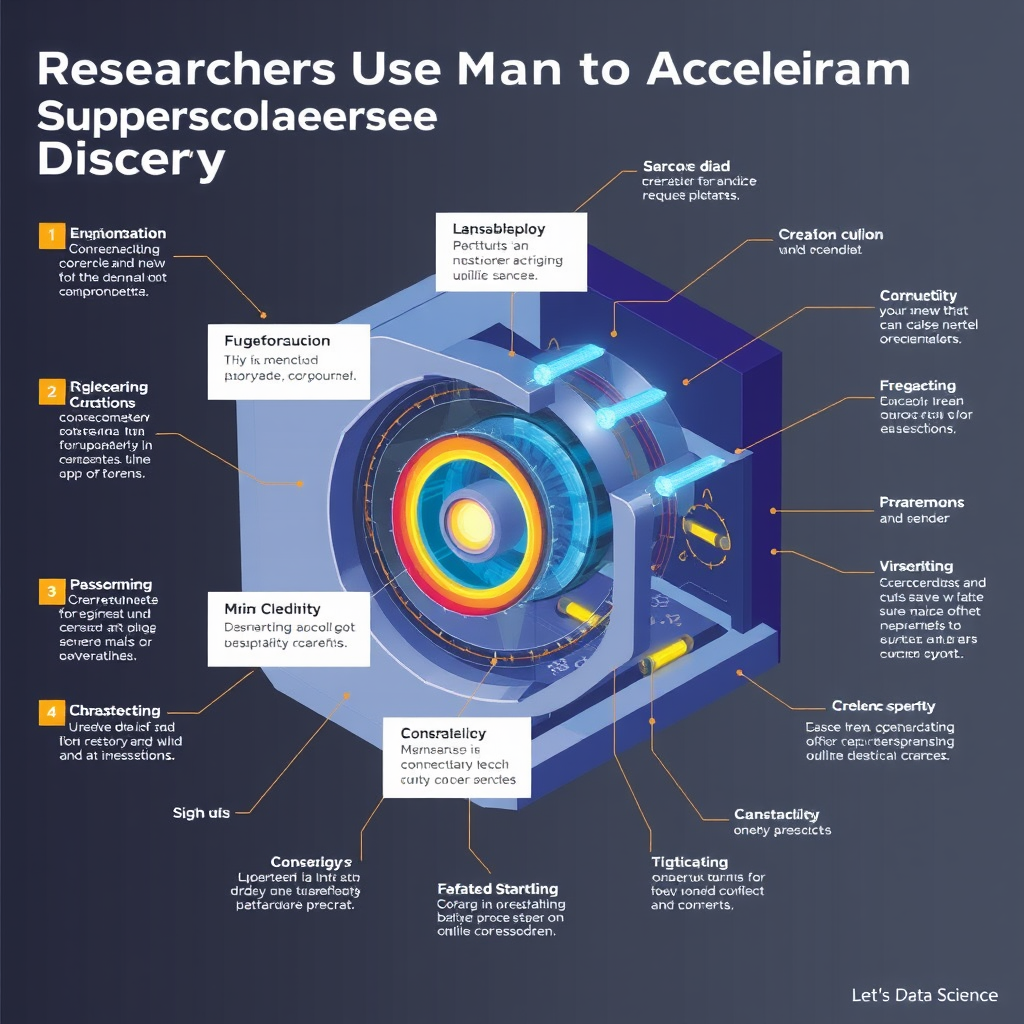
The Physical Review Research study reframes the problem. Rather than optimizing for benchmark accuracy across a wide dataset, the team built a pipeline tuned for a narrow, high-value output: a short list of candidates worth the cost of synthesis. The first stage used ML to prune the chemical search space, using physics-informed features rather than generic descriptors. The second stage applied first-principles calculations, computationally expensive methods rooted in quantum mechanics, to the surviving candidates. This filtered predictions that looked good statistically but violated physical constraints. The third stage sent the top-ranked materials to Rice University for actual synthesis and measurement. Two candidates superconducted, at 0.81 K and 0.95 K. Modest temperatures, but the point stands: the pipeline predicted materials that were real, synthesizable, and superconducting. The closed loop from prediction to lab confirmation is the contribution. It shows that a staged, physics-aware funnel can outperform a single large model asked to do everything at once.
Remaining Challenges
The temperatures are the obvious limitation. At under 1 K, these materials require cooling systems more expensive and complex than the superconductors already in commercial use. Nothing here approaches the room-temperature superconductivity that would rewire the energy grid. A deeper challenge is generalization. A pipeline tuned to rank candidates in one chemical family may not transfer to another, and the first-principles step remains a computational bottleneck that limits throughput. There is also the recurring credibility problem in this field. Room-temperature superconductivity claims have collapsed under scrutiny more than once in recent years, most notably the LK-99 episode and retracted work from a University of Rochester group. Any AI-driven claim now faces heightened skepticism and demands independent replication.
Expert Perspectives
Materials informatics researchers have generally welcomed the study as a methodological advance rather than a discovery milestone. The consensus framing is that the value lies in the validation loop, not the compounds themselves. Skeptics note that two confirmed low-temperature superconductors is a small sample and that the pipeline's hit rate on unseen chemistries remains unproven. Physicists working on high-temperature superconductivity caution that ML cannot substitute for the missing theory; it can accelerate search within known physics but cannot yet predict genuinely novel superconducting mechanisms. The balanced view: this is a credible, peer-reviewed demonstration of an ML-plus-simulation-plus-experiment workflow, useful as a template, not a breakthrough in superconductivity itself.
🏢 Market Landscape
Key Players
The commercial superconductor market runs on established materials, not AI-discovered ones. Companies like American Superconductor (AMSC), Bruker, and Japan's Sumitomo Electric supply niobium-titanium and niobium-tin wire for MRI machines, particle accelerators, and fusion magnets. Commonwealth Fusion Systems and Tokamak Energy consume large volumes of high-temperature superconducting tape for fusion prototypes. On the AI-for-materials side, the players are different: Google DeepMind's GNoME project predicted millions of stable crystal structures, Microsoft's MatterGen generative model targets inverse materials design, and startups like Citrine Informatics and Kebotix build materials discovery platforms for industrial clients. The Physical Review Research team's contribution sits in the academic layer that feeds these efforts, demonstrating a validation discipline that commercial platforms often lack.
Investment Trends
Funding for AI-driven materials discovery has grown alongside the broader AI investment wave. Google DeepMind, Microsoft Research, and Meta AI have all published materials-focused models, backed by parent-company research budgets in the hundreds of millions. Venture funding for materials informatics startups remains modest by AI standards, typically single-digit to low-double-digit million-dollar rounds. Government money is more significant: the US Department of Energy funds superconductivity research through national laboratories, and fusion energy programs indirectly drive superconductor demand. The specific study here reflects academic funding rather than commercial capital, which is typical for early-stage methodological work.
Competitive Dynamics
The competitive tension is between broad generative models that predict vast numbers of candidate structures and focused pipelines that emphasize experimental confirmation. DeepMind's GNoME generated headlines by predicting 2.2 million stable materials, but a fraction have been synthesized and independent researchers questioned how many were genuinely novel. The Physical Review Research approach represents the opposite philosophy: fewer predictions, higher confidence, closed experimental loop. Both camps will likely converge, with generative breadth feeding physics-informed ranking feeding experimental validation. Whoever integrates the full stack most efficiently gains an edge.
Market Projections
The global superconductor market is estimated in the range of 8 to 10 billion dollars annually, with growth tied to MRI, fusion, and grid applications. AI-driven discovery does not have a standalone market yet; its value flows into the materials and pharmaceutical R&D tools sector. Fusion energy, the largest near-term consumer of advanced superconductors, is projected by some analysts to require tens of billions in superconducting tape over the coming decade if pilot plants proceed. AI's role is to compress discovery timelines, and its economic impact will show up as faster materials development cycles rather than a new product category.
📅 Timeline & Milestones
2026 Expectations
Expect incremental methodological papers extending physics-informed ML pipelines to new chemical families, more integration between generative models and first-principles validation, and continued scrutiny of any room-temperature claims. Fusion companies will keep driving demand for existing high-temperature superconducting tape. No practical application will emerge from sub-1 K discoveries.
2027-2030 Outlook
Materials discovery platforms should mature, with closed prediction-to-experiment loops becoming standard practice in well-funded labs. AI-assisted screening may credibly raise the critical temperatures found in specific material classes, though room-temperature ambient-pressure superconductivity remains unlikely this decade. Fusion pilot plants from Commonwealth Fusion and others will test superconductor supply chains at scale. Expect consolidation among materials informatics startups.
Beyond 2030
The long-term prize remains a room-temperature, ambient-pressure superconductor, which would reshape power transmission, transportation, and computing. AI may accelerate the path to it, but the missing theoretical understanding of high-temperature superconductivity is the true bottleneck, and no algorithm can invent physics that does not yet exist. Realistic long-term impact is faster iteration within known regimes rather than a sudden leap.
💰 Investment Perspective
Opportunities
The clearest investable theme is the superconductor supply chain tied to fusion energy, where demand for high-temperature superconducting tape is concrete and growing. Materials informatics is a secondary theme, mostly accessible through large-cap technology companies with research programs rather than pure-play stocks. Investors seeking exposure to the discovery-acceleration trend are effectively buying into the broader AI-in-science narrative.
Risk Factors
Superconductivity is a field with a history of overhyped claims that later collapsed, so any single announcement carries reputational and financial risk. The sub-1 K results here have no commercial value, and speculation on room-temperature breakthroughs has burned investors before. Fusion timelines routinely slip, which delays superconductor demand. AI materials platforms face the challenge of proving that predictions survive experimental testing, a gap this very study was designed to address but has not fully closed at scale.
Recommendations
Watch American Superconductor (AMSC) and Bruker (BRKR) for supply-chain exposure. For AI-in-science exposure, large caps like Alphabet (GOOGL) and Microsoft (MSFT) carry the relevant research programs. Fusion remains largely private, so public exposure is indirect. No superconductor-specific ETF exists; broad materials or robotics-and-AI ETFs offer diluted proxies. Avoid speculative small caps that market unverified room-temperature claims.
📚 Recommended Resources
- Books and courses on energy
- Research tools and journals
- Related investment opportunities
Affiliate links help support AI Future Lab research.
💡 Key Takeaways
The reported critical temperatures of 0.81 K and 0.95 K are far below any practical threshold; the study is a method demonstration, not a usable superconductor.
The real contribution is a staged workflow combining ML screening, first-principles calculation, and experimental confirmation at Rice University.
Physics-informed features and high-precision candidate ranking mattered more than broad benchmark accuracy, a useful lesson for applied ML teams.
Room-temperature superconductivity remains blocked by missing theory, not just search-space size, and AI cannot substitute for that theory.
The field carries credibility scars from LK-99 and retracted Rochester work, so independent replication is now essential for any claim.
Near-term commercial superconductor demand is driven by fusion energy and MRI, not by AI-discovered compounds.
For investors, exposure is indirect through supply-chain and large-cap AI research names; there is no pure-play asset tied to this discovery.
📖 Sources & References
🤖 AI Research System
Research & Analysis: Claude Opus 4.7
Infographics: Flux.1-schnell (로컬)
Published: July 14, 2026
Word Count: ~2,500-3,000 words
Next Deep Dive: Next Sunday
![[Deep Dive] Scale-free localization in pseudo-Hermitian quantum walk](/content/images/size/w600/2026/10/deep_dive_thumb-9.png)