[Deep Dive] Physicists demonstrate Hong–Ou–Mandel interference with more than 10 atoms - Phys.org
![[Deep Dive] Physicists demonstrate Hong–Ou–Mandel interference with more than 10 atoms - Phys.org](/content/images/size/w1200/2026/07/deep_dive_thumb.png)
Physicists demonstrate Hong–Ou–Mandel interference with more than 10 atoms - Phys.org
Computing • July 04, 2026
Reading time: ~12 minutes
📑 Contents
📊 Executive Summary
The Hong-Ou-Mandel (HOM) effect, first observed with two photons in 1987, has long served as a benchmark test of quantum indistinguishability. A study published in Nature Physics now extends this two-particle interference phenomenon to a system of up to 12 neutral atoms, a regime where controlling identical massive particles is far harder than manipulating light. When indistinguishable atoms meet at an effective beam splitter, they bunch into shared output ports rather than splitting evenly, defying classical statistical expectations. The result matters because atoms carry mass, interact, and can store quantum information for far longer than photons, making atomic HOM interference relevant to quantum simulation, metrology, and eventually computing. The demonstration builds on years of progress in optical tweezer arrays and cold-atom control. While still a laboratory proof-of-concept, it signals that multi-particle quantum statistics can be engineered deterministically in matter, opening experimental paths that photonic systems cannot easily follow.
A single particle at each output is never found, even though that is the statistically expected outcome if the beam splitter were simply distributing particles at random.
🔬 Technical Deep Dive
Current State
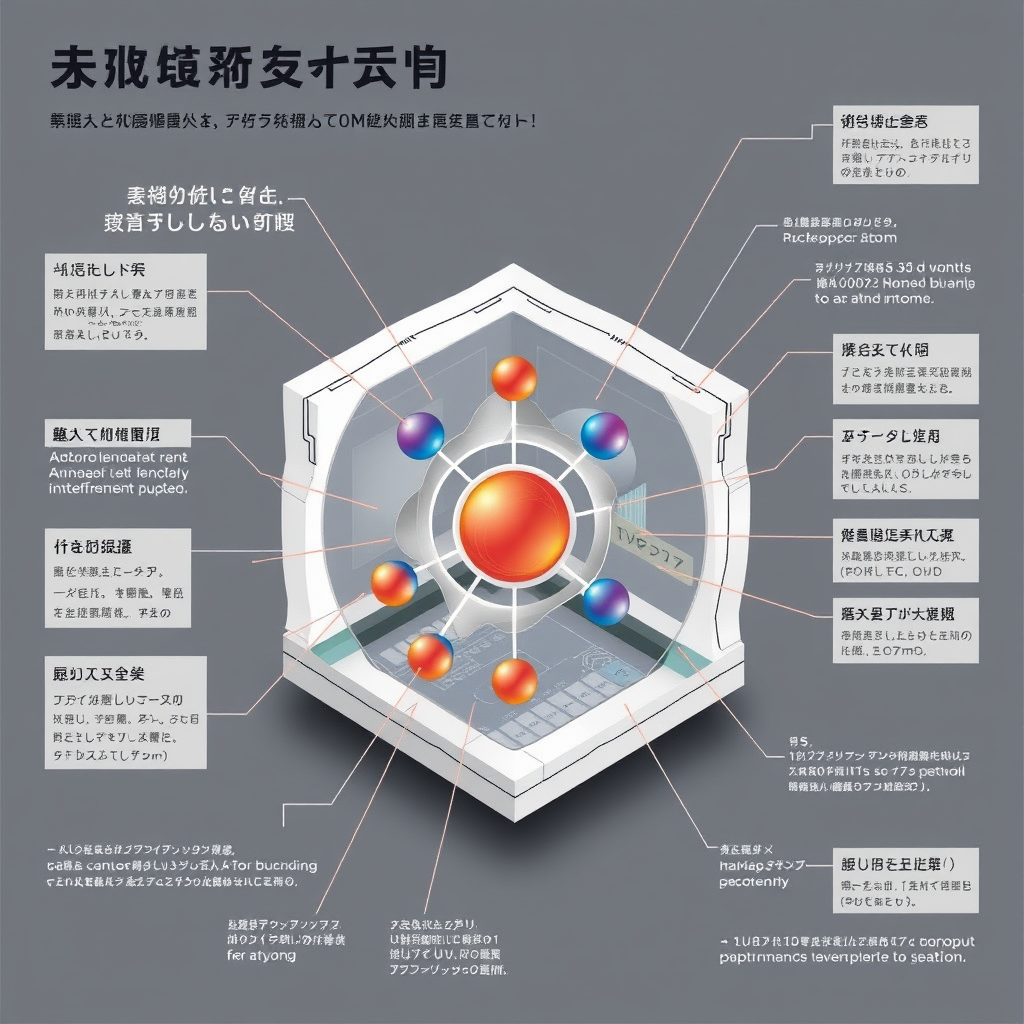
The Hong-Ou-Mandel effect describes what happens when two identical quantum particles arrive simultaneously at the two inputs of a beam splitter. Classically, you would expect them to sort into all possible output combinations, including one particle at each port. Quantum mechanics forbids this for indistinguishable bosons: the probability amplitudes for the two 'one-at-each-port' paths cancel, so the particles emerge together in the same output. For photons, this was demonstrated nearly four decades ago and has become a routine calibration tool for photonic quantum technologies. Extending it to atoms is a different order of difficulty. Atoms have mass, they can collide and interact, and they must be cooled to sub-microkelvin temperatures and prepared in identical internal and motional states before any interference is visible. The new work uses controlled arrays of neutral atoms, likely held and moved in optical tweezers, to construct atomic analogs of beam splitters and route particles into interfering paths.
Recent Breakthroughs
Scaling HOM interference from two particles to twelve is the headline advance. Two-atom HOM had been shown previously, but pushing to a dozen indistinguishable atoms tests multi-particle quantum statistics in a regime where the number of interfering paths grows combinatorially. The suppression of the single-atom-per-output outcome across all twelve particles is strong evidence that the atoms remain mutually indistinguishable and that the collective interference holds up as the system grows. This is significant because massive particles decohere through mechanisms photons do not experience, so preserving indistinguishability across a larger ensemble demonstrates a high degree of experimental control over motional states, trap uniformity, and timing.
Remaining Challenges
Several obstacles remain before this becomes a practical tool. Maintaining indistinguishability gets exponentially harder as atom number rises, since every atom must share identical motional and internal quantum states. Atomic interactions, absent for photons, can introduce phase shifts and loss that degrade interference. Detection efficiency and the fidelity of the atomic beam-splitter operation also cap how cleanly the effect can be read out. The honest limitation here is scale: twelve atoms is a meaningful jump for matter-wave interference, but it remains orders of magnitude short of the particle counts needed for fault-tolerant quantum computing or industrially useful quantum simulation.
Expert Perspectives
Physicists working in cold-atom and quantum-optics communities generally view atomic HOM scaling as a stepping stone rather than an endpoint. The consensus framing is that demonstrating multi-particle bosonic statistics in a controllable matter platform validates theoretical models of quantum many-body interference and provides a testbed for boson-sampling-style problems using atoms instead of photons. Skeptics caution that headline particle counts can obscure the fidelity question: what matters for applications is not just how many atoms interfere, but how faithfully the ideal quantum statistics are reproduced.
🏢 Market Landscape
Key Players
No company owns atomic HOM interference directly, but the enabling neutral-atom platform underpins several well-funded quantum ventures. QuEra Computing, spun out of Harvard and MIT, builds neutral-atom quantum processors using optical tweezer arrays, the same class of technology behind this experiment. Pasqal in France pursues analog and digital neutral-atom quantum computing and quantum simulation. Atom Computing in California has demonstrated systems exceeding a thousand atomic qubits. Larger players including IonQ (trapped ions), IBM and Google (superconducting qubits), and PsiQuantum (photonics) compete across adjacent modalities, and photonic firms have the most direct commercial experience with HOM interference as a calibration technique.
Investment Trends
Quantum computing broadly attracted several billion dollars in cumulative private and public funding over recent years, with neutral-atom startups capturing a growing share. Pasqal has raised over 100 million euros across funding rounds, and QuEra and Atom Computing have each drawn substantial venture and strategic investment. Government programs in the United States, European Union, and Asia continue to channel public money into cold-atom and quantum-sensing research, the funding streams most directly relevant to matter-wave interference science.
Competitive Dynamics
The competitive picture is modality-driven. Neutral atoms offer scalability in qubit count and long coherence, trapped ions offer high gate fidelity, superconductors offer speed, and photonics offers room-temperature operation and networking. Atomic HOM results strengthen the scientific credibility of the neutral-atom camp by showing fine control over identical particles, though this specific experiment is basic research rather than a product roadmap item.
Market Projections
Analyst forecasts for the broader quantum computing market range widely, with common estimates placing the sector in the tens of billions of dollars annually by the mid-2030s. Quantum sensing and metrology, arguably the nearest-term beneficiary of precise atomic interference control, is projected to grow into a multi-billion-dollar market over the same period. These figures carry high uncertainty given the early technical stage.
📅 Timeline & Milestones
2026 Expectations
Expect follow-up papers attempting to increase atom number and characterize interference fidelity more rigorously, along with theoretical work connecting atomic bunching to boson-sampling complexity. Independent replication by other cold-atom groups would be the key validation milestone this year.
2027-2030 Outlook
Over the medium term, atomic multi-particle interference could feed into quantum simulation experiments probing many-body physics that classical computers struggle to model, and into next-generation atomic sensors and clocks that exploit indistinguishability for improved precision. Neutral-atom quantum processors are likely to keep scaling qubit counts and improving gate fidelities during this window.
Beyond 2030
Longer term, the ability to control large ensembles of indistinguishable massive particles may contribute to fault-tolerant quantum computing architectures and to metrological devices operating at fundamental quantum limits. Any such outcome depends on solving the fidelity and decoherence challenges that scale with particle number, and remains speculative.
💰 Investment Perspective
Opportunities
Investors seeking exposure to the science underpinning this result should look at the neutral-atom quantum ecosystem and at quantum-sensing companies. The nearest-term commercial payoff from precise atomic control is likely in metrology, timing, and navigation rather than computing. Publicly traded pure-play quantum names offer direct but volatile exposure, while diversified semiconductor and defense-technology firms provide indirect participation with lower risk.
Risk Factors
Quantum stocks are highly speculative, thinly traded in some cases, and prone to sentiment swings disconnected from technical progress. This particular breakthrough is basic research with no revenue attached, and translating twelve-atom interference into commercial products could take a decade or more, if it happens at all. Overhyped timelines are a recurring pattern in the sector.
Recommendations
Publicly traded names with quantum exposure include IonQ (IONQ), Rigetti (RGTI), and D-Wave (QBTS), all volatile pure-plays. For diversified exposure, thematic vehicles such as the Defiance Quantum ETF (QTUM) spread risk across quantum and computing-adjacent firms. Large-cap holders IBM, Alphabet, and Nvidia offer stability with modest quantum upside. QuEra, Pasqal, and Atom Computing remain private.
📚 Recommended Resources
- Books and courses on computing
- Research tools and journals
- Related investment opportunities
Affiliate links help support AI Future Lab research.
💡 Key Takeaways
Researchers demonstrated Hong-Ou-Mandel interference with up to 12 neutral atoms, extending a photonic phenomenon into massive-particle territory.
The signature result is near-total suppression of the single-atom-per-output outcome, confirming the atoms bunch and remain indistinguishable.
Atoms are harder to control than photons because they have mass, interact, and require sub-microkelvin cooling to become identical.
The work validates the neutral-atom platform commercialized by QuEra, Pasqal, and Atom Computing, though it is basic research, not a product.
Nearest-term applications lie in quantum simulation and precision metrology rather than general-purpose quantum computing.
Scale remains the honest limitation: twelve atoms is far short of the counts needed for practical quantum advantage.
Watch for independent replication and fidelity characterization as the next validation steps in 2026.
📖 Sources & References
🤖 AI Research System
Research & Analysis: Claude Opus 4.7
Infographics: Flux.1-schnell (로컬)
Published: July 04, 2026
Word Count: ~2,500-3,000 words
Next Deep Dive: Next Sunday
![[Deep Dive] Scale-free localization in pseudo-Hermitian quantum walk](/content/images/size/w600/2026/10/deep_dive_thumb-9.png)