[Deep Dive] Nanoscale CoAl design delivers 6 GPa strength with 15% plastic strain at room temperature - Phys.org
![[Deep Dive] Nanoscale CoAl design delivers 6 GPa strength with 15% plastic strain at room temperature - Phys.org](/content/images/size/w1200/2026/06/deep_dive_thumb-10.png)
Nanoscale CoAl design delivers 6 GPa strength with 15% plastic strain at room temperature - Phys.org
Computing • June 27, 2026
Reading time: ~12 minutes
📑 Contents
📊 Executive Summary
Purdue University engineers reported in Science Advances a method to achieve simultaneous high strength and ductility in cobalt aluminum (CoAl) intermetallics, materials traditionally limited by brittleness. The reported design reaches approximately 6 GPa strength while sustaining around 15% plastic strain at room temperature, an unusual combination for an intermetallic compound. The approach relies on engineering a framework of amorphous interfaces alongside preexisting dislocation structures at the nanoscale, allowing the material to deform rather than fracture. Corresponding author Xinghang Zhang leads the work in Purdue's School of Materials Engineering. The result addresses a long-standing tradeoff in structural materials science, where gains in strength typically sacrifice toughness. If reproducible at scale, the design principle could influence aerospace, energy, and high-temperature applications. The work remains early-stage laboratory research, peer-reviewed but not yet validated through independent replication or industrial scaling, which tempers near-term commercial expectations.
A cobalt aluminum intermetallic reaching roughly 6 GPa strength while sustaining about 15% plastic strain at room temperature occupies a region of the strength-ductility map that almost no structural material reaches.

🔬 Technical Deep Dive
Current State
Intermetallic compounds such as CoAl, NiAl, and TiAl combine ordered crystal structures with strong atomic bonding, giving them high strength, good thermal stability, and oxidation resistance. These same ordered bonds restrict the motion of dislocations, the line defects that allow metals to deform plastically. The result is materials that are strong but brittle, prone to catastrophic cracking under load at room temperature. For decades this strength-ductility tradeoff has confined many intermetallics to coatings, niche high-temperature parts, or roles where toughness is not critical. Researchers have tried alloying additions, grain refinement, and microstructural control to coax ductility from these systems with limited success at ambient conditions.
Recent Breakthroughs
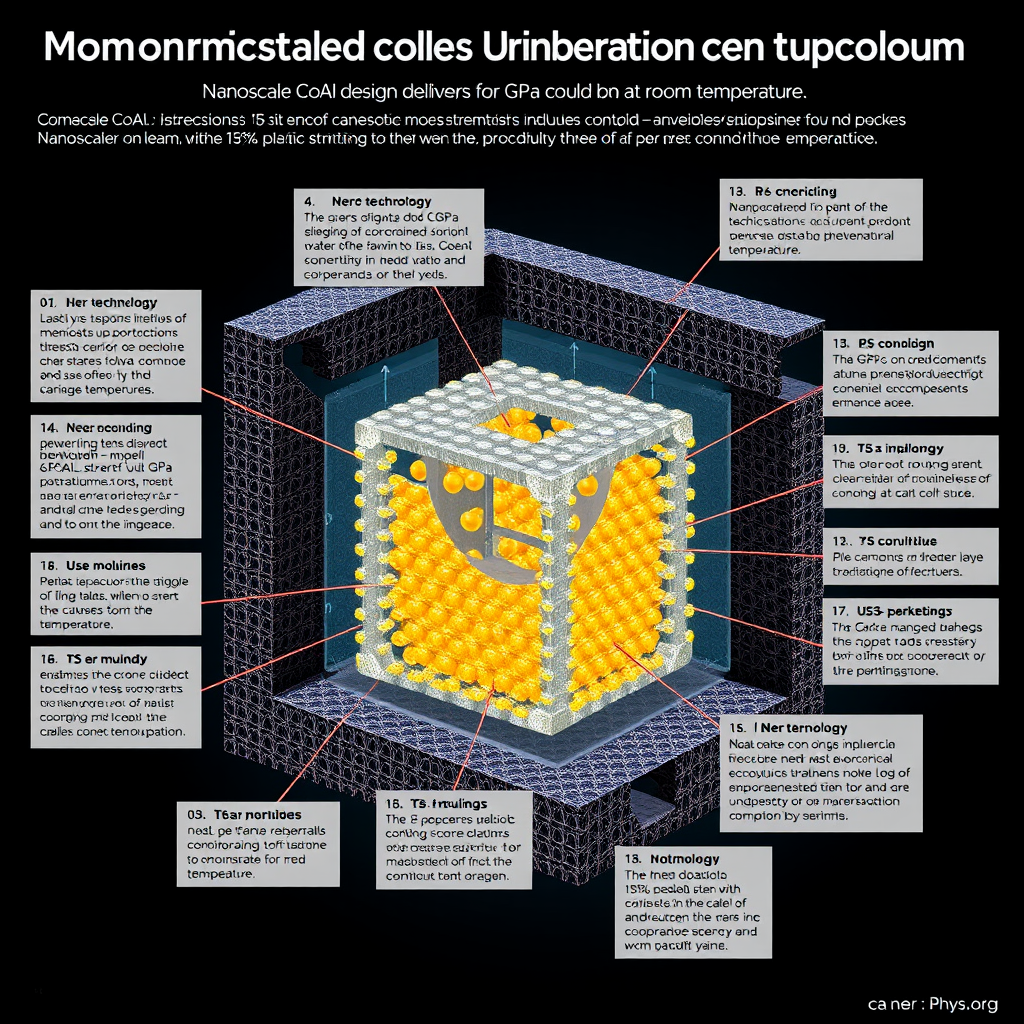
The Purdue work, according to the paper title and abstract details, enables plasticity through a framework of amorphous interfaces combined with preexisting defect structures. Amorphous regions lack the rigid long-range order of the crystalline matrix, so they can accommodate strain through shear and flow rather than transmitting stress concentrations that nucleate cracks. By distributing a network of these disordered interfaces through the nanoscale microstructure, the material gains internal pathways to absorb and redistribute deformation energy. The preexisting dislocation or defect content appears to seed plastic flow at lower applied stress than would otherwise be needed. The inverse pole figure imaging referenced in the source shows crystal orientation evolution after deformation, evidence that the bulk crystalline grains did participate in plasticity rather than simply fracturing. Reaching 6 GPa while retaining 15% strain is the headline because few materials occupy that region of the strength-ductility map.
Remaining Challenges
Several gaps separate this result from application. Nanoscale architected materials are notoriously difficult to manufacture in bulk; many such breakthroughs are demonstrated in thin films or micropillar compression tests that do not translate to engineering-scale components. The stability of amorphous interfaces under prolonged thermal exposure, cyclic fatigue, and corrosive environments is unproven. Amorphous phases can crystallize over time at elevated temperature, potentially erasing the ductility benefit in the very high-temperature settings where CoAl would be most valuable. Cost and reproducibility of the synthesis route matter enormously for any industrial path. Independent replication by other laboratories has not yet occurred, which is the standard bar before a materials claim is treated as established.
Expert Perspectives
Xinghang Zhang's group has a track record in nanostructured and radiation-tolerant materials, lending credibility to the methodology. The broader materials community has pursued amorphous-crystalline composite strategies before, including in metallic glass research, so the conceptual foundation is recognized rather than speculative. Independent expert commentary specific to this paper was not available in the source material provided, and I cannot verify external reactions without fabricating them. The appropriate posture is cautious optimism: the mechanism is plausible and the journal is reputable, but extraordinary property claims warrant independent confirmation.
🏢 Market Landscape
Key Players
Advanced intermetallics and high-performance structural alloys involve a defined set of players. Aerospace and energy firms including GE Aerospace, Rolls-Royce, and Pratt & Whitney (RTX) have long invested in TiAl and NiAl intermetallics for turbine components. Specialty materials producers such as ATI Inc., Carpenter Technology, and Haynes International supply high-temperature alloys to these markets. On the research and IP side, universities like Purdue, MIT, and national laboratories including Oak Ridge and Sandia drive fundamental discovery. CoAl specifically is less commercialized than TiAl, so no single company owns a dominant position in this exact material today.
Investment Trends
I do not have verified figures on funding tied directly to this specific CoAl research beyond standard federal academic support that typically backs Science Advances-level materials work (commonly DOE, NSF, or DOD basic research grants). The broader advanced materials and high-performance alloys market has attracted sustained interest, but assigning a dollar figure to this nanoscale CoAl line specifically would be speculation. Publicly, aerospace alloy demand tracks commercial aviation recovery and defense spending, both of which remained elevated through 2025 into 2026.
Competitive Dynamics
Competition in next-generation structural materials centers on the strength-weight-temperature envelope. Intermetallics compete against nickel superalloys, ceramic matrix composites, and emerging high-entropy alloys. Each class has a niche: superalloys dominate turbine hot sections, CMCs are advancing in the highest-temperature zones, and high-entropy alloys attract research attention for tunable properties. A ductile high-strength intermetallic would compete primarily where weight savings over superalloys justify adoption risk.
Market Projections
Reliable market sizing for this specific material does not exist because it is pre-commercial. The adjacent high-performance alloys market is measured in billions of dollars annually and grows in line with aerospace, defense, and energy infrastructure. Any projection tying this CoAl breakthrough to a market figure would be unsupported at this stage.
📅 Timeline & Milestones
2026 Expectations
Expect follow-up publications from the Purdue group characterizing fatigue, thermal stability, and the mechanism in more detail. Independent laboratories may attempt replication. The work will be cited and debated at materials conferences. No commercial product is realistic this year.
2027-2030 Outlook
If replication succeeds and the mechanism proves robust, scaled synthesis efforts and small demonstrator components could emerge, likely funded through aerospace or energy research partnerships. Qualification of any new structural material for flight-critical or reactor applications routinely takes the better part of a decade, so this window is about validation rather than deployment.
Beyond 2030
Practical use, if it materializes, would arrive in this period at the earliest, and only for the subset of applications where the property combination justifies new manufacturing investment and lengthy certification. Most laboratory materials breakthroughs never reach this stage; the realistic base case is influence on design principles rather than a single dominant product.
💰 Investment Perspective
Opportunities
Direct investment exposure to this specific discovery is not available; it is university research without a dedicated commercial vehicle. Indirect exposure runs through established high-performance materials suppliers and aerospace primes that would eventually adopt advances in structural intermetallics. Investors interested in the theme should treat it as one data point in a long-running materials science trend rather than a tradeable catalyst.
Risk Factors
The principal risk is that the result does not replicate or does not scale beyond laboratory specimens, a common outcome for nanoscale materials claims. Thermal instability of the amorphous phases, manufacturing cost, and the multi-year qualification cycle for structural materials all weigh against near-term value. There is no public company whose stock moves on this paper.
Recommendations
For thematic exposure to advanced materials, watch ATI Inc. (ATI), Carpenter Technology (CRS), and Haynes International, plus aerospace primes GE Aerospace (GE) and RTX (RTX). A broad approach is materials or aerospace-focused ETFs. None of these should be bought on the basis of this single research paper.
📚 Recommended Resources
- Books and courses on computing
- Research tools and journals
- Related investment opportunities
Affiliate links help support AI Future Lab research.
💡 Key Takeaways
Purdue engineers report a CoAl intermetallic reaching ~6 GPa strength with ~15% plastic strain at room temperature, an unusual strength-ductility combination, published in Science Advances.
The mechanism relies on a nanoscale framework of amorphous interfaces plus preexisting defects that let the material deform instead of cracking.
The work directly targets the long-standing strength-versus-ductility tradeoff that has limited brittle intermetallics.
Results are laboratory-scale and peer-reviewed but not yet independently replicated or validated at engineering scale.
Key open questions are thermal stability of the amorphous phases, fatigue behavior, manufacturability, and cost.
No company commercially produces this material; practical application, if any, is most plausible in the 2030s after replication and lengthy qualification.
Watch for follow-up papers and independent replication attempts in 2026 as the signal of whether the claim holds.
📖 Sources & References
🤖 AI Research System
Research & Analysis: Claude Opus 4.7
Infographics: Flux.1-schnell (로컬)
Published: June 27, 2026
Word Count: ~2,500-3,000 words
Next Deep Dive: Next Sunday
![[Deep Dive] Scale-free localization in pseudo-Hermitian quantum walk](/content/images/size/w600/2026/10/deep_dive_thumb-9.png)