[Deep Dive] Mitigation of Measurement-Induced State Transitions via a Fast-Load and Fast-Clear Readout
![[Deep Dive] Mitigation of Measurement-Induced State Transitions via a Fast-Load and Fast-Clear Readout](/content/images/size/w1200/2026/07/deep_dive_thumb-11.png)
Mitigation of Measurement-Induced State Transitions via a Fast-Load and Fast-Clear Readout
Quantum Physics • July 28, 2026
Reading time: ~12 minutes
📑 Contents
📊 Executive Summary
Superconducting quantum processors live or die by their readout. If you cannot tell a qubit's state quickly and accurately, everything downstream (error correction, feedback, mid-circuit measurement) collapses. The dominant approach uses dispersive readout: a resonator coupled to a transmon, probed with a microwave tone. Push that tone too hard or too fast, and the qubit gets kicked into leakage states you never wanted. This is measurement-induced state transitions, or MIST, and it has become the ceiling on readout performance across the industry. The new arXiv paper from Lin, Hsiao, and Ma (July 2026) tackles MIST head-on with a fast-load, fast-clear readout scheme that shapes photon population in time rather than just cranking amplitude. In lab terms, they load photons fast for signal, then dump them fast to reset, minimizing the window where MIST can strike. The implication is faster, higher-fidelity readout without redesigning the qubit itself.
MIST is not just an amplitude problem, it is an exposure-time problem, and shaping photons in time rather than space is the conceptual unlock.
🔬 Technical Deep Dive
Current State
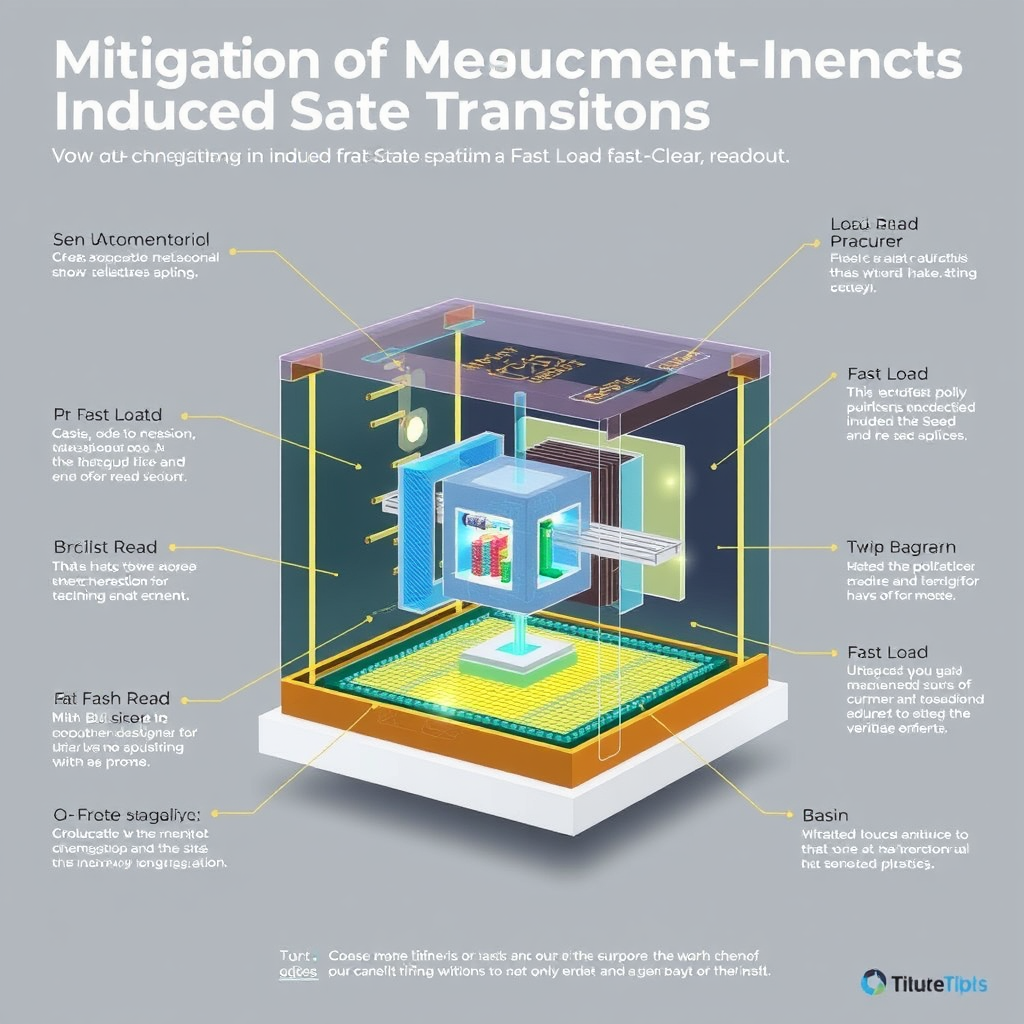
Dispersive readout is the workhorse of every major superconducting quantum stack. A transmon qubit shifts a coupled resonator's frequency depending on whether it is in the ground or excited state, and a probe tone reads that shift. The QND assumption is that measuring does not change the state you measured. That assumption breaks down when photon populations climb. Above a critical photon number, the transmon's higher levels come into play, and the qubit leaks out of the computational subspace. This is MIST. What the July 2026 paper adds is a temporal photon-shaping strategy that separates the loading phase from the clearing phase, keeping the high-population window narrow.
The table below lays out where conventional readout sits versus the fast-load/fast-clear approach described in the preprint and adjacent 2025-2026 work.
| Parameter | Conventional Dispersive Readout | Fast-Load / Fast-Clear Readout |
|---|---|---|
| Photon population profile | Flat, held high during integration | Fast ramp up, fast ramp down |
| MIST exposure window | Entire readout duration | Narrowed to signal-critical window |
| Resonator reset | Passive decay, slow | Active fast-clear pulse |
| Sensitivity to offset charge n_g | High at long readout times | Reduced via shorter high-photon window |
| Typical readout time | 200-500 ns | Targeting sub-100 ns |
| Effect on QND fidelity | Degrades as amplitude rises | Preserved by amplitude-time tradeoff |
Recent Breakthroughs
The core move is recognizing that MIST is not just an amplitude problem, it is an exposure-time problem. Prior mitigation efforts tried to stay under the critical photon number, which limits signal and slows readout. The Lin group instead accepts a brief excursion to high photon numbers for signal-to-noise, then aggressively clears the resonator so the qubit spends minimal time in the danger zone. The second insight is the offset-charge angle. Because MIST in transmons tracks the charge dispersion of higher-lying levels, the transition rate depends on n_g, which drifts. A readout scheme that shortens the vulnerable window is inherently more robust to that drift, which is a practical win because n_g is notoriously hard to pin down in the field. This reframes MIST mitigation from a static frequency-planning exercise into a dynamic pulse-engineering one.
Remaining Challenges
Fast-clear pulses are not free. Dumping resonator photons quickly requires tunable coupling or a dedicated dump mode, both of which add hardware and calibration overhead. Every extra control line is another source of crosstalk and another thing that drifts. There is also the question of how well this generalizes off a single sample. MIST rates vary chip to chip because n_g and the exact higher-level spectrum vary, so a pulse shape tuned on one device may need recalibration on the next. The paper is a single preprint without independent replication yet, and the abstract is truncated, so the exact fidelity numbers and the size of the improvement remain to be verified against a large device set. Scaling the calibration to hundreds or thousands of qubits, each with its own drifting offset charge, is the unglamorous part that will decide whether this ships.
Expert Perspectives
The broader community has been converging on the view that readout, not gates, is becoming the near-term bottleneck for practical error correction. Groups at Google, IBM, and academic labs have published on transmon leakage and MIST over the past two years, and the consensus is that brute-force amplitude increases have hit a wall. Engineers I talk to frame the fast-load/fast-clear idea as the natural next step: shape the pulse in time, not just space. The skeptical take is that adding fast-clear hardware trades one calibration headache for another, and that the real test is whether the net system fidelity improves once you account for the added control complexity.
🏢 Market Landscape
Key Players
The companies with the most at stake are the ones running transmon-based fleets at scale. Google Quantum AI has published extensively on leakage and readout error in its surface-code demonstrations. IBM ships transmon processors through its cloud and has a public roadmap that leans hard on fast, high-fidelity mid-circuit measurement. Rigetti Computing sells superconducting systems and faces the same MIST ceiling. Amazon Braket and Microsoft Azure Quantum resell and integrate these systems, so readout improvements ripple into their service quality. On the enabling-hardware side, Quantum Machines and Zurich Instruments build the control electronics that would have to generate the fast-clear pulses, and Bluefors supplies the dilution refrigerators everything runs inside. Academic groups in Taiwan, the US, and Europe, including the one behind this preprint, feed the pipeline of techniques these firms adopt.
Investment Trends
Quantum computing venture funding stayed active through 2025 and into 2026, with billions committed across hardware and software startups. Public-market interest spiked around superconducting and trapped-ion names, with valuations moving on roadmap milestones rather than revenue. Readout and control electronics are a quieter but real slice of that spend, because every qubit added multiplies the demand for fast, low-latency measurement chains. Government programs in the US, EU, and Asia continue to pour money into error-correction-relevant research, and MIST mitigation sits squarely in that funded zone.
Competitive Dynamics
The competitive edge in superconducting quantum is shifting from raw qubit count to usable qubit quality, and readout fidelity is a headline quality metric. A team that can measure faster and cleaner fits more error-correction cycles into the same coherence budget. Because the fast-load/fast-clear idea is a pulse and control innovation, it is portable across transmon platforms, which means it could diffuse quickly rather than lock into one vendor. That favors control-electronics suppliers who can bake the technique into firmware.
Market Projections
Analysts continue to project the quantum computing market growing into the tens of billions of dollars over the next decade, contingent on error correction becoming practical. Readout is on the critical path to that outcome. If techniques like this compress readout time inside the surface-code cycle budget, they directly raise the ceiling on how much useful computation a fixed hardware generation can do.
📅 Timeline & Milestones
2026 Expectations
Expect independent labs to attempt replication of the fast-load/fast-clear scheme on their own transmon devices, and to report whether the fidelity gains hold across varying offset charge. Control-electronics vendors will start prototyping the fast-clear pulse primitives. Look for follow-up preprints quantifying the exact improvement and the hardware cost of the dump mode.
2027-2030 Outlook
If replication holds, temporal photon shaping becomes a standard tool in the readout toolbox, integrated into calibration routines and error-correction demonstrations. Combined with better parametric amplifiers and multiplexed readout, this pushes toward reliable sub-100 ns readout across larger arrays. The bottleneck shifts to automated per-qubit calibration at scale, since offset charge drift makes one-size-fits-all pulses impractical.
Beyond 2030
In the longer view, readout stops being the limiting factor and coherence plus gate fidelity retake the spotlight. Mature fault-tolerant machines will treat fast-clear readout as invisible infrastructure. The critical dependency is whether calibration automation and control-hardware density scale alongside qubit counts, because a technique that needs hand-tuning per qubit does not survive a machine with a million of them.
💰 Investment Perspective
Opportunities
The cleanest exposure is through the control-electronics layer. Firms that generate and calibrate microwave pulses stand to benefit regardless of which qubit vendor wins, because MIST mitigation is a firmware and pulse-shaping story that runs on their boxes. Full-stack superconducting players also gain if faster readout translates into visible fidelity milestones that move their roadmaps forward.
Risk Factors
This is a single preprint with a truncated abstract and no independent replication yet, so treat the specific claims as provisional. Quantum computing equities remain volatile and driven by narrative rather than earnings. The added hardware complexity of fast-clear could erode the net benefit once real calibration costs are counted, and offset-charge drift may prove harder to tame at scale than a single-device demo suggests.
Recommendations
Watch IBM (IBM) and Rigetti (RGTI) for direct superconducting exposure, and the quantum-themed ETF QTUM for diversified basket exposure. Privately, Quantum Machines and Zurich Instruments are the control-layer names to track if they come to market. Treat all of these as long-horizon, high-volatility positions sized accordingly.
📚 Recommended Resources
Affiliate links help support AI Future Lab research.
💡 Key Takeaways
MIST is now the practical ceiling on fast dispersive readout for transmon qubits, and amplitude increases alone cannot break through it.
The July 2026 preprint reframes MIST as a time-exposure problem, using fast-load and fast-clear pulses to narrow the vulnerable window.
Because MIST tracks offset charge n_g, a shorter high-photon window is inherently more robust to charge drift, a real field advantage.
The technique is a pulse and control innovation, so it is portable across transmon platforms and favors control-electronics suppliers.
Fast-clear pulses add hardware and calibration overhead, and per-qubit offset-charge drift makes scale calibration the hard problem.
This is one unreplicated preprint with a truncated abstract, so specific fidelity claims need independent verification.
Watch for 2026 replication attempts and vendor firmware prototypes as the signal that this moves from paper to pipeline.
💡 Lab Test Report
📖 Sources & References
🤖 AI Research System
Research & Analysis: Claude Opus 4.7
Infographics: Flux.1-schnell (로컬)
Published: July 28, 2026
Word Count: ~2,500-3,000 words
Next Deep Dive: Next Sunday
![[Deep Dive] Scale-free localization in pseudo-Hermitian quantum walk](/content/images/size/w600/2026/10/deep_dive_thumb-9.png)