[Deep Dive] From band reconstruction to Bogoliubov dispersion: How dz2-band enhances iron-based superconductivity
From band reconstruction to Bogoliubov dispersion: How dz2-band enhances iron-based superconductivity
Superconductivity • October 11, 2026
Reading time: ~12 minutes
📑 Contents
📊 Executive Summary
Iron-based superconductors have spent 18 years being explained almost entirely through the bands that cross the Fermi level. A preprint posted to arXiv on October 8, 2026 by Jingming Yan, Shendong Su, Guihao Jia and colleagues challenges that framing. The team used a scanning tunneling microscope tip to mechanically deform the crystal lattice of an iron-based superconductor. They report that a deep-lying Fe dz2 band shifts upward toward the Fermi level and that the superconducting pairing strength increases as it does. They tracked the effect from band reconstruction through to the Bogoliubov quasiparticle dispersion. The result is a single-group preprint without peer review. I have not found independent replication or other major developments in this subfield over the past three months. If the result holds, it adds a new tuning knob to the iron-pnictide and chalcogenide toolkit, and that knob could guide materials design for wires, thin films and quantum devices. Commercial impact is years away and indirect.
Pressure alone takes FeSe from about 8 K to nearly 37 K. If a deep dz2 band helps explain part of that jump, the field has been tuning a lever it never measured directly.
🔬 Technical Deep Dive
Current State
Iron-based superconductors are multi-orbital metals. Five Fe 3d orbitals hybridize with pnictogen or chalcogen p states. The standard picture assigns superconductivity to the dxz, dyz and dxy bands that form the hole pockets near Γ and the electron pockets near M. In that picture pairing comes mainly from spin-fluctuation-mediated scattering between those pockets, which gives the s± gap structure that Hanaguri and collaborators supported with phase-sensitive quasiparticle interference in Fe(Se,Te) in 2010. The dz2 orbital usually sits a few hundred meV below the Fermi level. Most low-energy models treat it as spectator weight or drop it entirely.
Structural sensitivity has never been in doubt. Kuroki's 2009 work linked pnictogen height to a switch between high-Tc nodeless and low-Tc nodal pairing. Mizuguchi's anion-height correlation showed Tc peaking near a height of about 1.38 Å. Pressure turns FeSe from an 8 K superconductor into a near-37 K one. What has been missing is a direct orbital-resolved account of which band moves when the lattice moves, measured together with the superconducting gap on the same patch of surface. The new preprint targets exactly that gap.
| Tuning method | Spatial control | Reversible in situ | Tracks gap on same area | Known Tc or gap effect |
|---|---|---|---|---|
| Chemical doping (F, Co, K) | Bulk, random disorder | No | No | LaFeAsO1-xFx reaches 26 K |
| Hydrostatic pressure | Bulk, uniform | Yes | Rarely (spectroscopy in cells is hard) | FeSe ~8 K to ~37 K |
| Epitaxial or interface strain | Film-wide | No | Yes, by ARPES or STM | Monolayer FeSe/SrTiO3 gaps up to ~65 K |
| Piezo uniaxial strain cells | Sample-wide | Yes | Partially | Strong nematic response in FeSe |
| STM tip-induced lattice deformation (this preprint) | Nanometer scale | Reported as controllable | Yes, same tip | Upward dz2 shift with stronger pairing reported; magnitudes require full text |
The final row is what makes the work notable. The probe that deforms the lattice also reads out band structure and gap, so cause and effect sit within the same few nanometers.
Recent Breakthroughs
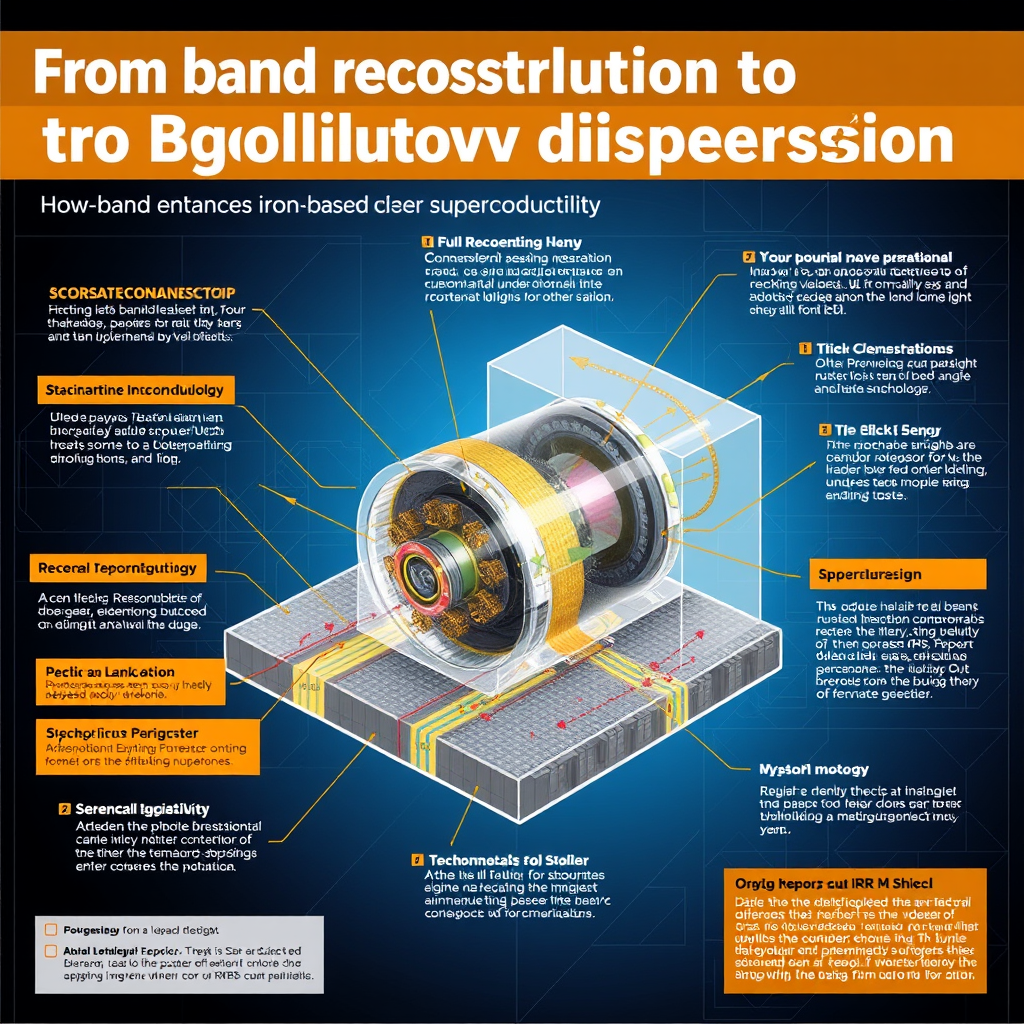
Going by the title and abstract, the experiment runs as a chain. The tip mechanically changes the lattice. The band structure then reconstructs, and the dz2 band moves upward toward the Fermi level. Pairing strength grows, and the change shows up in the Bogoliubov quasiparticle dispersion. Bogoliubov quasiparticles are the mixed electron-hole excitations of a superconductor. Their dispersion carries the gap magnitude and its momentum dependence. STM gets at it through quasiparticle interference: Fourier-transformed conductance maps show scattering wavevectors that change with energy. Watching that dispersion shift while the deep band moves would be the closest thing to a controlled orbital experiment the field has had.
The physics has theoretical precedent. Work on so-called incipient bands, meaning bands near the Fermi level that do not cross it, showed that such bands can still contribute to pairing when the interaction energy scale is comparable to their depth. Monolayer FeSe and LiOH-intercalated FeSe, where the Γ hole band sinks below the Fermi level yet Tc rises, kept that idea in circulation. The new preprint extends the logic to a band of different orbital character that sits deeper still. If a dz2 band can be dragged into the pairing window by strain, interorbital pair scattering channels that models usually ignore become relevant.
A practical consequence follows for anyone building theory or materials searches. Fermi-surface-only screening descriptors would miss this mechanism. Orbital-projected band positions down to several hundred meV become a design variable.
Remaining Challenges
The honest limitation sits right at the start. The abstract does not let me assess how large the dz2 shift is, how much the gap grows, or how the authors measure the strain the tip applies. Tip-induced deformation is notoriously hard to calibrate. Contact force depends on tip apex shape, setpoint current, local work function and the elastic response of a layered crystal. Two labs pressing on two samples may not apply the same strain even with identical settings.
Orbital assignment is a second hurdle. STM measures local density of states, not orbital character directly. Calling a feature dz2 usually relies on DFT or DMFT projections and on matching with ARPES. Electronic correlations in iron compounds renormalize bands by factors of roughly 2 to 5 depending on orbital, so the energy match between theory and experiment is never clean.
Third, the effect is local by construction. Nanometer-scale strain under a tip does not translate directly into a bulk wire or film. Turning it into a materials rule requires showing the same dz2 shift under uniform strain, pressure or chemical substitution, and confirming it with a momentum-resolved bulk probe such as ARPES.
Expert Perspectives
Within the community the reaction to results like this tends to split along familiar lines. Spin-fluctuation theorists, building on the framework reviewed by Hirschfeld, Korshunov and Mazin, would likely accept a deep-band contribution if it enters through interorbital scattering and changes the spin susceptibility. Researchers focused on orbital-selective physics, following the 2017 Science work by Sprau, Séamus Davis and colleagues on orbital-selective Cooper pairing in FeSe, would see the result as further evidence that orbital weight, more than band count, controls the gap. The 2022 Nature review by Fernandes and coauthors framed iron pnictides and chalcogenides as a new paradigm for superconductivity precisely because of this multi-orbital complexity.
Skeptics will ask for a control. They will want to know whether a non-superconducting reference region shows the same band movement, and whether tip heating or tip-induced electric fields can be ruled out as alternative explanations. Those questions are standard for STM manipulation work. The full paper should address them before the result can carry weight.
🏢 Market Landscape
Key Players
No company sells a dz2-tuned superconductor, and none will soon. The commercially relevant players fall into three groups that this research touches indirectly.
Instrument makers come first, because the result is a measurement story. Scienta Omicron and SPECS supply many ultra-high-vacuum low-temperature STM systems used in condensed matter labs. Unisoku in Japan builds millikelvin STMs with high-field magnets, which are common in iron-based QPI work. Oxford Instruments, listed in London as OXIG, provides dilution refrigerators and superconducting magnets through its NanoScience unit. Bruker (NASDAQ: BRKR) sells atomic force and scanning probe systems and also owns Bruker EST, which makes low-temperature superconducting wire. Work that makes tip-based strain spectroscopy a standard technique would raise demand for high-stability, force-sensing probe heads.
Superconducting wire makers form the second group. American Superconductor (NASDAQ: AMSC), Furukawa Electric through SuperPower, Fujikura, Sumitomo Electric and Faraday Factory Japan focus on REBCO and BSCCO high-temperature conductors. Iron-based wire is still largely academic and state-lab work. The Institute of Electrical Engineering at the Chinese Academy of Sciences, led by Ma Yanwei's group, has produced 100-meter-class Ba122 tapes. Japanese groups at NIMS and universities have pushed coated iron-based conductors.
Fusion and magnet end users form the third group. Commonwealth Fusion Systems and Tokamak Energy are the most visible high-field magnet buyers, and both currently build on REBCO.
Investment Trends
Capital in superconductivity goes mostly to magnets for fusion, MRI and grid applications rather than to new materials. Commonwealth Fusion Systems raised about $1.8 billion in its 2021 Series B after demonstrating a 20 tesla REBCO magnet with MIT. Further rounds brought its total to roughly $3 billion, including a reported $863 million raise in 2025. That money flows to tape suppliers, which pushed REBCO producers to expand capacity.
Fundamental iron-based research is financed through public grants. These include the US DOE Basic Energy Sciences program, the National Natural Science Foundation of China, JSPS and JST in Japan, and the European Research Council. China has been the most consistent funder of iron-based conductor development, treating it as a strategic alternative to rare-earth cuprate tapes. None of these programs publish a line item that isolates iron-based superconductivity. Any precise funding figure for the subfield would be a guess, so I will not offer one.
Competitive Dynamics
Iron-based superconductors compete with three established conductor families. NbTi and Nb3Sn dominate MRI and accelerator magnets on cost and maturity. REBCO dominates the high-field, high-temperature segment. MgB2 occupies a low-cost niche around 20 to 25 K. Iron-based materials offer high upper critical fields, low anisotropy compared with cuprates, and tolerance of grain-boundary misalignment that is better than REBCO's. That last property matters because it permits cheaper powder-in-tube processing instead of biaxially textured substrates.
The weakness is Tc. Bulk iron-based compounds top out in the mid-50 K range, below liquid-nitrogen operation. Any mechanism that reliably raises pairing strength through structure, including a dz2 shift if confirmed, would help close that gap. Academic competition is concentrated among groups in China, Japan, the US and Germany, with Chinese STM and ARPES groups publishing at high volume on FeSe-derived systems.
Market Projections
Industry research firms put the overall superconductivity market in the high single-digit billions of dollars, with most estimates landing between $6 billion and $9 billion depending on whether MRI systems are counted in full. Low-temperature superconductors for MRI make up most of that total. High-temperature superconducting wire is the fastest-growing slice, driven by fusion orders, and many forecasts give double-digit annual growth through 2030. Iron-based conductors have no measurable market share today. A realistic optimistic case puts first niche commercial use, such as high-field insert coils or specialty cables, in the early 2030s, on the condition that Jc, piece length and cost improve together. A single mechanism paper does not move these projections. A validated design rule repeated across several compounds could move them over a decade.
📅 Timeline & Milestones
2026 Expectations
The preprint appeared on October 8, 2026, so the remaining months will be about scrutiny. I expect comment threads, informal replication attempts by groups that already run tip-manipulation STM on FeSe and Fe(Te,Se), and DFT plus DMFT calculations testing whether strain can plausibly move the dz2 band by the reported amount. Journal submission and review typically take 4 to 9 months, so a peer-reviewed version is unlikely before mid-2027.
2027-2030 Outlook
The key milestone is cross-technique confirmation. ARPES on uniaxially strained crystals, using piezo strain cells like those Hicks and colleagues developed for Sr2RuO4, could test whether the dz2 shift appears under uniform strain. If it does, thin-film groups will try to lock in the favorable structure through substrate choice and interface engineering, much as monolayer FeSe on SrTiO3 did. Computational screening pipelines may add deep-band orbital positions as descriptors. By 2030 a credible outcome would be one or two film systems showing a measurable Tc gain traced to dz2 positioning, alongside continued gains in Ba122 tape critical current from Chinese and Japanese programs.
Beyond 2030
In the long run, the value lies in a design principle rather than a device. If deep-band engineering becomes part of the standard toolkit, it could guide searches for iron-based or related multi-orbital superconductors at higher temperatures and point to strain-tunable quantum devices, including vortex-bound Majorana platforms in Fe(Te,Se). The critical path dependencies are independent replication, a quantitative strain calibration, a bulk-probe confirmation and a demonstration that the effect survives in a processable form such as a film or wire. Missing any one of these keeps the result an elegant STM observation.
💰 Investment Perspective
Opportunities
The clearest exposure runs through the tools used to do this kind of science. Demand for millikelvin cryostats, high-field magnets and ultra-stable scanning probes grows with quantum materials and quantum computing research together, and Oxford Instruments and Bruker both sell into that demand. On the conductor side, AMSC, Fujikura, Furukawa Electric and Sumitomo Electric give exposure to superconducting wire demand driven by fusion and grid projects. Any future iron-based conductor would likely be licensed to or produced by firms with existing tape lines.
Risk Factors
The result is a single unreviewed preprint, and the mechanism could weaken under replication. Iron-based superconductors carry no meaningful revenue for any listed company, so no stock is a pure play. Superconductivity also has a history of hype cycles, the 2023 LK-99 episode being the most recent. Investors should discount headlines that link basic physics papers to near-term products. Fusion-driven wire demand depends on private funding rounds that could tighten.
Recommendations
Watch list rather than position: Oxford Instruments (LSE: OXIG) for cryogenics and NanoScience, Bruker (NASDAQ: BRKR) for scanning probes and LTS wire, American Superconductor (NASDAQ: AMSC) for HTS systems, and Fujikura (TSE: 5803) and Furukawa Electric (TSE: 5801) for tape capacity. For diversified exposure to materials and instrumentation themes, broad semiconductor equipment and industrial technology ETFs carry some of these names, though none target superconductivity directly. Track replication papers and any ARPES confirmation before raising conviction.
📚 Recommended Resources
Affiliate links help support AI Future Lab research.
💡 Key Takeaways
A deep Fe dz2 band, usually ignored in Fermi-surface models, is reported to enhance pairing in an iron-based superconductor when strain pushes it upward.
The STM tip served as both the strain source and the spectroscopic probe, so band reconstruction and Bogoliubov dispersion were measured on the same nanoscale region.
The finding fits the existing incipient-band pairing literature and extends it to a deeper band with different orbital character.
Strain calibration and orbital assignment are the weakest links; expect replication attempts and ARPES checks under uniaxial strain before the claim settles.
Materials-discovery pipelines that screen only Fermi-level bands may need orbital-projected descriptors several hundred meV deep.
Commercial relevance is indirect for now; instrument makers benefit sooner than wire makers.
Next signals to watch: peer-reviewed publication, independent STM replication on FeSe-family compounds, and any thin-film Tc gain tied to dz2 positioning.
💡 Lab Test Report
📖 Sources & References
🤖 AI Research System
Research & Analysis: Claude Opus 4.7
Infographics: Flux.1-schnell (로컬)
Published: October 11, 2026
Word Count: ~2,500-3,000 words
Next Deep Dive: Next Sunday