[Deep Dive] Figure AI Helix-02: Humanoid Robots Now Complete Full 8-Hour Factory Shifts Autonomously
![[Deep Dive] Figure AI Helix-02: Humanoid Robots Now Complete Full 8-Hour Factory Shifts Autonomously](/content/images/size/w1200/2026/05/deep_dive_thumb-8.png)
Figure AI Helix-02: Humanoid Robots Now Complete Full 8-Hour Factory Shifts Autonomously
Robotics & AI • May 16, 2026
Reading time: ~12 minutes
📑 Contents
📊 Executive Summary
Figure AI's May 13, 2026 announcement marks a watershed moment for embodied AI: Figure 03 humanoid robots completed a full 8-hour autonomous shift sorting packages on conveyor belts at human-parity speeds (~3 seconds per package), powered by the new Helix-02 vision-language-action model and an underlying neural whole-body controller called System 0 (S0). Most consequentially, S0 replaced approximately 109,000 lines of hand-engineered C++ locomotion code with a single neural network trained on 1,000+ hours of human motion data. All inference runs onboard — no cloud dependency. In parallel, Figure's BotQ manufacturing facility scaled from 1 robot/day to 1 robot/hour in 120 days — a 24x throughput increase. Competitive pressure is intensifying: Meta acquired humanoid startup ARI on May 1, 2026, Apptronik raised $520M in February, and Tesla continues to iterate on Optimus. The implications for industrial labor markets, capital allocation, and the broader AI infrastructure stack are profound and accelerating.
Figure replaced 109,000 lines of hand-engineered C++ locomotion code with a single neural network — and then ran it for eight straight hours on a real factory floor at human speed. The era of programmed robots is ending.
🔬 Technical Deep Dive
Current State
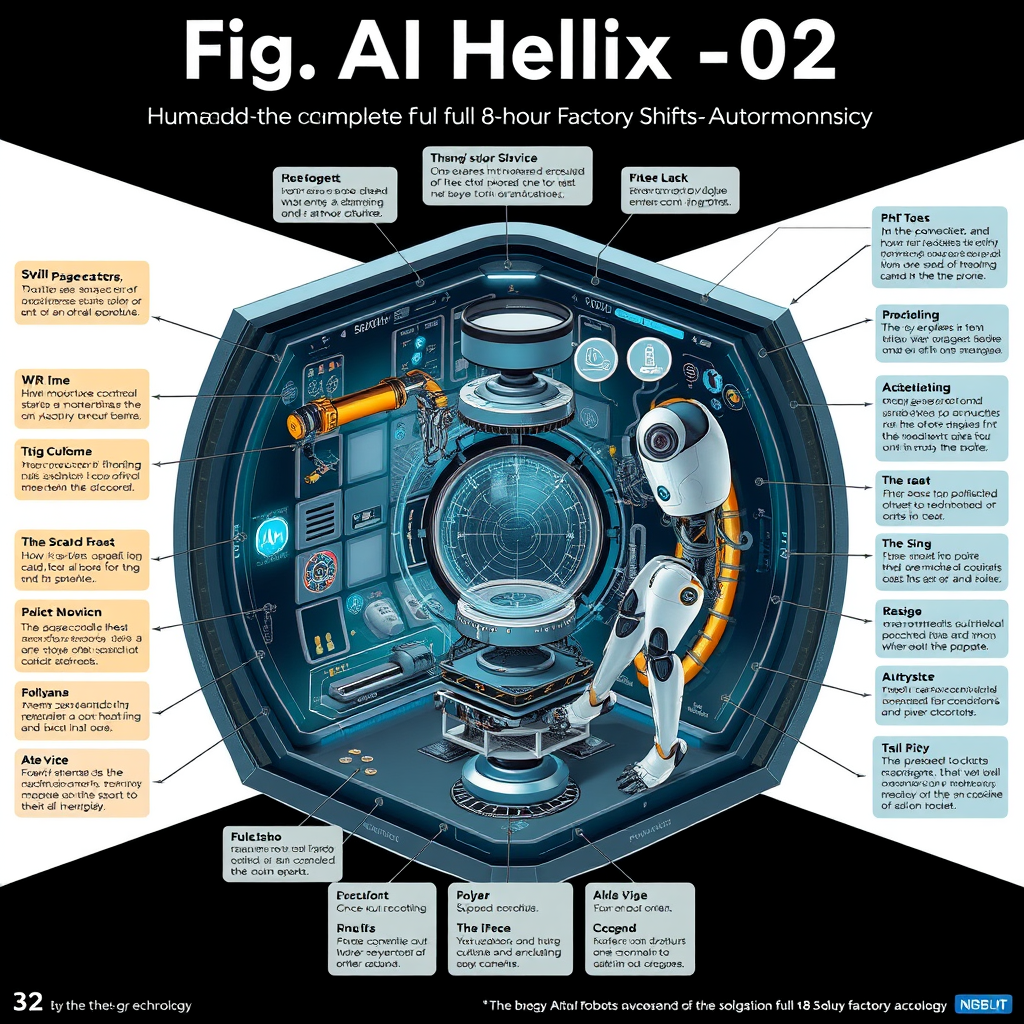
The humanoid robotics field has transitioned from teleoperated demos and choreographed showcases to measurable industrial utility in roughly 18 months. Figure AI's Helix-02 represents a second-generation vision-language-action (VLA) architecture: a dual-system design where a high-level 'System 2' reasoning model interprets context, scene semantics, and task intent, while a faster 'System 1' policy executes continuous motor control at high frequency. Helix-02 extends this with System 0 (S0) — a learned whole-body controller that handles balance, locomotion, and full-body coordination. Critically, S0 was trained on over 1,000 hours of human motion capture and operational telemetry, enabling end-to-end pixel-to-torque control. This means Figure 03 detects barcodes, plans grasps, and executes pick-and-place purely from camera input — no fiducials, no pre-mapped environments, no scripted trajectories. All inference runs onboard the robot, eliminating cloud latency and network dependency.
Recent Breakthroughs
Three breakthroughs stand out. First, the elimination of 109,000 lines of hand-tuned C++ is not merely a code-cleanup story — it represents a paradigm shift from model-based control (where engineers encode physics and gait constraints explicitly) to data-driven control (where the network learns implicit dynamics). This dramatically compresses the iteration cycle: new behaviors are now trained rather than coded. Second, sustained 8-hour autonomy on a real conveyor line crosses a psychological and economic threshold. Previous humanoid demos lasted minutes; an 8-hour shift implies thermal stability, battery management, error recovery, and graceful degradation are all working in production. Third, multi-robot coordination on shared conveyor uptime suggests emergent fleet-level behaviors — robots are not just individually competent but collectively orchestrated. Helix-02's onboard inference is enabled by aggressive model distillation and likely custom silicon paths, an area where Figure has been quietly investing.
Remaining Challenges
Significant hurdles remain. Generalization across tasks is unproven — package sorting is a constrained domain with predictable object geometries and motions. Cluttered, dynamic environments (e.g., assembly with deformable materials, human co-workers in motion) remain substantially harder. Dexterous manipulation of small or fragile items still trails human capability by a wide margin. Battery life and swap logistics constrain continuous deployment beyond a single shift. Safety certification for human-adjacent operation under standards like ISO 10218 and ISO/TS 15066 is incomplete across the industry. And while Figure claims onboard inference, the compute, power, and thermal envelope required for Helix-02-class models in a humanoid form factor is at the bleeding edge of what's feasible.
Expert Perspectives
Industry analysts at Bank of America and Goldman Sachs have revised humanoid TAM projections upward following the announcement, with Goldman now modeling a $38B humanoid market by 2035 (vs. $6B prior). Robotics researchers note that the S0 architecture echoes recent academic work on whole-body diffusion policies and parallels DeepMind's RT-2 lineage, but Figure's scale of real-world training data is unmatched outside Tesla. Skeptics including Rodney Brooks continue to caution that demo-to-deployment ratios in robotics historically disappoint, and that 'human parity on one task' is not the same as economic substitution.
🏢 Market Landscape
Key Players
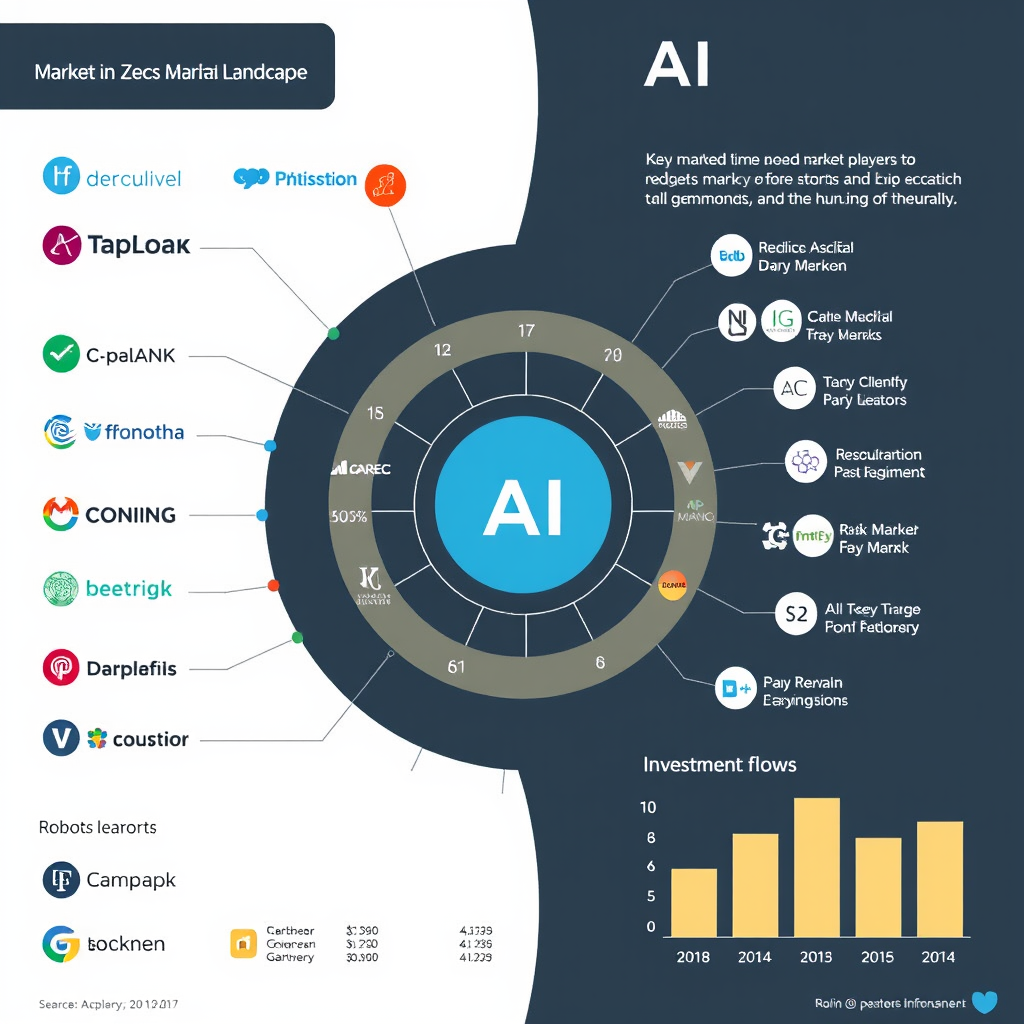
The competitive field has consolidated around five serious contenders. Figure AI, now reportedly valued north of $40B following its 2025 raise from Microsoft, NVIDIA, and OpenAI-affiliated funds, leads on integrated VLA deployment. Tesla Optimus benefits from Tesla's manufacturing flywheel and FSD vision stack; Elon Musk has guided to thousands of internal Optimus units in Tesla factories by end of 2026, though external deployments remain limited. Apptronik, partnered with Mercedes-Benz and Google DeepMind, raised $520M in February 2026 and is positioning Apollo as the open-platform alternative. Meta's May 1, 2026 acquisition of ARI signals that Big Tech now considers humanoid hardware a foundational AI surface — Meta's strategy appears focused on consumer/home rather than industrial. Boston Dynamics (Hyundai), Agility Robotics (Digit, deployed at GXO and Amazon), 1X Technologies (Neo, consumer-focused), and Chinese players Unitree and Fourier complete the front rank.
Investment Trends
Cumulative humanoid funding exceeded $7B in the 12 months ending May 2026, per PitchBook estimates. Beyond Apptronik's $520M, notable rounds include 1X's $100M+ Series C, Physical Intelligence's $400M (foundation models for robotics), and Skild AI's $300M. NVIDIA's Isaac GR00T platform has become de facto infrastructure, with NVIDIA reporting humanoid simulation revenue as a fast-growing segment. Capital is bifurcating: hardware integrators (Figure, Apptronik, 1X) and software/foundation-model layers (Physical Intelligence, Skild, Covariant) attract distinct investor profiles.
Competitive Dynamics
The Meta-ARI deal reframes the landscape. For 18 months the assumption was that vertical integrators (Figure, Tesla) would win because robotics requires tight hardware-software coupling. Meta's entry — alongside rumors of Apple and Amazon humanoid programs — suggests platform players believe they can commoditize the hardware and capture the AI layer. Figure's response has been to accelerate manufacturing (BotQ's 24x throughput jump) and lock in commercial customers like BMW and a previously announced major US logistics partner.
Market Projections
Goldman Sachs' updated humanoid forecast pegs the addressable market at $38B by 2035; Morgan Stanley's more aggressive scenario reaches $5T by 2050 assuming widespread labor substitution. ARK Invest models 1B humanoid units in service by 2040. Near-term, industrial deployments (logistics, automotive assembly, electronics) will dominate through 2028 before consumer applications scale.
📅 Timeline & Milestones
2026 Expectations
Expect Figure to announce 2-3 additional Tier-1 commercial customers by Q4 2026 and to disclose unit shipment numbers for the first time. Tesla Optimus is targeted for limited external pilots by end of year. Apptronik Apollo deployments at Mercedes plants should scale from pilots to multi-line production. Regulatory frameworks (OSHA guidance, EU Machinery Regulation updates) are expected to clarify human-robot co-working rules. NVIDIA GTC Fall 2026 will likely showcase second-generation GR00T foundation models trained on cross-company humanoid data.
2027-2030 Outlook
By 2028, expect humanoids to be a standard line item in capex budgets for top-50 global manufacturers and 3PLs. Cost per humanoid should fall from current ~$50K-$150K range to $20K-$40K as BotQ-style facilities scale across the industry. Foundation models for manipulation will likely converge on 2-3 dominant architectures, mirroring the LLM consolidation. Consumer pilots (eldercare, household) begin meaningfully in 2029-2030 but remain niche. Expect at least one major humanoid IPO (Figure or Apptronik) by 2028, and consolidation among second-tier hardware players.
Beyond 2030
Post-2030, the critical question is labor displacement velocity. If unit economics reach $15K/robot and 5-year operating life, payback periods for low-wage manual labor fall under 12 months, triggering policy responses (robot taxes, retraining mandates, UBI debates). The long-tail challenge is dexterous, unstructured work — repair, construction, agriculture — which may require another decade. Geopolitically, humanoid manufacturing capacity will become a strategic asset comparable to semiconductors, with US-China bifurcation likely. Critical path dependencies: battery energy density, actuator costs, foundation model generalization, and safety certification regimes.
💰 Investment Perspective
Opportunities
The cleanest public-market exposures remain picks-and-shovels: NVIDIA (NVDA) for GR00T and Isaac simulation, TSMC (TSM) for custom inference silicon, and component suppliers including harmonic drive makers (Harmonic Drive Systems, 6324.T), precision actuator firms, and sensor providers like Sony (SNE) for image sensors. Among integrators, Tesla (TSLA) offers the most liquid pure-play, though Optimus is a small fraction of valuation. Pre-IPO exposure to Figure, Apptronik, and 1X is available via secondary markets and select late-stage venture funds. Hyundai (005380.KS) owns Boston Dynamics and trades at a discount to robotics peers.
Risk Factors
Three risks dominate. First, technical: generalization beyond constrained tasks is unproven, and a high-profile safety incident could trigger regulatory freeze. Second, capital: humanoid startups burn $200M-$500M annually; a funding-market downturn could force consolidation at distressed valuations. Third, competitive commoditization: if Meta/Apple successfully commoditize the hardware layer, integrator margins compress dramatically. Valuations across the sector already price in significant execution success.
Recommendations
For public-market investors: overweight NVDA and selected component suppliers; treat TSLA's Optimus optionality as a free call option rather than core thesis. Watch ETFs including ROBO (Global Robotics), BOTZ (Global X Robotics & AI), and ARKQ (ARK Autonomous Technology). For accredited investors, secondary access to Figure and Apptronik remains the highest-conviction direct play but carries illiquidity risk. Avoid hype-driven small-caps without revenue.
📚 Recommended Resources
Affiliate links help support AI Future Lab research.
💡 Key Takeaways
Figure AI's Helix-02 + System 0 replaced 109,000 lines of C++ with a single neural net trained on 1,000+ hours of human motion — a paradigm shift from engineered to learned control.
8-hour autonomous shifts at ~3-sec/package human parity mark the first credible economic threshold for humanoid labor in logistics.
BotQ's 24x manufacturing throughput jump (1/day to 1/hour in 120 days) is as important as the AI breakthrough — manufacturing is the new bottleneck.
Meta's May 2026 acquisition of ARI signals Big Tech entering humanoids as a platform play, threatening vertical integrators' moats.
Capital is bifurcating: hardware integrators (Figure, Apptronik) vs. foundation-model layers (Physical Intelligence, Skild) — both will likely persist.
Best public-market exposure remains picks-and-shovels (NVDA, component suppliers) rather than pure-play humanoid stocks at current valuations.
Watch for: first disclosed Figure unit shipment numbers, Tesla Optimus external pilots, and the first regulatory framework for human-adjacent humanoid operation.
📖 Sources & References
🤖 AI Research System
Research & Analysis: Claude Opus 4.7
Infographics: Flux.1-schnell (로컬)
Published: May 16, 2026
Word Count: ~2,500-3,000 words
Next Deep Dive: Next Sunday
![[Deep Dive] Scale-free localization in pseudo-Hermitian quantum walk](/content/images/size/w600/2026/10/deep_dive_thumb-9.png)