[Deep Dive] Extreme-ultraviolet spectroscopy using quantum logic: a feasibility study for singly-ionized helium
![[Deep Dive] Extreme-ultraviolet spectroscopy using quantum logic: a feasibility study for singly-ionized helium](/content/images/size/w1200/2026/08/deep_dive_thumb-12.png)
Extreme-ultraviolet spectroscopy using quantum logic: a feasibility study for singly-ionized helium
Quantum Physics • August 25, 2026
Reading time: ~12 minutes
📑 Contents
📊 Executive Summary
Precision spectroscopy has spent forty years perfecting control of visible and near-UV transitions while the extreme-ultraviolet band above 20 eV stayed effectively off limits: no mirrors worth the name, no cavities, no cycling transitions for fluorescence readout. A preprint posted 24 August 2026 by A. Martinez de Velasco, V. P. J. Barbe and E. L. Grundeman (arXiv:2608.23516) proposes a quantum logic scheme that sidesteps the readout problem entirely, mapping a weak XUV excitation in a single trapped helium ion onto the shared motional mode it occupies with a co-trapped logic ion, then reading the answer out on the logic ion where the photon budget is generous. The team validates the protocol numerically for the 1S-2S transition in He+ at roughly 9.87 PHz. If it holds up on a real trap, it opens a QED test with a lever arm on nuclear-size and bound-state corrections that hydrogen simply cannot provide, and it hands the highly charged ion clock community a general-purpose detection tool.
A single 60.8 nm photon kicks a helium ion by about 1.6 m/s, roughly 25 times harder than a visible clock photon kicks calcium. The thing that made XUV spectroscopy impossible to detect is exactly what makes it easy to feel.
🔬 Technical Deep Dive
Current State
The reason XUV precision spectroscopy has lagged is boringly practical. Below about 105 nm there is no transmissive optic, above roughly 30 eV there is no normal-incidence mirror with useful reflectivity, and every photon you generate arrives via high-harmonic generation with conversion efficiencies in the 10^-6 to 10^-8 range. Then comes the second wall: even if you excite the ion, how do you know? Helium ions have no cycling transition anywhere near the visible. Fluorescence detection, the workhorse of trapped-ion metrology since the 1980s, is simply unavailable.
Two communities have been circling this problem from opposite directions. The Amsterdam group at LaserLaB VU built Ramsey-comb spectroscopy, using pairs of amplified frequency-comb pulses upconverted through HHG to retain comb-level phase coherence at 51 to 110 nm, and demonstrated kHz-level accuracy on deep-UV molecular hydrogen transitions. The Garching group around Udem and Hansch pushed direct XUV frequency-comb generation toward 60.8 nm. Meanwhile the quantum logic lineage that began with Schmidt and Wineland's 2005 Al+ demonstration matured into the PTB Ar13+ clock in 2022 and into photon-recoil spectroscopy, where the momentum kick from a single absorbed photon is amplified into a detectable motional excitation. The new preprint welds those two lineages together.
| Approach | Excitation source | Readout | Ions probed | Realistic uncertainty | Status |
|---|---|---|---|---|---|
| Direct XUV comb + fluorescence | Cavity-enhanced HHG comb | Scattered photon detection | Ion cloud | Not applicable to He+ | Blocked: no cycling transition |
| Ramsey-comb + ion loss/quench detection | Two amplified comb pulses, HHG upconverted | Destructive state-selective ionization | Small cloud, many shots | ~10^-12 to 10^-13 | Demonstrated in DUV, XUV pending |
| Quantum logic on motional mode (this work) | Pulsed or CW XUV, single ion | Logic-ion sideband readout, non-destructive | Single He+ with co-trapped logic ion | 10^-15 near term, 10^-17 projected | Numerically validated, not yet built |
| Highly charged ion clock (Ar13+, PTB) | Optical, 441 nm | Quantum logic on Be+ | Single ion | 2.2 x 10^-17 achieved | Operating since 2022 |
The table makes the structural point: quantum logic is the only column where single-ion, non-destructive, repeatable interrogation and XUV wavelengths coexist. Everything else forces a trade.
Recent Breakthroughs
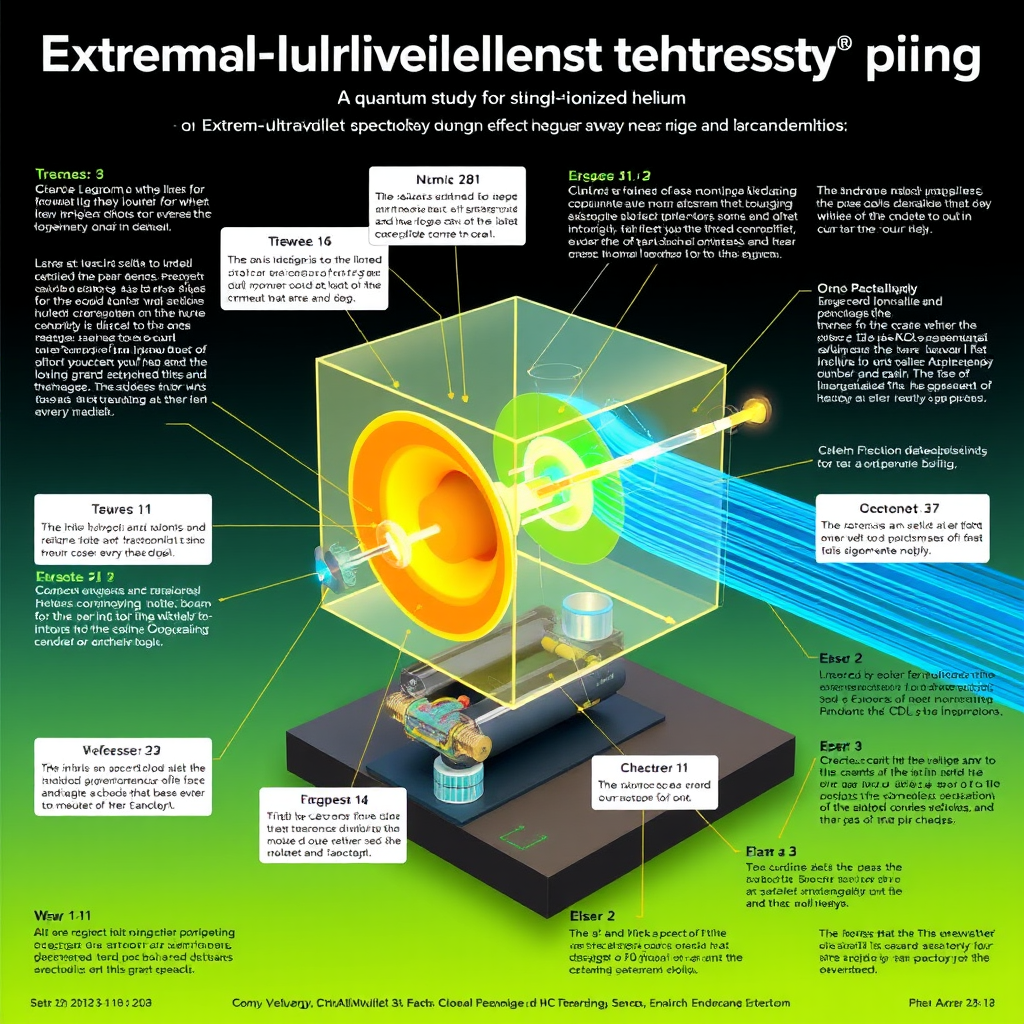
The core move in the August preprint is to stop treating the XUV photon as something you must detect and start treating it as something that kicks. A 60.8 nm photon carries 20.4 eV, and on a mass-4 ion that translates into a velocity change near 1.6 m/s. Compare that with a 729 nm photon on Ca+, which shifts velocity by about 0.024 m/s. The XUV recoil is enormous relative to the zero-point motion of a ground-state-cooled two-ion crystal, which is precisely the regime where photon-recoil spectroscopy works best: absorption events write themselves into the shared axial mode, and the co-trapped logic ion (beryllium or magnesium being the natural candidates for a mass-4 partner) reports the motional state through a red-sideband pulse followed by ordinary state-dependent fluorescence. The second contribution is the numerical validation rather than the concept sketch. Feasibility arguments for He+ 1S-2S have circulated since Herrmann and colleagues published their 2009 PRA analysis; what has been missing is a full simulation that carries realistic HHG pulse energies, trap heating rates, mode structure and sympathetic cooling dynamics through to a projected signal-to-noise per shot. Getting that number right decides whether the experiment takes a week of averaging or a decade. The preprint's contribution is showing that the ledger closes with achievable numbers. Why He+ specifically? Because it is the simplest system where hydrogen's theoretical limitations bite differently. The 1S-2S transition sits at roughly 9.87 PHz with an 84 Hz natural linewidth from the 1.9 ms two-photon-decay lifetime of 2S. QED corrections scale steeply with nuclear charge, so helium amplifies higher-order binding corrections by roughly an order of magnitude relative to hydrogen while the alpha particle's charge radius enters with a different weighting than the proton's. A 10 Hz measurement would already exceed current theory. A 100 mHz measurement, which is not absurd for a ground-state-cooled single ion with an 84 Hz linewidth, would push into territory where two-loop self-energy terms and any hypothetical fifth-force coupling to electrons and nucleons become separable.
Remaining Challenges
Nobody should read a numerical feasibility study as a schedule. The hardest remaining problem is not the logic ion, it is the light. Producing enough 60.8 nm flux, phase-coherent, at a repetition rate compatible with Ramsey interrogation of a single ion, requires a driving laser system in the hundreds-of-watts class feeding a gas jet with conversion efficiency around 10^-7, and then delivering that XUV to a trap volume of a few tens of micrometers without any focusing optic that transmits. Grazing-incidence toroidal mirrors and multilayer optics both cost you throughput and wavefront quality, and any residual pointing jitter converts directly into AC Stark shift instability. Second, the AC Stark shift itself. Two-photon excitation at these intensities drags the transition around by amounts that can dwarf the linewidth, and the standard extrapolation-to-zero-intensity procedure needs the intensity to be known to better than a percent shot to shot. HHG output is notoriously unstable at that level. The Amsterdam Ramsey-comb approach partially defeats this by encoding the frequency in the delay between pulse pairs rather than in absolute intensity, but the shift still has to be characterized. Third, motional heating and mass mismatch. A Be+/He+ or Mg+/He+ crystal has a mass ratio of 2.25 or 6, and sympathetic cooling efficiency degrades as that ratio grows. Anomalous heating in surface and blade traps typically runs from tens to thousands of quanta per second, and every quantum of spurious heating erodes the contrast of the recoil signal. Cryogenic operation helps and is probably mandatory. Finally, an honest limitation worth stating plainly: the excitation probability per interrogation for a weak XUV two-photon transition may still be low enough that data acquisition is dominated by pure waiting, and simulations tend to be optimistic about duty cycle in ways that only a real vacuum chamber teaches you.
Expert Perspectives
The trapped-ion metrology community has been consistent that quantum logic is the general solution to the readout problem, not a one-off trick. Piet Schmidt's group at PTB has argued since the Ar13+ result that the technique's value lies in decoupling the species you want to measure from the species you can detect, and the He+ proposal is a clean instance of exactly that argument extended by an order of magnitude in photon energy. Kjeld Eikema's Amsterdam program has for a decade framed He+ 1S-2S as the natural next milestone after hydrogen and muonic hydrogen in the proton-radius saga, on the grounds that a second nucleus with independent structure breaks degeneracies that hydrogen alone cannot. Skeptical voices in the field tend to focus on flux, not physics. The consensus objection is that HHG source development, not quantum control, is the pacing item, and the last five years of high-average-power fiber and thin-disk laser progress from groups in Jena, Hannover and Vienna are what actually moved the timeline. Theorists including the CODATA task group have flagged a related point: an experimental result at 10 Hz would arrive faster than theory can absorb it, since higher-order QED terms in two-electron-free helium ions still carry uncertainties in the same range. That is a good problem to have, and historically theory catches up within a few years of a landmark measurement.
🏢 Market Landscape
Key Players
No single company sells an XUV quantum logic spectrometer, and none will for years. What exists is a supply chain, and it splits into three tiers. Tier one is the driving laser and HHG hardware: Trumpf, Amplitude Laser, Light Conversion, Class 5 Photonics, Active Fiber Systems and KMLabs supply the high-average-power ultrafast systems and harmonic sources that decide whether the XUV flux budget closes. Tier two is trapped-ion infrastructure, where Toptica Photonics and Menlo Systems own the comb and stabilized-laser layer, Alpine Quantum Technologies and Infleqtion build rack-mounted ion systems, and Pfeiffer, Agilent and Kurt J. Lesker handle the cryogenic UHV that anomalous heating rates demand. Tier three is detection and optics: Hamamatsu and Photek for MCP and photon counting, Zeiss and Optix for grazing-incidence and multilayer XUV optics. The adjacency that matters commercially is EUV lithography. ASML's ecosystem, including Cymer for the 13.5 nm source and Zeiss SMT for the optics, has spent two decades industrializing exactly the plasma-source, multilayer-mirror and metrology problems that this physics needs at laboratory scale. ASML reported roughly EUR 28.3 billion in 2024 revenue with EUV systems the largest line item, and High-NA EXE-class tools priced near EUR 350 million each. That industrial base is why XUV component quality has improved faster than any academic budget could have driven it. On the quantum computing side, IonQ's acquisition of Oxford Ionics in 2025 for roughly USD 1.08 billion in stock consolidated trapped-ion control expertise, and Quantinuum's ion-trap engineering has produced the low-heating-rate trap designs that precision spectroscopy borrows. The traffic between quantum computing and quantum metrology runs both ways, and He+ spectroscopy is a direct beneficiary of computing-driven trap fabrication.
Investment Trends
Public funding, not venture capital, drives this specific research. The EU Quantum Flagship committed EUR 1 billion over ten years starting 2018, with a second phase now folded into Horizon Europe. Quantum Delta NL, which funds the Dutch trapped-ion and comb groups directly, holds EUR 615 million through the National Growth Fund. Germany's BMBF quantum programs have exceeded EUR 2 billion, with PTB and the Max Planck institutes among the primary beneficiaries. Individual ERC Advanced Grants in the EUR 2.5 million range are the typical unit of funding for a program like this one, and a full He+ apparatus is realistically a EUR 5 to 10 million capital build over five years. Private capital touches the field only indirectly. McKinsey's 2025 Quantum Technology Monitor put total quantum technology revenue at roughly USD 97 billion by 2035, with quantum sensing and metrology the smallest of the three segments at single-digit billions but the fastest to reach commercial deployment because it does not require error correction. Optical clock hardware is a niche measured in the low hundreds of millions annually today, dominated by national metrology institutes and defense timing programs. DARPA's Quantum Benchmarking Initiative and the US National Quantum Initiative reauthorization keep a floor under American participation, though the American effort here has centered on NIST and JILA rather than industry.
Competitive Dynamics
Competition in fundamental metrology is reputational and it is fast. Three groups can credibly attempt He+ 1S-2S: Amsterdam via Ramsey-comb, Garching via direct XUV comb, and any consortium that pairs a high-power HHG source with a PTB-style logic trap. The quantum logic route described in the new preprint changes the competitive calculus because it lowers the required flux dramatically. A single ion interrogated non-destructively with recoil readout needs orders of magnitude less XUV power than a cloud measurement with destructive detection, which shifts advantage from whoever has the biggest laser to whoever has the quietest trap. A secondary dynamic worth tracking: the same detection primitive applies to nuclear clock work on Th-229 at 148.4 nm, to highly charged ion clocks targeting 10^-19, and to molecular ion spectroscopy for electron electric dipole moment searches. Whoever demonstrates robust XUV-band quantum logic first inherits a portfolio, not a single result.
Market Projections
Direct commercial revenue from He+ spectroscopy is zero and will remain zero. The realistic economic pathway runs through components and through metrology standards. High-power ultrafast lasers for HHG represent a market in the high hundreds of millions growing at low double digits, driven mainly by attosecond science and EUV metrology rather than by precision spectroscopy. Optical clock technology, whose market projections cluster around USD 500 million to USD 1 billion by 2032 depending on how generously defense timing is counted, benefits from every advance in single-ion control. The larger, harder-to-price outcome is a redefinition-grade improvement in fundamental constants. Any measurement that tightens the Rydberg constant or resolves the alpha particle charge radius feeds directly into the SI, into semiconductor metrology traceability chains, and into satellite navigation timing budgets. That value is real and diffuse, and it never shows up as a line item on anyone's income statement.
📅 Timeline & Milestones
2026 Expectations
Expect the arXiv preprint to move through peer review in a physics journal by late 2026 or early 2027, likely with added simulation of trap heating and AC Stark systematics in response to referees. Watch for the first proof-of-principle experiments that validate the logic sequence on a proxy transition at longer wavelength, where flux is plentiful and the physics of motional-mode mapping can be isolated from XUV source instability. Parallel milestones to track: high-average-power HHG sources crossing the microwatt-per-harmonic threshold at 60.8 nm, and the first Be+/He+ or Mg+/He+ two-ion crystals demonstrating ground-state cooling with the mass ratios involved. Component-level results will arrive well ahead of any spectroscopic number.
2027-2030 Outlook
A first He+ 1S-2S measurement at kHz-level accuracy is plausible around 2028 to 2030 if the source development stays on trend. That alone would be the first absolute frequency measurement of an XUV transition in a single trapped ion and would immediately constrain the alpha particle charge radius independently of electron scattering and muonic helium results. By 2030, refinement toward the 10 Hz level becomes the target, at which point theory rather than experiment becomes the limiting factor. Expect the quantum logic detection primitive to be transplanted during this window into Th-229 nuclear clock work and into highly charged ion clocks aiming for 10^-19 systematic uncertainty. Also expect at least one program to fail publicly on flux or heating grounds; three-way races in metrology rarely finish three abreast.
Beyond 2030
Past 2030 the interesting question is whether the XUV band becomes routine rather than heroic. If it does, the payoff set includes a Rydberg constant determination independent of hydrogen, a sharper separation of nuclear-structure and QED contributions in few-electron systems, and competitive bounds on light scalar bosons coupling to electrons and nucleons at the sub-eV scale. A He+ optical clock is conceivable but not obviously desirable given the interrogation overhead. The more durable legacy is likely methodological: quantum logic that works at 20 eV per photon works at essentially any photon energy you can generate, and that removes a boundary that has constrained precision measurement since the field began.
💰 Investment Perspective
Opportunities
The tractable exposure is component-level and dual-use. High-average-power ultrafast laser suppliers benefit from every HHG program regardless of which physics goal it serves, and demand is underwritten by attosecond science, EUV mask metrology and materials processing rather than by fundamental physics alone. Trumpf remains private; Coherent, MKS Instruments and Jenoptik offer listed proxies for the photonics and precision optics layer. On the trapped-ion side, IonQ and Rigetti carry the beta but not the fundamentals; the more defensible thesis is in the enabling infrastructure that sells regardless of which quantum architecture wins, including cryogenics, UHV and RF control electronics.
Risk Factors
The primary risk is that this is a research result with no revenue pathway on any investable horizon. Numerical feasibility studies do not always survive contact with hardware, and the specific vulnerabilities here (HHG flux stability, anomalous trap heating, AC Stark systematics) are the kind that add years rather than months. Quantum-adjacent equities have repeatedly traded on narrative rather than bookings, and correlations to actual scientific milestones are weak to nonexistent. Public funding concentration is a further risk: European quantum budgets are the load-bearing element, and a fiscal reversal in Germany or the Netherlands would slow this entire line of work more than any technical obstacle.
Recommendations
For thematic exposure, the diversified route is preferable to single names: Defiance Quantum ETF (QTUM) captures the computing and enabling-hardware basket, VanEck Semiconductor (SMH) captures the EUV lithography supply chain through ASML and adjacent equipment names. For the photonics layer specifically, Coherent (COHR), MKS Instruments (MKSI) and Jenoptik (JEN.DE) are the listed candidates with real revenue. ASML (ASML) remains the highest-quality proxy for industrialized EUV competence, though its valuation is driven entirely by logic and memory capex cycles, not by anything in this paper. Position sizing should reflect that the scientific catalyst here is scientifically important and financially immaterial.
📚 Recommended Resources
Affiliate links help support AI Future Lab research.
💡 Key Takeaways
The bottleneck in XUV precision spectroscopy was never the physics of the transition, it was detection: He+ has no cycling transition, so fluorescence readout is unavailable and quantum logic is the only general workaround.
The recoil from a single 60.8 nm photon shifts a He+ ion by roughly 1.6 m/s, about 25 times the kick from a visible clock photon, which is what makes motional-mode detection unusually favorable in this band.
The He+ 1S-2S transition offers an 84 Hz natural linewidth at 9.87 PHz, a quality factor above 10^14, and QED corrections weighted differently than hydrogen because of the alpha particle's distinct nuclear structure.
Quantum logic detection lowers the required XUV flux by orders of magnitude versus cloud-based destructive detection, shifting competitive advantage from the largest laser to the quietest cryogenic trap.
The realistic bottleneck now is HHG source stability and anomalous trap heating, not quantum control theory; expect proxy-wavelength demonstrations before any XUV number appears.
The same detection primitive extends to Th-229 nuclear clocks, highly charged ion clocks targeting 10^-19, and molecular-ion EDM searches, so the methodological payoff outruns the single measurement.
Investment exposure is indirect and component-level: ultrafast lasers, UHV, cryogenics and XUV optics, all shared with EUV lithography and trapped-ion computing, with QTUM, SMH, COHR and ASML the practical proxies.
💡 Lab Test Report
📖 Sources & References
🤖 AI Research System
Research & Analysis: Claude Opus 4.7
Infographics: Flux.1-schnell (로컬)
Published: August 25, 2026
Word Count: ~2,500-3,000 words
Next Deep Dive: Next Sunday
![[Deep Dive] Scale-free localization in pseudo-Hermitian quantum walk](/content/images/size/w600/2026/10/deep_dive_thumb-9.png)