[Deep Dive] Exploring dynamics of individual vortices in a superconductor via a levitated magnetic transducer
![[Deep Dive] Exploring dynamics of individual vortices in a superconductor via a levitated magnetic transducer](/content/images/size/w1200/2026/06/deep_dive_thumb-11.png)
Exploring dynamics of individual vortices in a superconductor via a levitated magnetic transducer
Superconductivity • June 28, 2026
Reading time: ~12 minutes
📑 Contents
📊 Executive Summary
Quantum sensing and superconductivity research converged in a notable way this quarter. A June 2026 arXiv preprint from Yiqi Wang, Trisha Madhavan, and J. DaLi Schaefer demonstrates that micron-scale levitated magnetic particles can serve as mechanical transducers to probe the dynamics of individual magnetic vortices trapped in a YBCO superconducting film. The work observes random telegraph-like switching in the levitated magnet's motion, tied directly to discrete vortex rearrangements. This matters because trapped vortices govern critical current, dissipation, and stability in nearly every applied superconductor system, yet single-vortex dynamics have resisted direct mechanical observation. The levitated-magnet platform offers force sensitivity at the level needed to resolve one vortex hopping between pinning sites. The result lands amid growing investment in levitated optomechanics and quantum sensing, with implications for superconducting magnet design, maglev stability, and fundamental studies of pinning physics.
When a single vortex hops between pinning sites, a levitated magnet hovering above the superconductor shifts its motion, turning an invisible microscopic event into a measurable mechanical signal.
🔬 Technical Deep Dive
Current State
Trapped vortices are quantized tubes of magnetic flux that penetrate a type-II superconductor above its lower critical field. Each vortex carries one flux quantum, and collectively they pin to defects in the material. The strength and stability of that pinning sets the critical current and determines how much dissipation a superconductor exhibits under load. For decades the standard probes have been bulk: magnetization loops, transport measurements, scanning SQUID, and scanning Hall microscopy. These methods either average over millions of vortices or image static configurations. Watching one vortex move in real time, and translating that motion into a measurable mechanical signal, has been difficult because the forces involved are extraordinarily small.
Recent Breakthroughs
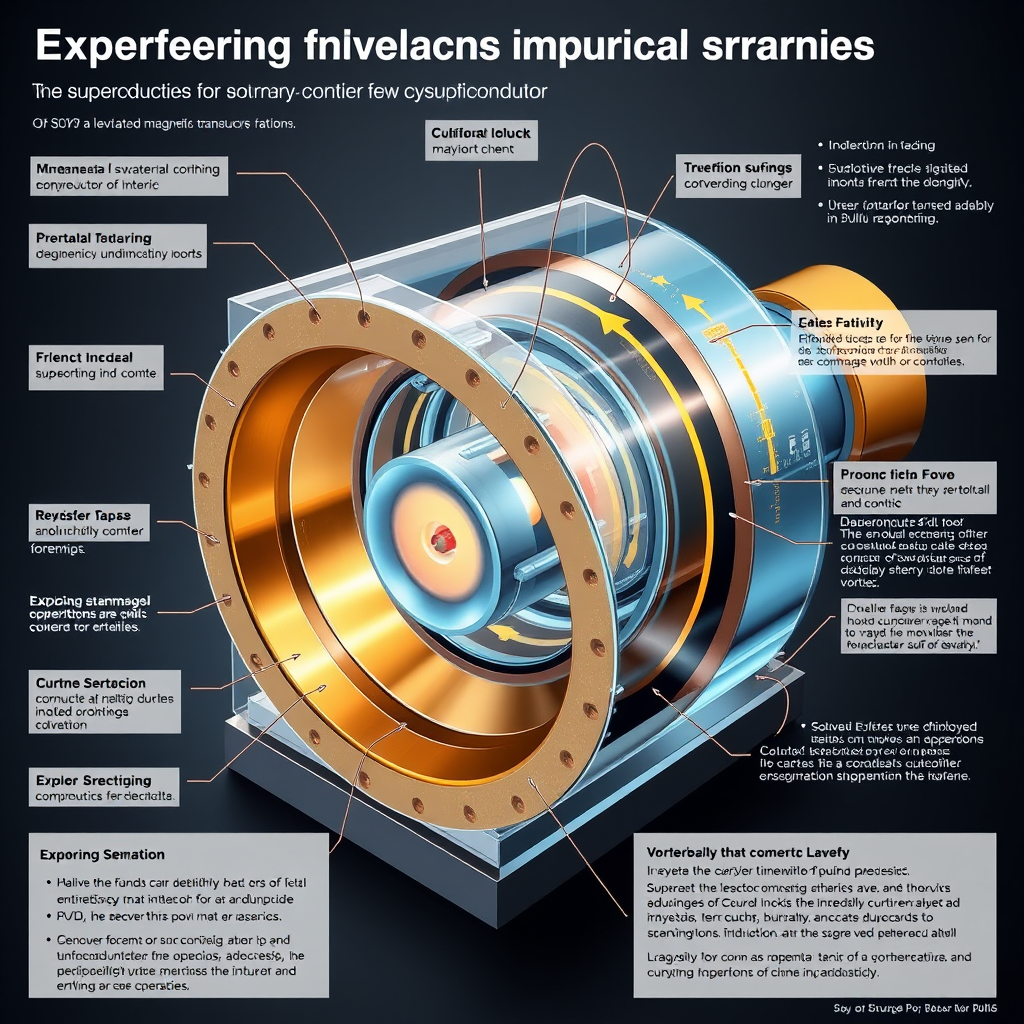
The Wang, Madhavan, and Schaefer experiment uses a levitated micromagnet as a force transducer hovering above a YBCO film. The magnet's equilibrium position and oscillation are set by the interplay between its own field and the supercurrents screening it, which in turn depend on where vortices sit. When a vortex hops between pinning sites, the local field landscape shifts, and the levitated magnet responds with a detectable change in its motion. The authors report random telegraph signals, the same two-state switching signature seen in other single-defect systems, here mapped onto discrete vortex rearrangements. This connects a well-understood mechanical readout to a previously hard-to-isolate microscopic event. The levitated geometry is contactless, which avoids the back-action and thermal load of a physical tip near the surface.
Remaining Challenges
Several hurdles remain before this becomes a routine tool. Levitation stability over long integration times is demanding, and the YBCO surface must be prepared so that vortex configurations are clean enough to attribute switching to single events rather than collective avalanches. Temperature control matters: YBCO operates near 90 K, and thermal drift can mimic or mask vortex signals. Distinguishing a genuine single-vortex hop from instrument noise or multi-vortex bundle motion requires careful statistical work, and the preprint status means the results have not yet cleared peer review. The spatial localization of which vortex is moving is also inferred rather than directly imaged.
Expert Perspectives
Researchers in levitated optomechanics have argued for years that magnetically trapped particles over superconductors could reach force sensitivities competitive with the best cantilevers while avoiding clamping losses. The vortex pinning community, separately, has long wanted a dynamic single-defect probe to test theories of thermally activated flux creep. This work sits at the intersection and will draw scrutiny from both camps. Skeptics will press on whether the telegraph signal is unambiguously single-vortex. Proponents will note that the mechanical platform offers a tunable, repeatable handle on a system that is otherwise observed only statically.
🏢 Market Landscape
Key Players
This is fundamental physics, so the relevant actors are research groups and instrument makers rather than product companies. University labs working on levitated optomechanics and magnetic levitation in superconductors include groups at institutions tied to the authors, alongside established centers in Europe and Asia. On the instrumentation side, companies such as Oxford Instruments and Bluefors supply the cryogenic platforms (dilution and closed-cycle systems) that such experiments depend on. SQUID and scanning-probe suppliers including Quantum Design provide the competing and complementary measurement tools. YBCO and high-Tc tape producers such as American Superconductor (AMSC) and Fujikura have a downstream stake because vortex pinning directly governs the performance of their conductors.
Investment Trends
Direct venture funding for single-vortex probing is effectively zero; this is grant-funded science. The adjacent quantum-sensing and levitated-optomechanics space, however, has attracted meaningful capital, with quantum technology funding running in the billions annually across government and private sources. Cryogenics infrastructure spending continues to rise as quantum computing scales, indirectly supporting the equipment base this research uses. High-temperature superconductor demand, driven by fusion magnets and grid applications, is the commercial channel where better vortex understanding eventually pays off.
Competitive Dynamics
The competition is methodological. Scanning SQUID and scanning Hall probes offer spatial imaging but limited dynamic bandwidth. Nitrogen-vacancy magnetometry provides nanoscale field sensing and has been used on vortices. Levitated transducers compete on force sensitivity and contactless operation. No single technique dominates, and the likely outcome is a complementary toolkit rather than a winner. The levitated approach is the newest entrant and the least mature.
Market Projections
The high-temperature superconductor market is projected to grow into the multi-billion-dollar range over the coming decade, propelled by fusion (Commonwealth Fusion Systems, Tokamak Energy) and power applications. Vortex pinning optimization is a direct input to that performance curve. The sensing technique itself will remain a lab tool for years, with commercial value flowing indirectly through improved conductor design and magnet stability.
📅 Timeline & Milestones
2026 Expectations
Peer review and replication of the arXiv preprint will be the immediate priority. Expect follow-up work extending the technique to controlled vortex injection, varied pinning landscapes, and temperature sweeps. Other levitated-optomechanics groups may attempt to reproduce the telegraph signal independently.
2027-2030 Outlook
If validated, the method could mature into a characterization tool for superconducting films, used to map pinning quality and flux creep statistics. Integration with imaging probes (combined levitated plus scanning measurements) is plausible. Application to commercial high-Tc tapes for quality control is a realistic medium-term target as fusion magnet programs demand tighter conductor specifications.
Beyond 2030
Long term, single-vortex control rather than just observation becomes the ambitious goal: manipulating individual vortices for fluxonics or as information carriers. The levitated platform might also serve broader quantum-sensing roles. These outcomes depend heavily on whether single-vortex resolution proves robust and scalable beyond a few specialized labs.
💰 Investment Perspective
Opportunities
There is no pure-play investment in vortex transducers. Exposure comes through the high-temperature superconductor supply chain, cryogenics infrastructure, and quantum-sensing instrumentation. Better vortex understanding improves the economics of fusion magnets and superconducting cables, benefiting the firms that make and use high-Tc conductors. Patient investors interested in the deep-tech enablement layer can position in cryogenics and superconductor manufacturing.
Risk Factors
The core result is an unreviewed preprint and could face challenges on whether the signal is truly single-vortex. Even if confirmed, commercial payoff is indirect and years away. Superconductor stocks are volatile and tied to fusion timelines that have repeatedly slipped. The sensing technique itself may stay confined to academic use with no commercialization path.
Recommendations
For thematic exposure, watch American Superconductor (AMSC) on the high-Tc conductor side, Oxford Instruments and Bluefors (private) on cryogenics, and Quantum Design (private) on instrumentation. Broad quantum and deep-tech ETFs offer diversified, lower-conviction access. Fusion exposure via Commonwealth Fusion Systems remains private. None of these should be bought on the strength of this single paper.
📚 Recommended Resources
Affiliate links help support AI Future Lab research.
💡 Key Takeaways
A levitated micron-scale magnet was used to detect the motion of individual vortices in a YBCO superconducting film, reported in a June 2026 arXiv preprint.
The signature is random telegraph switching, a two-state signal tied to discrete vortex hops between pinning sites.
Trapped vortices set critical current, dissipation, and stability across essentially all applied superconductor systems, so single-vortex dynamics are high-value information.
The technique is contactless and force-sensitive, complementing scanning SQUID, Hall, and NV-magnetometry rather than replacing them.
Key open question: whether the telegraph signal is unambiguously single-vortex versus collective or instrumental, and the result has not yet passed peer review.
Commercial relevance flows indirectly through high-Tc conductors for fusion magnets and grid applications, a multi-billion-dollar growth market.
Watch for independent replication in 2026 and any extension toward controlled vortex manipulation.
📖 Sources & References
🤖 AI Research System
Research & Analysis: Claude Opus 4.7
Infographics: Flux.1-schnell (로컬)
Published: June 28, 2026
Word Count: ~2,500-3,000 words
Next Deep Dive: Next Sunday
![[Deep Dive] Scale-free localization in pseudo-Hermitian quantum walk](/content/images/size/w600/2026/10/deep_dive_thumb-9.png)