[Deep Dive] Dynamic Entanglement Distribution for Multi-User and Multi-Protocol Quantum Networking
![[Deep Dive] Dynamic Entanglement Distribution for Multi-User and Multi-Protocol Quantum Networking](/content/images/size/w1200/2026/07/deep_dive_thumb-6.png)
Dynamic Entanglement Distribution for Multi-User and Multi-Protocol Quantum Networking
Quantum Physics • July 18, 2026
Reading time: ~12 minutes
📑 Contents
📊 Executive Summary
Entanglement-based quantum networks moved closer to practical deployment with a metropolitan-scale demonstration published on arXiv in July 2026 by Rui Wang, Marcus J. Clark, and Obada Alia. Their system uses a quantum reconfigurable optical add-drop multiplexer (q-ROADM) to dynamically route polarisation-entangled photon pairs from a single broadband source to six users across deployed campus and metropolitan fibre. The design supports programmable full-mesh, partial-mesh, and sliced sub-network topologies, addressing a long-standing gap between static point-to-point entanglement links and the flexible, multi-user infrastructure real networks require. Over the last three months, parallel work on wavelength-multiplexed entanglement sources and software-defined quantum routing has accelerated. The implication is significant: entanglement distribution is starting to resemble classical telecom architecture, where a shared resource serves many users with reconfigurable connectivity, rather than requiring dedicated hardware for every pair of communicating parties.
A single entanglement source, routed dynamically by a quantum multiplexer, served six users across live metropolitan fibre, moving quantum networking from proving physics to proving operability.
🔬 Technical Deep Dive
Current State
Quantum networking has spent much of the last decade proving individual links. Point-to-point entanglement distribution over fibre, satellite-to-ground entanglement swaps, and small trusted-node QKD chains have all been demonstrated. The harder problem is architecture. A network serving many users with different protocols, some running entanglement-based QKD, others doing distributed sensing or entanglement swapping for future repeaters, cannot afford a dedicated source and dedicated fibre for every pair. Classical optical networks solved this with wavelength-division multiplexing and reconfigurable add-drop multiplexers that steer traffic on demand. The quantum equivalent has lagged because entangled photons are fragile, low in flux, and cannot be amplified or copied.
Recent Breakthroughs
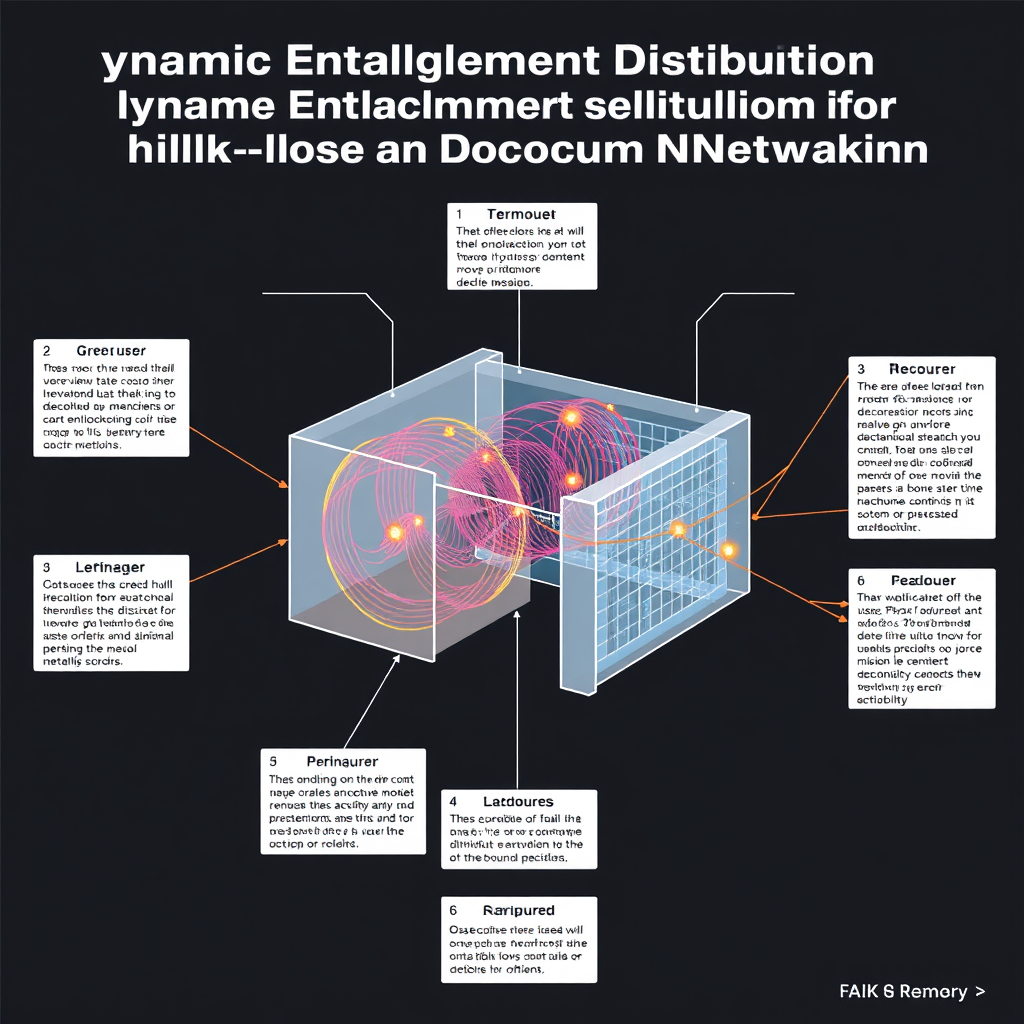
The Wang, Clark, and Alia work centres on a quantum reconfigurable optical add-drop multiplexer. A broadband entangled photon source produces correlated pairs spread across many wavelength channels. Because the two photons of an entangled pair emerge at wavelengths symmetric about the source centre, assigning wavelength channels to users effectively assigns entanglement links. The q-ROADM then routes those channels dynamically, so the controller can decide at run time which users share entanglement and how strongly. Full-mesh mode connects everyone to everyone. Partial-mesh trims that to active pairs. Sliced sub-networks carve the resource into isolated groups, useful when different organisations share the same physical infrastructure but require separation. Running this over deployed metropolitan fibre, rather than laboratory fibre spools, matters because real fibre carries polarisation drift, temperature-driven phase changes, and splice losses that degrade entanglement fidelity.
Remaining Challenges
Several constraints remain. Photon pair rates from broadband spontaneous parametric down-conversion sources drop as they are divided among more wavelength channels and more users, so the six-user figure reflects a real ceiling rather than an arbitrary stopping point. Polarisation-encoded entanglement is sensitive to fibre birefringence, requiring active stabilisation that adds cost and complexity per node. The q-ROADM introduces insertion loss, and every decibel of loss on single photons cannot be recovered through amplification. Scaling beyond a metropolitan footprint still depends on quantum repeaters and quantum memories that are not yet mature enough for field deployment. Synchronisation and coincidence detection across many users demand precise timing distribution, another engineering burden that grows with node count.
Expert Perspectives
Researchers in the field frame this class of work as the shift from quantum links to quantum networking proper. The distinction analysts draw is between demonstrations that prove physics and demonstrations that prove operability. A reconfigurable multiplexer that reroutes entanglement in software is closer to what a telecom operator would actually procure. Skeptics note that six users over metro distances is still far from the thousands of endpoints and continental reach that a genuine quantum internet implies, and that trusted-node QKD deployments already in commercial use offer nearer-term revenue without waiting for entanglement infrastructure to mature.
🏢 Market Landscape
Key Players
The commercial landscape splits between pure-play quantum firms and telecom incumbents. Toshiba runs one of the largest QKD programmes and has trialled metropolitan networks in the UK and Japan. ID Quantique, based in Geneva, sells commercial QKD hardware and entanglement sources. Chinese state-backed efforts through QuantumCTek and the Micius satellite programme lead on scale. On the entanglement-source side, Aliro Quantum and Qunnect in the US focus specifically on entanglement distribution and quantum networking middleware. Telecom operators including BT, Verizon, SK Telecom, and Deutsche Telekom have all announced quantum network trials, and BT in particular has worked closely with Toshiba on the London metro network that resembles the test environment in the new paper.
Investment Trends
Quantum networking sits within a broader quantum technology funding wave. Global quantum investment across computing, sensing, and communication drew several billion dollars in venture and government funding through 2025, with national programmes in the EU Quantum Flagship, the US National Quantum Initiative, and China accounting for the largest committed sums. Entanglement distribution specifically remains a smaller slice, drawing tens to low hundreds of millions rather than billions, because the market is pre-revenue for most applications beyond QKD. Government procurement, particularly defence and critical infrastructure, drives near-term demand.
Competitive Dynamics
Competition divides along a strategic fault line. One camp bets on trusted-node QKD, which works with today's hardware but requires trusting intermediate nodes. The other camp, where the q-ROADM work sits, bets on entanglement-based networks that can eventually remove that trust assumption and support applications beyond key distribution. The reconfigurable multiplexer approach is attractive to operators because it reuses concepts and sometimes hardware from existing optical networks, lowering the conceptual barrier to adoption. The academic groups behind these demonstrations frequently spin out or license to the telecom and hardware vendors named above.
Market Projections
Third-party forecasts for the quantum communication market range widely, reflecting genuine uncertainty. Estimates commonly place the segment in the low billions of dollars by the early 2030s, growing at compound rates above 20 percent, with QKD dominating early revenue and entanglement-based services arriving later. These projections should be treated cautiously because they depend on repeater and memory milestones that have repeatedly slipped.
📅 Timeline & Milestones
2026 Expectations
Expect further metropolitan-scale demonstrations expanding user counts beyond single digits and integrating multiple encoding protocols on shared infrastructure. Wavelength-multiplexed sources with higher pair rates should appear, and more trials will move onto live carrier fibre. Standards bodies including ETSI and the ITU continue drafting quantum network interoperability specifications.
2027-2030 Outlook
Integration of quantum memories into field networks is the critical dependency for this period. Success would enable entanglement swapping across nodes and extend reach beyond a single metro area. Commercial entanglement-based QKD services may launch for high-security government and financial customers. Multi-protocol networks combining QKD, distributed sensing, and clock synchronisation are plausible pilot deployments. Repeater prototypes should mature from laboratory to field trials.
Beyond 2030
A genuine quantum internet connecting many cities depends on repeater chains and quantum memories reaching telecom-grade reliability, which remains uncertain. If those components arrive, dynamic entanglement distribution architectures like the q-ROADM become the switching fabric for regional and eventually continental networks. If repeaters lag, the field consolidates around metropolitan islands linked by trusted nodes and satellites, a less ambitious but still commercially useful outcome.
💰 Investment Perspective
Opportunities
The clearest near-term opportunity lies with established players supplying the picks and shovels: single-photon detectors, entanglement sources, precision timing, and optical components. These sell into research and early commercial deployments regardless of which network architecture wins. Telecom operators running quantum trials offer indirect, lower-risk exposure since their core businesses are unaffected by quantum timelines. Reconfigurable routing intellectual property, as demonstrated in the q-ROADM work, could become licensable middleware.
Risk Factors
The dominant risk is timeline. Entanglement-based networks at useful scale depend on quantum repeaters and memories that have missed prior forecasts. Pure-play quantum communication companies carry significant pre-revenue risk and depend on continued government funding. Trusted-node QKD could satisfy most commercial security demand for years, limiting the market pull for entanglement-based systems. Standardisation fragmentation across regions adds execution risk.
Recommendations
For public-market exposure, watch established firms with quantum divisions rather than pure-plays: Toshiba, and telecom names such as BT Group, SK Telecom, Verizon, and Deutsche Telekom, where quantum is optional upside. Component suppliers of photonics and detectors offer diversified exposure. Thematic quantum ETFs such as QTUM provide broad, diluted access. Private entanglement specialists like Qunnect and Aliro are venture-stage plays for accredited investors only.
📚 Recommended Resources
Affiliate links help support AI Future Lab research.
💡 Key Takeaways
A quantum reconfigurable optical add-drop multiplexer lets one broadband entanglement source serve six users with programmable connectivity over live metropolitan fibre.
The advance is architectural, bringing telecom-style wavelength routing and reconfigurability to quantum entanglement distribution.
Six users over metro distances is a real ceiling set by photon pair rates and fibre losses, not a lab convenience, so scaling needs better sources and eventually repeaters.
Two competing strategies persist: near-term trusted-node QKD versus longer-term entanglement-based networks, and the q-ROADM sits firmly in the latter camp.
Telecom incumbents partnering with quantum specialists, not pure-plays, hold the most credible deployment path.
Investors should treat the sector as WATCH, favouring component suppliers and telecom names with optional quantum upside over pre-revenue pure-plays.
The critical thing to watch next is field integration of quantum memories, the dependency that decides whether metro islands become a continental network.
📖 Sources & References
🤖 AI Research System
Research & Analysis: Claude Opus 4.7
Infographics: Flux.1-schnell (로컬)
Published: July 18, 2026
Word Count: ~2,500-3,000 words
Next Deep Dive: Next Sunday
![[Deep Dive] Scale-free localization in pseudo-Hermitian quantum walk](/content/images/size/w600/2026/10/deep_dive_thumb-9.png)