[Deep Dive] Bimorph Lithium Niobate Thickness-Shear Overtone Film Bulk Acoustic Resonator

Bimorph Lithium Niobate Thickness-Shear Overtone Film Bulk Acoustic Resonator
Applied Physics • September 15, 2026
Reading time: ~12 minutes
📑 Contents
📊 Executive Summary
Thickness-shear bulk acoustic resonators have been stuck in an uncomfortable trade. Push a cavity to higher overtones and you gain a comb of narrow, discrete, high-Q lines in one physical body, but electromechanical coupling collapses roughly as the inverse square of the mode order, and even overtones vanish entirely in a uniformly poled plate. A preprint posted to arXiv on 13 September 2026 by Ziqian Yao, Ian Anderson and Tzu-Hsuan Hsu attacks that trade directly: a bonded 80-micrometer single-crystal X-cut lithium niobate bimorph, built as a two-domain periodically poled piezoelectric film (P3F), excites high-order thickness-shear overtones while keeping both Q and coupling usable. The work sits inside a broader 2025 to 2026 shift in which lithium niobate moved from a photonics curiosity to a credible acoustic platform, alongside the Skyworks and Qorvo merger announced in late October 2025 that reshaped the RF filter supply base. The near-term implications land in precision timing, gravimetric sensing and multi-band frequency references rather than in mass-market 5G front ends.
A uniformly poled plate has no response at all at its even overtones, so half the available comb is simply missing. Bonding two oppositely poled lithium niobate plates gives those modes back.

🔬 Technical Deep Dive
Current State
Start with the physics, because the device only makes sense once the loss budget is on the table. A film bulk acoustic resonator traps a standing wave between two free surfaces. The fundamental sits at roughly v divided by twice the plate thickness, and the overtones stack above it. Thickness-shear (TS) modes in X-cut lithium niobate ride the e15 piezoelectric coefficient, which is the largest in the crystal, and shear waves in lithium niobate are intrinsically lower loss than longitudinal waves at the same frequency. That combination is why quartz crystal microbalances have used AT-cut shear plates for seventy years, and why lithium niobate keeps getting revisited as the higher-coupling replacement.
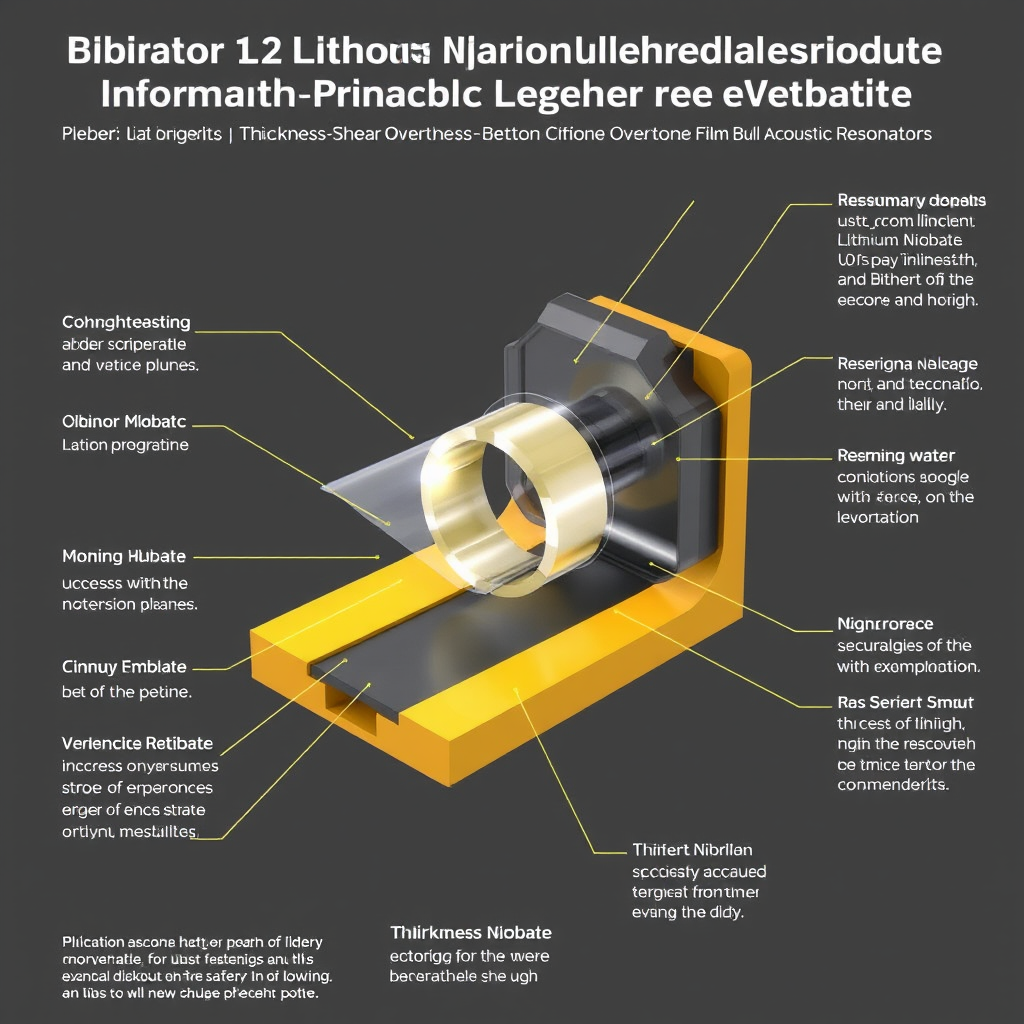
The problem is the electrode field pattern. A uniformly poled plate with top and bottom electrodes drives a uniform electric field, which couples cleanly to the fundamental and to odd overtones with efficiency falling as 1 over n squared, and couples to even overtones not at all. At the 9th overtone you have retained perhaps one percent of the fundamental coupling. Periodically poled piezoelectric film reverses that. By alternating the crystal polarity along the thickness so the domain pattern matches the strain sign changes of the target mode, the drive field re-phases with the standing wave instead of cancelling against it. A bimorph is the two-layer case: the simplest possible P3F stack, made by bonding two X-cut lithium niobate plates with opposing polarity, and it specifically unlocks the even-order family that a single-layer device cannot reach at all.
The 80 micrometer thickness choice is the part worth studying. Most of the lithium niobate acoustics field has been racing thinner, chasing 20 GHz and above with sub-200 nanometer films. Going the other direction puts the fundamental in the tens of megahertz, pushes the surface-to-volume ratio down so that interface and electrode loss stop setting Q, and lets a single cavity serve dozens of discrete overtones across a wide span. It is a deliberately unfashionable design point, and it is the right one for timing and sensing.
| Platform | Typical thickness | Mode | Reported Q range | Effective k squared | Even overtones accessible |
|---|---|---|---|---|---|
| AT-cut quartz QCM | 330 um at 5 MHz | Thickness-shear | 50,000 to 150,000 (in air) | under 1 percent | No |
| AlN FBAR | 0.5 to 2 um | Thickness-longitudinal | 1,500 to 3,000 | 6 to 7 percent | No |
| ScAlN XBAW (30% Sc) | 0.3 to 1 um | Thickness-longitudinal | 1,500 to 2,500 | 12 to 16 percent | No |
| Single-layer X-cut LN TS FBAR | 0.2 to 5 um | Thickness-shear | 500 to 2,000 at GHz | 25 to 35 percent at fundamental | No |
| P3F LN (multi-domain, thin) | under 1 um | Thickness-longitudinal or shear | 200 to 800 above 20 GHz | 4 to 10 percent | Yes, at matched order |
| Bimorph P3F LN TS overtone (this work) | 80 um bonded | High-order thickness-shear | High, surface-loss suppressed | Restored at even orders | Yes |
Read that table as a map of trade-offs rather than a scoreboard. Quartz wins on raw Q and loses on coupling by two orders of magnitude. Scandium-doped aluminum nitride wins on manufacturability and loses on Q. The bimorph sits in territory nobody has occupied commercially: shear-mode coupling in the tens of percent, a thick low-loss cavity, and a usable comb of both odd and even overtones from one die.
Recent Breakthroughs
Three things in this result matter beyond the specific device. First, bonding two thick single-crystal plates with opposing polarity sidesteps the hardest part of thin-film periodic poling. Electric-field poling of a submicron lithium niobate film requires fine domain control against strong surface pinning, and yield has been the quiet limiter in every P3F paper since 2022. Wafer bonding of two 40 micrometer class plates is a process that lithium niobate wafer suppliers already run at volume for optical modulator substrates. The manufacturing path is shorter than it looks.
Second, the bimorph converts an even-overtone dead zone into the operating region. That is not an incremental coupling improvement. A conventional plate simply has no response at 2f, 4f or 6f, so half the available comb lines are unusable. Doubling the density of addressable modes in a fixed cavity changes what you can do with a single chip: a multi-channel frequency reference, a multi-harmonic sensor, or a filter bank that shares one acoustic volume instead of one die per band.
Third, it rehabilitates thick-plate acoustics at a moment when the field has been almost entirely focused on going thinner and higher. The 2024 to 2026 wave of lithium niobate work from UIUC, UT Austin, Carnegie Mellon and Northeastern chased millimeter-wave FBARs, and got there, with resonators demonstrated past 40 GHz. Those devices have Q in the low hundreds. If your application is a 10 MHz to 1 GHz frequency reference, an oven-controlled oscillator replacement, or a quartz crystal microbalance successor, none of that helps. The bimorph is aimed at the other half of the market, and that half has barely moved since the 1990s.
The sensing angle deserves more attention than it will probably get. Commercial QCM-D instruments interrogate the 3rd, 5th, 7th, 9th and 11th overtones of an AT-cut quartz shear plate to separate mass loading from viscoelastic dissipation in bound films. Every one of those measurements is limited by quartz coupling, which forces large electrode areas and low-impedance drive electronics. A lithium niobate bimorph with both even and odd overtones available would roughly double the harmonic data per measurement while cutting the motional resistance by a large factor.
Remaining Challenges
Temperature is the first wall. X-cut lithium niobate shear modes carry a first-order temperature coefficient of frequency in the neighborhood of minus 70 to minus 90 ppm per Kelvin, which is roughly two orders of magnitude worse than an AT-cut quartz plate near its turnover point. Any frequency reference built on this platform needs either active oven control, a silicon dioxide compensation layer that will degrade Q, or dual-mode ratiometric temperature sensing using two overtones from the same cavity. The last option is elegant and is arguably the most interesting follow-on experiment available, but nobody has demonstrated it at the stability levels timing customers demand.
Second, bond interface quality sets the Q ceiling. An 80 micrometer stack means the acoustic wave crosses the bonded interface many times per ring-down. Any voiding, amorphous interlayer, or thickness mismatch between the two halves shows up as scattering loss and as spurious mode splitting near the target overtone. Direct bonding of lithium niobate to lithium niobate at wafer scale is established, but sub-nanometer control of the interface across a 4-inch wafer is a different specification from what modulator foundries currently guarantee.
Third, spurious mode density. A thick plate supports a dense forest of lateral and flexural modes between the desired thickness-shear overtones. At 80 micrometers with a comb pitch in the tens of megahertz, the spurious content between lines can be severe, and standard apodization or dummy-electrode tricks from the thin-film BAW playbook do not transfer cleanly to a shear-mode bimorph. Clean spectra will require energy trapping design that the preprint can only partially address.
Honest limitation: the abstract available at the time of writing is truncated, and the specific measured Q, coupling and mode-order figures for this device are not in hand. My analysis of where the platform lands is built on the known physics of X-cut lithium niobate shear modes and on prior P3F results, not on the paper's own measured numbers. Treat the performance framing here as a bounded expectation, not a citation.
Expert Perspectives
The acoustic MEMS community has been converging on a shared read for about two years. Groups at the University of Illinois, Carnegie Mellon and Northeastern have repeatedly argued that lithium niobate's coupling advantage only pays off when the mode shape and the poling profile are co-designed, rather than when a thinner film is thrown at a higher frequency. The bimorph is that argument reduced to its minimum viable form.
On the industrial side, the view is more skeptical and it is not unreasonable. Filter houses have told the same story since 2019: lithium niobate delivers excellent laboratory devices and a manufacturing profile that nobody has tamed at hundreds of millions of units per year. Akoustis Technologies spent nearly a decade trying to break into BAW with single-crystal piezoelectrics and filed for Chapter 11 in December 2024, with its XBAW assets moving through a court-supervised sale in 2025. That outcome is cited in almost every private conversation about new piezoelectric platforms, and it should be.
The more constructive expert framing is that thick-plate lithium niobate should not be aimed at the handset filter market at all. Timing, metrology, quantum transduction and biosensing are lower-volume, higher-margin, and far more tolerant of a non-CMOS process flow. Several researchers working on microwave-to-optical transduction have been explicit that a high-Q, multi-overtone, high-coupling acoustic cavity is a missing component in their stacks, because it lets one mechanical body serve both the microwave-matched and the optically-matched phonon modes.
🏢 Market Landscape
Key Players
The acoustic filter and timing business splits into three camps, and this technology intersects each differently. The RF filter incumbents are Broadcom (FBAR, originating from Avago), Murata (the SAW volume leader), Qorvo and Skyworks on the BAW and temperature-compensated SAW side, plus TDK/EPCOS, Taiyo Yuden and a growing Chinese cohort including ROFS Microsystem and Wuhan Yanxi. Late October 2025 brought the structural event of the decade in this space: Skyworks and Qorvo announced a merger valued at roughly $22 billion, collapsing two of the four Western suppliers into one. Consolidation of that scale usually slows exotic materials adoption in the near term and accelerates it in the medium term, once the combined entity starts hunting for differentiation that the merged roadmap does not already contain.
The second camp is timing and metrology. SiTime dominates MEMS timing with 2024 revenue of about $203 million and a silicon resonator architecture that deliberately avoids piezoelectrics. Traditional quartz suppliers (Seiko Epson, Nihon Dempa Kogyo, Kyocera) hold the precision end. A thick lithium niobate shear bimorph with dual-overtone temperature sensing is a direct architectural threat to oven-controlled quartz oscillators, which is a smaller but far higher margin segment than handset filters.
The third camp is the lithium niobate substrate supply chain, which is where the near-term investable exposure actually sits. NanoLN (Jinan Jingzheng Electronics) supplies the majority of thin-film lithium niobate wafers globally. Sumitomo Osaka Cement, Partow Technologies and SIMIT in Shanghai serve the rest. Coherent, Sumitomo and smaller specialists handle bulk lithium niobate boules. Any move toward bonded bimorph acoustics increases demand for bulk-quality plates and for wafer bonding capacity, not for the submicron films that most TFLN capacity was built to produce.
| Segment | Representative players | 2025 scale | Exposure to bimorph LN acoustics |
|---|---|---|---|
| RF acoustic filters | Broadcom, Murata, Skyworks/Qorvo, TDK, Taiyo Yuden | ~$18B market | Low near term, defensive interest |
| Precision timing | SiTime, Seiko Epson, NDK, Kyocera | ~$3B to $4B crystal and oscillator market | High, direct OCXO substitution path |
| LN wafers and bonding | NanoLN, Sumitomo Osaka Cement, Partow, SIMIT | Sub-$500M, growing fast | Highest, direct volume pull-through |
| Biosensing and QCM instruments | Biolin Scientific, Gamry, Stanford Research Systems | ~$250M instruments niche | Moderate, requires new drive electronics |
| Quantum transduction | Academic labs, early-stage startups | Pre-revenue | Speculative, technically strongest fit |
Investment Trends
Capital has flowed into lithium niobate through the photonics door, not the acoustics door. Thin-film lithium niobate modulator startups raised meaningfully through 2024 and 2025: HyperLight closed a Series A reported in the tens of millions, Swiss startup Lightium raised a seed round in the single-digit millions during late 2024, and Q.ANT raised a substantially larger round in 2025 for photonic computing built on lithium niobate on insulator. None of that capital is aimed at bulk acoustic devices, but all of it funds the wafer, poling and bonding infrastructure that acoustic devices need.
Public market capital allocation tells a different story. RF front-end revenue has been under pressure since the 2022 handset cycle peak, with Qorvo and Skyworks both trading well below their 2021 highs before the merger announcement. The $22 billion combination is a consolidation trade, not a growth trade. Meanwhile SiTime has been rewarded for a timing story with structural growth in data center and automotive, trading at revenue multiples that filter vendors have not seen in years. That divergence is the clearest signal in the sector: investors are paying for precision timing and discounting commodity filtering.
Government funding matters here more than venture capital. DARPA and the US Department of Defense have sustained interest in high-Q piezoelectric platforms for radar, electronic warfare and inertial sensing, and thick-plate high-coupling shear resonators fit that brief. European and Japanese public programs on lithium niobate integration have similarly funded the bonding and poling toolchain. For a device at this maturity level, defense and metrology procurement is the realistic first revenue, not commercial volume.
Competitive Dynamics
The competitive question is whether bimorph lithium niobate has to beat quartz or beat aluminum nitride, and the answer is quartz. Against scandium aluminum nitride BAW in a handset filter, this platform loses on process compatibility, thermal stability and cost per die, and it will keep losing for years. Against an AT-cut quartz plate in an OCXO or a QCM, it wins on coupling by more than an order of magnitude, wins on overtone density, and loses on temperature stability, which is a solvable engineering problem rather than a physics wall.
The other competitor is the silicon MEMS resonator. SiTime has demonstrated that a temperature-compensated silicon device plus a fractional-N loop can substitute for quartz in enormous volumes. A lithium niobate bimorph does not compete on cost against that. It competes on phase noise close to carrier and on the availability of many high-Q modes in one body, where a silicon MEMS device with Q in the tens of thousands and near-zero piezoelectric coupling simply cannot follow.
Geopolitically, the supply chain concentration is uncomfortable. The dominant supplier of high-quality lithium niobate wafers is Chinese, and US and European programs relying on this material class carry an unhedged single-source risk. Expect that to drive incremental capacity investment in Japan, Europe and the US regardless of whether this specific device succeeds.
Market Projections
Consensus analyst forecasts put the RF acoustic filter market near $18 billion in 2025 and in the high $20 billion range by 2030, with a compound growth rate around 7 to 9 percent driven by band count in 5G Advanced and early 6G sub-terahertz front ends. Bimorph thick-plate lithium niobate addresses effectively none of that in the forecast window.
The addressable markets that actually matter for this device are smaller and more concentrated. The precision oscillator segment, meaning OCXO and high-stability TCXO for telecom infrastructure, GNSS-denied navigation, radar and test equipment, sits in the $1.5 billion to $2.5 billion range depending on how you draw the line. Gravimetric and acoustic biosensing instruments add a few hundred million. Quantum transduction components are pre-revenue and will remain so past 2030. A realistic serviceable market for a thick-plate lithium niobate overtone platform through 2032 is in the low hundreds of millions of dollars, which is a poor venture outcome and an excellent outcome for a specialty component supplier or a licensed IP block inside an existing timing vendor.
📅 Timeline & Milestones
2026 Expectations
Expect the remainder of 2026 to be characterized by replication and characterization rather than productization. The immediate technical follow-ons are measured Q versus overtone order across a wide span, spurious mode mapping between comb lines, and bond interface loss extraction. A dual-overtone self-temperature-sensing demonstration is the single most valuable next result, because it converts the platform's worst weakness into a differentiating feature. On the supply side, watch whether any lithium niobate wafer vendor announces a bonded bimorph substrate product, which would be the clearest signal that the process is considered repeatable. Integration of Skyworks and Qorvo will consume most of the industrial bandwidth in the filter world through 2026, which paradoxically opens room for university and defense-funded work to move without competitive pressure.
2027-2030 Outlook
Between 2027 and 2030 the realistic path runs through defense and metrology procurement. If dual-mode temperature compensation reaches the low parts-per-billion per Kelvin range, the platform becomes a credible OCXO alternative with substantially lower motional resistance and lower drive power, and that is a segment where a supplier can build a real business on tens of thousands of units per year at high ASPs. The second thread is multi-harmonic biosensing, where an instrument vendor could license the device as a QCM-D successor with roughly double the harmonic data density. Expect at least one startup to spin out of a US academic group with this platform between 2027 and 2029. Also expect the thin-film P3F branch of the same research family to reach commercially interesting millimeter-wave filters independently, which will pull bonding and poling process maturity along for free.
Beyond 2030
Past 2030 the most consequential use is likely quantum transduction and hybrid microwave-optical systems, where a single high-Q acoustic body supporting many addressable modes with strong piezoelectric coupling is an enabling component rather than an optimization. Lithium niobate is already the substrate of choice for integrated electro-optics, so an acoustic cavity built in the same material and on the same wafer removes an entire interface from the transduction chain. Whether that becomes a market depends entirely on whether quantum networking finds a commercial application, which remains an open question. The more boring and more probable long-term outcome: bimorph and multi-domain poling becomes a standard design technique inside piezoelectric resonator engineering, absorbed into the toolkit without any single company owning it.
💰 Investment Perspective
Opportunities
The cleanest exposure is upstream. Lithium niobate wafer and bonding capacity benefits regardless of which specific device architecture wins, because photonics, acoustics and quantum applications all pull on the same substrate and process base. That capacity is mostly private or embedded inside larger Japanese and Chinese conglomerates, which limits direct public access but makes Sumitomo Osaka Cement, Coherent and the Japanese materials names partial proxies.
The second opportunity is precision timing. SiTime has repriced the market's expectation of what a non-quartz resonator business can be worth, and any credible new high-Q platform that reaches product raises the strategic value of the incumbent quartz vendors as acquisition targets or as licensees. Seiko Epson and NDK are undervalued relative to the structural importance of precision timing in data center and GNSS-denied navigation.
The third is the merged Skyworks and Qorvo entity, purely as a consolidation and margin-recovery trade rather than as a bet on this technology. Combined scale in a commoditizing filter market improves pricing discipline, and the integration is the main driver of returns through 2027.
Risk Factors
The primary risk is that this remains a paper. Acoustic resonator literature is full of laboratory devices with outstanding figures of merit that never survived contact with wafer-scale yield requirements, and Akoustis's December 2024 Chapter 11 filing is the recent cautionary case for anyone underwriting new piezoelectric platforms. Thick bonded plates in particular carry stress, warpage and dicing risks that thin films do not.
Second, the temperature coefficient problem is unsolved at product level. If dual-mode compensation does not deliver, the platform is confined to laboratory instrumentation and never reaches timing.
Third, the addressable market is genuinely small. Even full technical success maps to a few hundred million dollars of serviceable revenue over the next six to eight years, which does not support a standalone public company.
Fourth, supply chain concentration in Chinese lithium niobate wafers creates a policy risk that is outside any company's control.
Recommendations
For direct exposure: SITM (SiTime) as the precision timing pure play, though it trades at a demanding multiple and is not a lithium niobate bet. SWKS and QRVO as a merger arbitrage and margin recovery position through the 2026 to 2027 integration. AVGO and 6981.T (Murata) as the quality incumbents with the balance sheets to acquire any of this technology outright. COHR (Coherent) for partial materials and substrate exposure.
For diversified exposure: SOXX and SMH capture the semiconductor complex broadly; XSD gives more equal-weight exposure to smaller analog and RF names, which is a better fit for this theme than the megacap-heavy alternatives. FIVG offers concentrated RF front-end exposure but has structurally underperformed since 2022 and I would not add it for this thesis.
Strategy: treat this as a technology to monitor for licensing and acquisition signals rather than as an investable theme. The actionable trigger is a wafer vendor announcing a bonded bimorph substrate product or a timing incumbent publishing a lithium niobate oscillator datasheet.
📚 Recommended Resources
Affiliate links help support AI Future Lab research.
💡 Key Takeaways
A bimorph, meaning two bonded lithium niobate plates with opposing polarity, unlocks even-order thickness-shear overtones that a uniformly poled plate physically cannot excite, roughly doubling the usable comb lines in one cavity.
The 80 micrometer thickness is a deliberate move against the field's trend toward submicron millimeter-wave films, trading frequency for a much better loss budget and a denser overtone spectrum.
X-cut lithium niobate shear modes offer coupling more than an order of magnitude above AT-cut quartz, which is the real competitive axis: this competes with quartz in timing and sensing, not with scandium aluminum nitride in handset filters.
Temperature coefficient near minus 70 to minus 90 ppm per Kelvin is the blocking issue. Dual-overtone ratiometric self-sensing from the same cavity is the most promising fix and the most valuable next experiment.
Bonding thick plates avoids the domain-control yield problems that have limited submicron periodically poled film work since 2022, making the manufacturing path shorter than the physics complexity suggests.
Market structure changed in late October 2025 with the approximately $22 billion Skyworks and Qorvo merger, which absorbs industrial attention through 2026 and leaves room for academic and defense-funded platforms to advance.
Watch for two specific triggers: a lithium niobate wafer vendor productizing a bonded bimorph substrate, and any timing incumbent publishing a lithium niobate oscillator specification.
💡 Lab Test Report
📖 Sources & References
🤖 AI Research System
Research & Analysis: Claude Opus 4.7
Infographics: Flux.1-schnell (로컬)
Published: September 15, 2026
Word Count: ~2,500-3,000 words
Next Deep Dive: Next Sunday