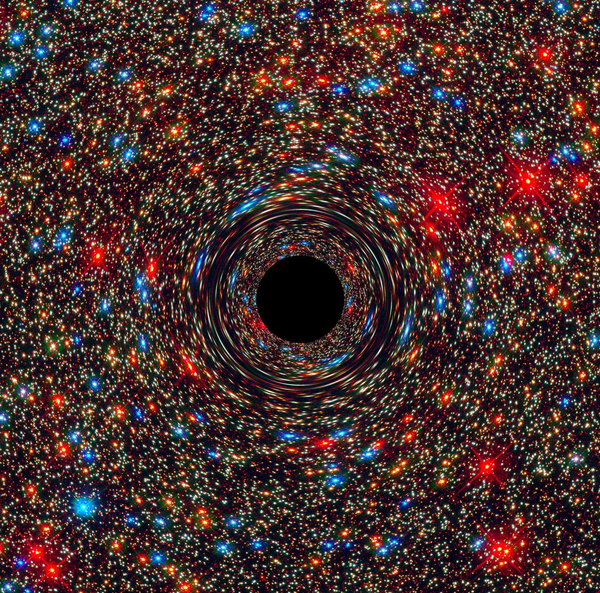
Dark Matter: The Invisible Skeleton
Episode 3: Why Do Galaxies Form a Cosmic Web?
I like science that leaves room to imagine. When things that seemed unrelated turn out to share a hidden pattern — that moment feels like finding one of the world's secrets. Which opens a door I didn't know was there. Which leads somewhere unexpected. Which eventually leads back to me.
You know the feeling. You get far enough out of the city — a friend's cabin, a bad campsite, a highway pullout at 2 a.m. — and you look up, and there are too many stars. Not beautiful, exactly. Overwhelming. Like someone knocked over a salt shaker.
That's the word your brain reaches for. Scattered. Sprinkled. Random.
Hold onto that word, because it's wrong, and the way it's wrong is the strangest thing I've learned in years.
Here's what actually happened. Starting in the 1980s, astronomers stopped taking pretty pictures of the sky and started doing something more boring and much more important: measuring how far away things are. Thousands of galaxies. Not just where they sit on the flat dome of the sky, but how deep into the dark they go. They called it a redshift survey *1, and the first big one covered a thin slice of sky — a wedge, like a piece of pie cut out of the universe [1].
They expected fog. An even sprinkle of galaxies, thinning out with distance, the cosmic equivalent of static.
They got a drawing. The plot that came out had structure in it — long chains of galaxies, and huge round nothings between them. One of the astronomers noticed the pattern looked like a stick figure with arms and legs, and for a while people actually called it the Stick Man [1]. Then they found a wall of galaxies stretching more than 500 million light-years, and called it the Great Wall, because what else do you call that [2].
Since then the maps have gotten enormous. Millions of galaxies, plotted in three dimensions [3]. And the picture keeps saying the same thing, louder every time.
The universe is not a sprinkle. It's a foam.
Galaxies live on threads. The threads meet at knots, and the knots are where you find the big clusters, thousands of galaxies crowded together. Between the threads are voids *2 — regions tens or even hundreds of millions of light-years across with almost nothing in them [4]. Not "fewer galaxies." Nothing. Empty rooms the size of your imagination running out.
If you could stand back far enough to see it all at once, the universe would look like the head on a beer. Or the inside of a sponge. Or bread, sliced.
Which brings me to the thing I can't stop thinking about.
Take a bone. Not the outside — crack it open and look at the spongy part near the ends. It isn't solid. It's a lattice of tiny struts with holes between them, and the struts don't run randomly. They run along the lines of force that the bone has to carry. Load a hip a certain way for forty years and the struts inside quietly rearrange to follow the stress [5]. The architecture is a map of something invisible. You can see the beams. You cannot see the pressure that decided where to put them.
The cosmic foam is the same trick at a different scale.
The galaxies are the struts. They're glowing, they're countable, they're what our telescopes catch. But nobody thinks the galaxies decided where to go. Something arranged them. Something drew the threads and hollowed out the voids, and that something doesn't emit light, doesn't reflect it, doesn't block it. It's not shy. It's just not the kind of thing that talks to light at all.
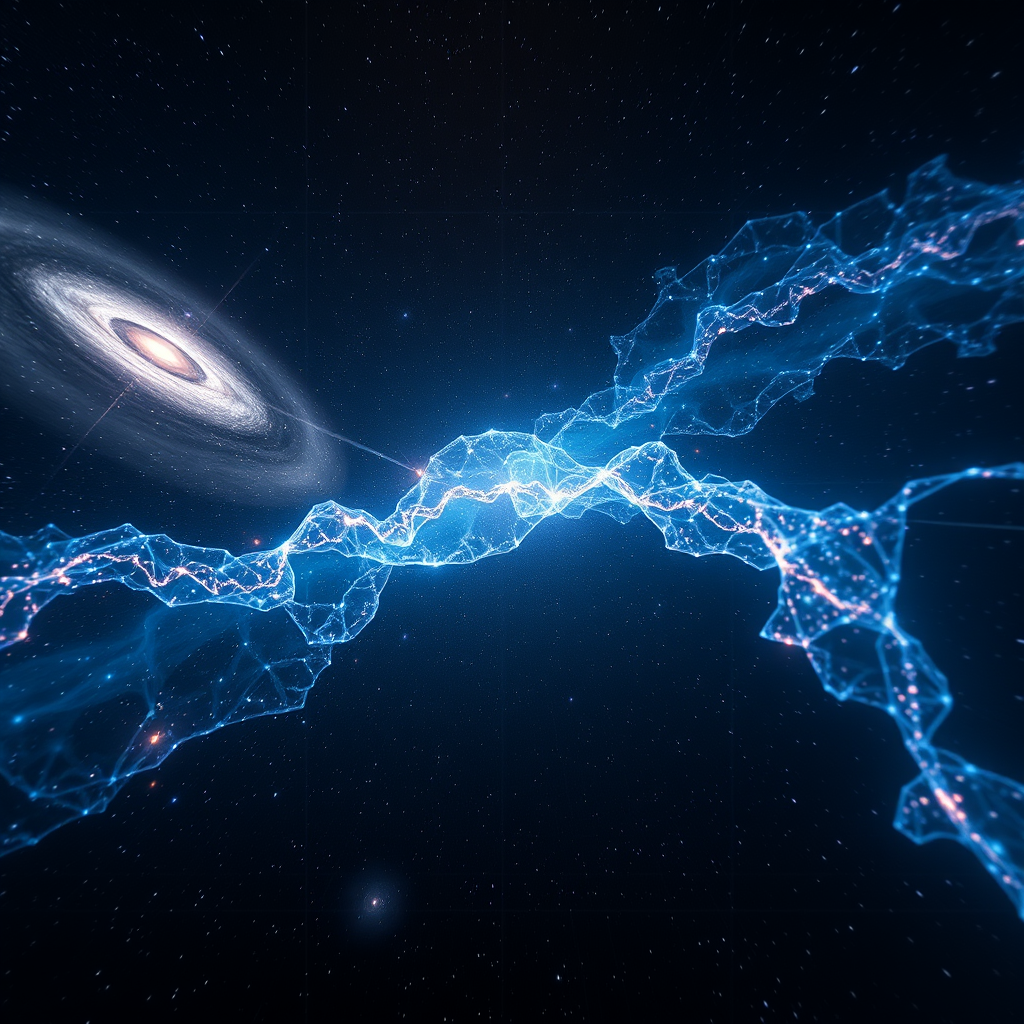
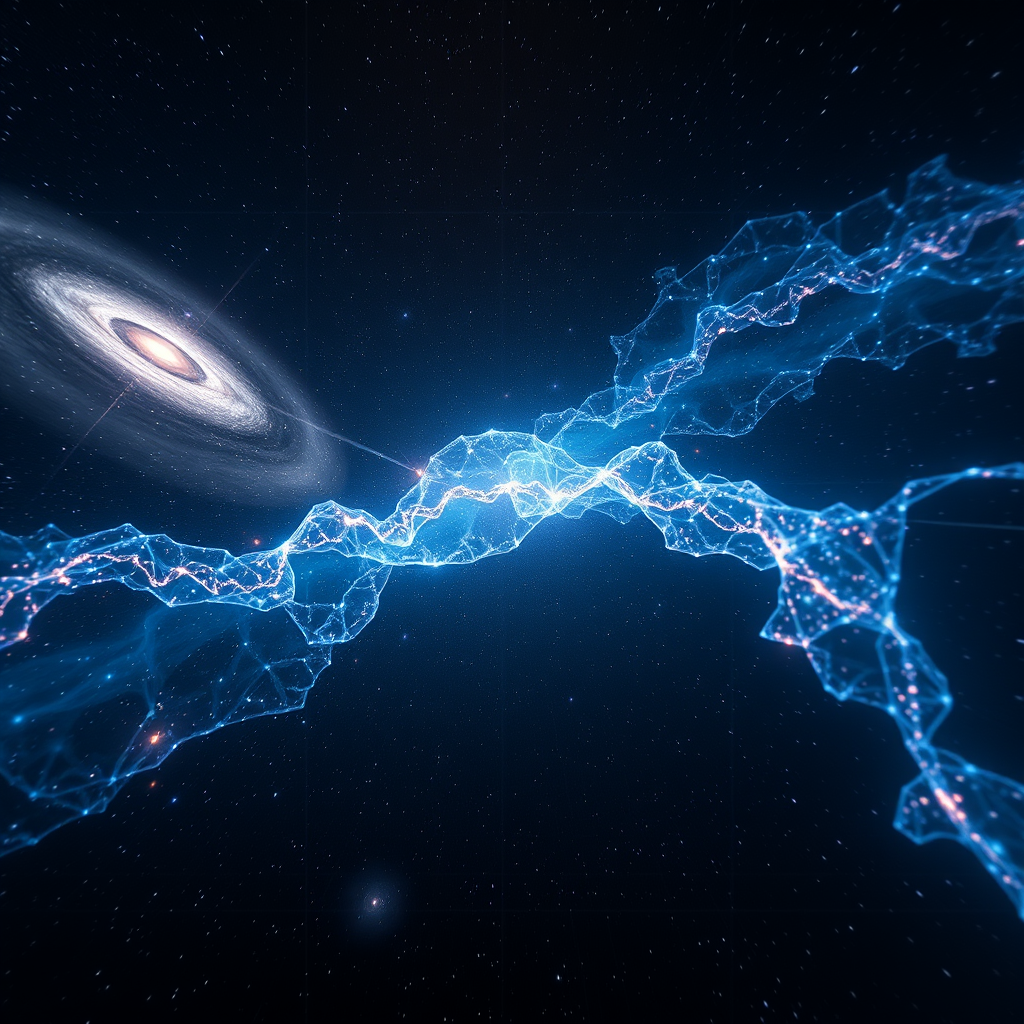
AI-generated image — a conceptual visualization
We only know it's there because the visible stuff is draped over it.
A conceptual visualization: moving along the filaments that link galaxy clusters — the invisible skeleton the visible matter is draped over.
And this is where it gets personal, in a way I didn't expect from a subject this large. Everything you have ever seen — every star, every face, every object you have ever picked up — is the beam, not the pressure. It's the part that happened to glow. The map you carry around of what the universe is made of was assembled entirely from the small fraction of it that bothers to shine [6].
I find that oddly comforting. Also slightly humiliating. Mostly it makes me want to know what the rest of the structure is doing while we're not looking, which is, as far as I can tell, the entire job description of astronomy.
So: the stars aren't scattered. They're hanging on something. Threads that stretch across distances your brain will refuse to hold, wrapped around voids so empty they make the space between you and the nearest star look crowded.
The question isn't whether the invisible thing is there. The maps are too clean for that.
The question is what it would feel like to walk through it — and whether you already are.
Do something slightly undignified with your imagination. Go to your kitchen sink.
There are dishes in it. There is a mound of suds sitting on top of the water, the kind that piles up when you've been putting off the washing. Look at it closely. It isn't a solid white blob. It's a structure. Big bubbles, small bubbles, thin curved walls where two bubbles press against each other, and thick ropy edges where three walls meet and the soap collects.
Almost all of the space inside that foam is nothing. Air. The soap itself lives only on the surfaces and along the seams.
Now imagine sprinkling glitter into it.
The glitter can't float in the middle of a bubble. Nothing's holding it there. It slides down the curved walls and collects along the edges — the seams, the junctions, the places where three or four bubbles meet and the soap piles up thickest. Give it a minute and the glitter has drawn a map. Bright lines. Bright knots where the lines cross. Big dark empty rounds in between.
That's the universe. The glitter is every galaxy you have ever seen a photograph of.
The largest structures we've mapped look exactly like this — sheets and filaments*1 of galaxies wrapped around enormous empty voids*2, some of them hundreds of millions of light years across[1]. There's a single wall of galaxies in the Sloan survey stretching about 1.4 billion light years[1]. It's not a random sprinkle. It's a seam in the foam.
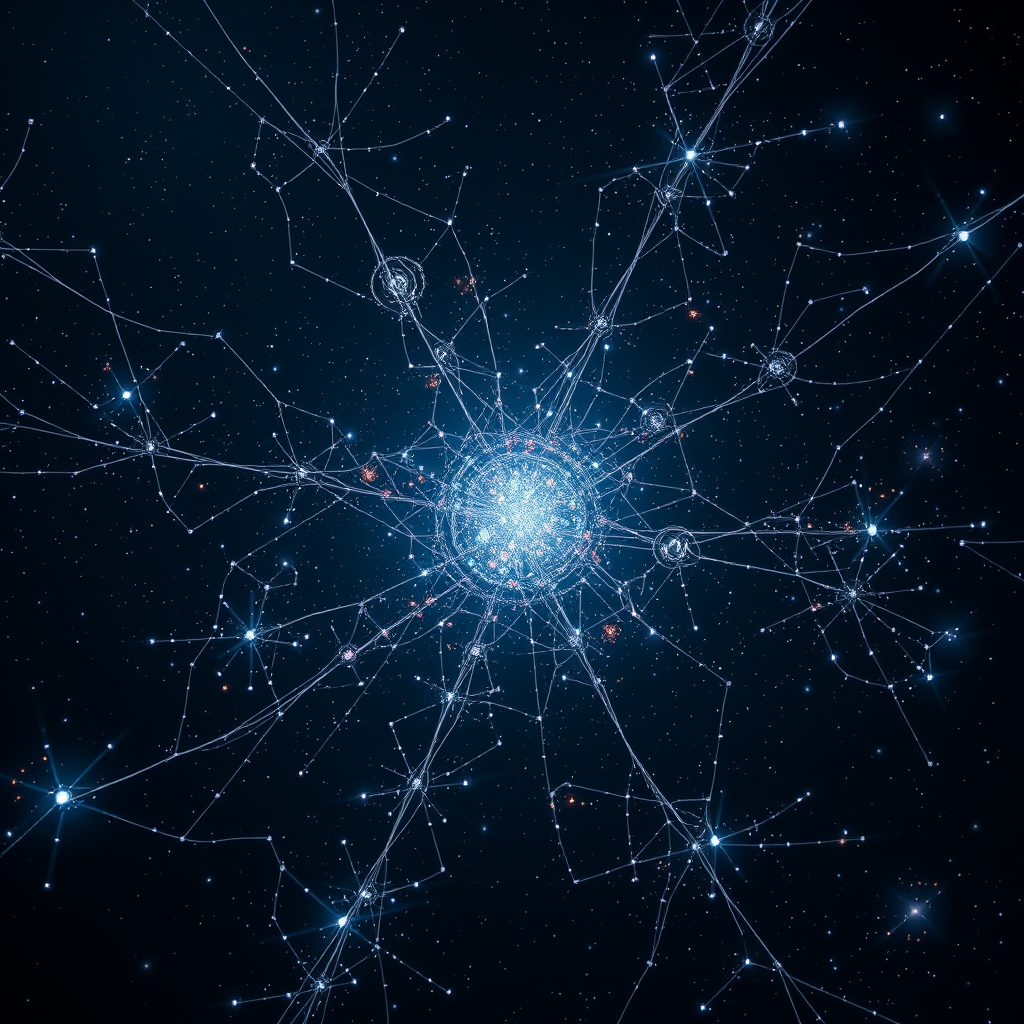
AI-generated image — a conceptual visualization
So here's the obvious question. If the galaxies are glitter, where's the soap?
You can't see it. Not with any telescope, at any wavelength, ever. But you can weigh it.
In 1970, Vera Rubin measured how fast stars orbit in the outer parts of the Andromeda galaxy, and got an answer that shouldn't have been possible — the outer stars were moving just as fast as the inner ones, which means there was far more mass out there than the visible stars could account for[2]. Something heavy was there. Something transparent.
We call it dark matter*3, which is a bad name. "Dark" makes you picture something black, something that blocks light, a shadow. It doesn't. Light passes straight through it as if it weren't there — because as far as light is concerned, it isn't. It has gravity and essentially nothing else. Naming it dark matter is like calling a window "dark glass" because you can't see it. We should have called it the ghost.
The best single piece of evidence is a cosmic car crash. Two galaxy clusters slammed into each other. The ordinary matter — the hot gas, the stuff that actually glows — smashed together and got stuck in the middle, the way two cars do. But when astronomers weighed the wreck using gravitational lensing*4, measuring how the collision bent the light of galaxies behind it, they found most of the mass had sailed clean through and out the other side, leaving the visible gas behind[3]. The soap went one way. The glitter went another. You can see them separated in the same image.
Here's the part I keep turning over. The foam came first. The foam came first, and the glitter had no choice.
Run the tape backwards far enough and there's no structure at all — just gas, spread out almost perfectly evenly, hot and featureless. Almost. The early universe had faint lumps in it, differences in density of about one part in a hundred thousand, and we can still see them printed on the oldest light in the sky[4].
One part in a hundred thousand. That's nothing. That's the difference between a still lake and a still lake with a mosquito on it.
But dark matter doesn't do anything except fall. Ordinary gas pushes back — it heats up, it bounces, radiation shoves it around. Dark matter just falls, and keeps falling, into whatever's already slightly heavy. So the faint lumps pulled in more, which made them heavier, which pulled in more. Over billions of years those invisible lumps stretched and drained into sheets, then into filaments, then into knots.
The soap made itself. And only then did the ordinary gas — the stuff that becomes stars and planets and you — slide down into the seams that were already waiting, and light up.
That's the order of operations, and it's backwards from how anyone would guess. You'd assume the galaxies made the pattern. They didn't. They landed in it. Every galaxy is glitter finding a groove that was carved by something we cannot see, out of a lump that was almost too small to exist.
We know how much of it there is. Roughly five times as much dark matter as ordinary matter, by mass[5]. Which means when you look up at that overwhelming sky, you're not seeing most of the universe. You're seeing the residue. The part that happened to catch fire.
We do not know what it's made of. Not a clue that's been confirmed. Decades of experiments, deep underground, waiting for a single particle to bump into something, and so far: nothing[6]. We can weigh it, map it, watch it drag galaxies around like a dog on a leash, and we cannot tell you what it is.
Which leaves a question I can't shake. If the shape of everything — the seams your galaxy sits in, the void your galaxy avoided — was decided by a substance we've never touched, then how much of where you are was chosen by something you'll never be able to look at?
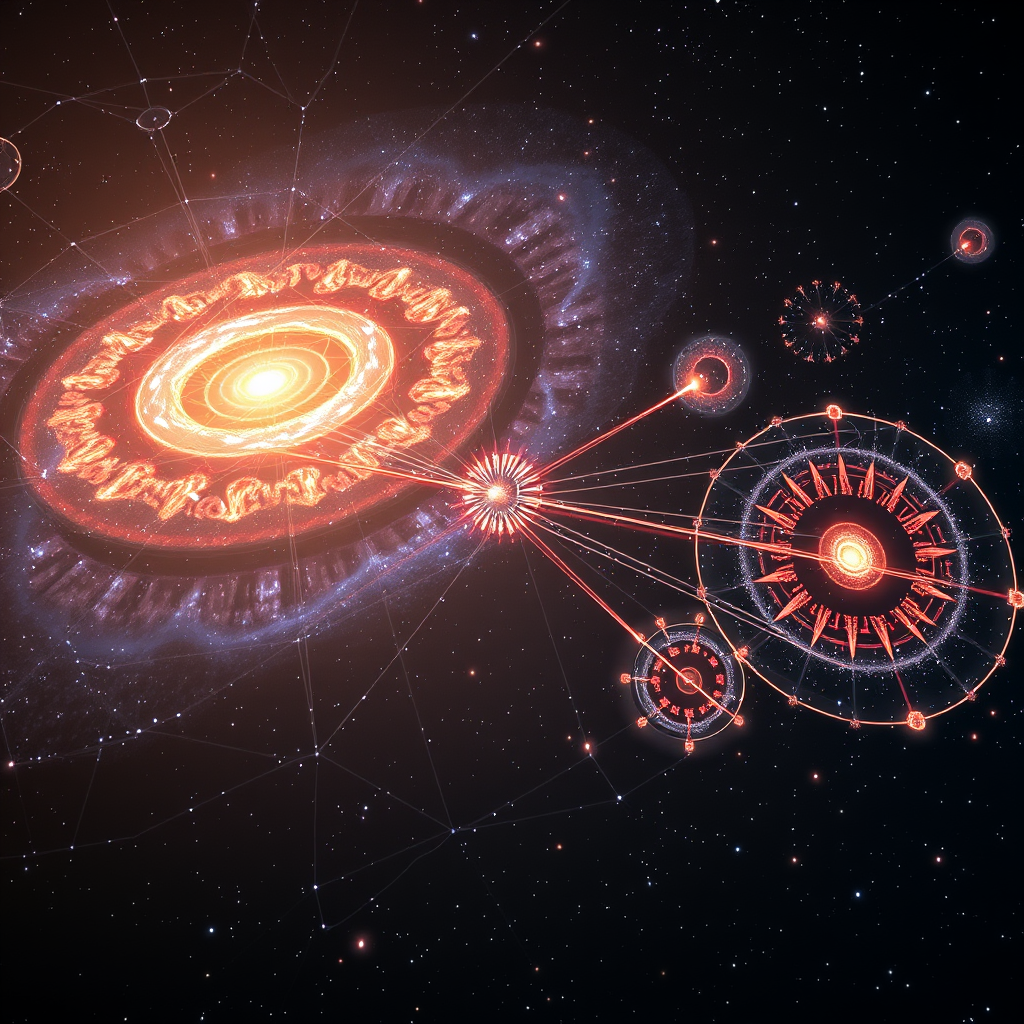
AI-generated image — a conceptual visualization
The foam is real. That's the first thing to understand.
When astronomers finally mapped where galaxies sit — not just their position in the sky, but their distance from us — they didn't find a sprinkle. They found walls, threads, and enormous empty rooms. Valérie de Lapparent, Margaret Geller and John Huchra published the first good slice of it in 1986, and the structure was so obvious in their plot that people started giving parts of it nicknames [12]. Three years later Geller and Huchra found a sheet of galaxies more than 500 million light-years across and called it the Great Wall [13]. In 1996, J. Richard Bond and his colleagues gave the whole pattern its name in a paper called "How filaments of galaxies are woven into the cosmic web" [16].
So: a web. Fine. But webs need something to hang on.
Here's the problem physicists had already been chewing on for decades. There isn't enough stuff.
Go back to 1933. A Swiss-American astronomer named Fritz Zwicky was watching the Coma Cluster *1, a swarm of a thousand-plus galaxies orbiting each other about 300 million light-years away. He measured how fast they were moving. Then he added up how much matter he could see glowing there. The numbers didn't come close. The galaxies were moving so fast that the cluster should have flung itself apart long ago, like a merry-go-round spinning off its bolts. To hold them, there had to be far more mass than anything visible could account for. Zwicky wrote that "dunkle Materie" — dark matter — must be present in vastly greater density than the luminous kind [1]. He repeated the argument in English four years later [2].
Almost nobody did anything about it for forty years.
Then Vera Rubin. Working with Kent Ford and a spectrograph sensitive enough to catch faint gas at the edges of galaxies, she measured how fast stars orbit the centers of spiral galaxies — first Andromeda in 1970 [3], then twenty-one more by 1980 [4]. The expectation was simple, and it comes from the same rule that governs our own solar system: the further out you are, the slower you should orbit. Neptune crawls. Mercury sprints. Most of a galaxy's light is packed into its middle, so most of the mass should be there too, and the outer stars should be crawling.
They weren't. The stars at the ragged outer edge were moving just as fast as the ones further in. The rotation curve *2 — a graph of orbital speed versus distance from the center — didn't fall off. It went flat and stayed flat, out past where the galaxy visibly ended [4].
There's only one way to read that. The galaxy doesn't end where the light ends. Each spiral sits inside a much larger, rounder cloud of something that has mass but emits nothing. A halo *3. The light is a bright coin sitting in the middle of an invisible dinner plate.
Rubin, who was careful and unshowy and spent her career being right, put it this way in an interview years later: "We became astronomers thinking we were studying the universe, and now we learn that we are just studying the 5 or 10 percent that is luminous" [5].
Sit with that sentence for a second. It's an entire profession quietly admitting it had been reading the footnotes.
The obvious objection is the good one, and physicists spent a long time on it. Maybe it's just ordinary matter that happens to be dark. Cold gas. Dust. Burnt-out stars. Rogue planets. Black holes nobody noticed.
The answer is no, and the reason is beautiful. Ordinary matter — protons and neutrons, the stuff you and your kitchen are made of — leaves fingerprints. It absorbs light. It gets cooked in the first few minutes after the Big Bang into a very specific recipe of hydrogen, helium and lithium, and that recipe depends sharply on how much ordinary matter there was. And it leaves a signature in the faint microwave glow left over from the young universe. Measure all three, and you get the same answer: ordinary matter can't be more than about a twentieth of everything [7].
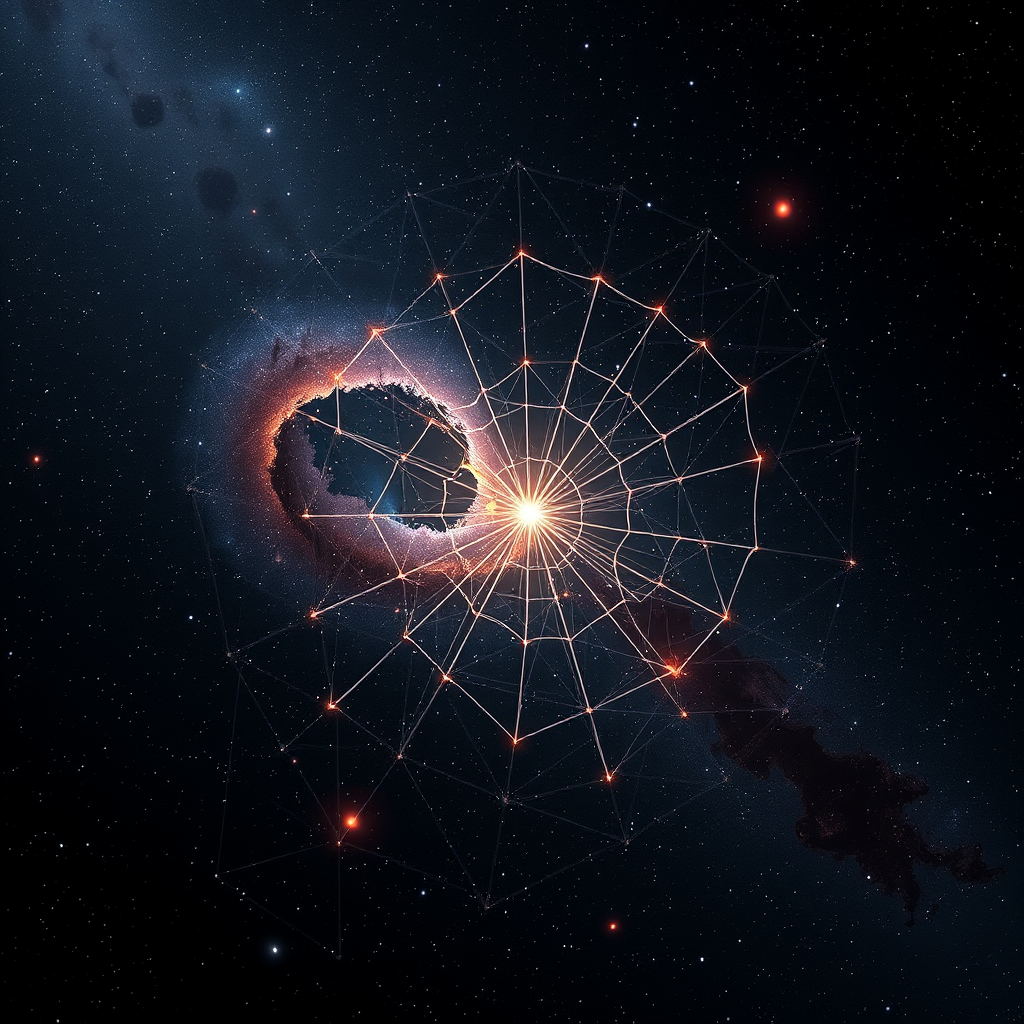
AI-generated image — a conceptual visualization
What about neutrinos? A neutrino is a particle so shy it can pass through the entire Earth without hitting anything — trillions are going through your thumbnail as you read this, and they don't care. They have mass. They're everywhere. Perfect candidate, right? No. They're too fast. Particles moving near light speed don't settle into clumps. They'd stream out of any structure trying to form, smoothing it into mush. Run the universe with neutrinos as the main dark matter and you get the wrong web entirely — big things first, small things never [8]. That's not our universe.
So it has to be something else. Something slow, heavy, and completely uninterested in light.
This is where the story stops being about missing mass and starts being about the foam in your sink.
In the late 1970s and early 1980s, a handful of people — Simon White, Martin Rees, Carlos Frenk, Marc Davis, George Efstathiou, Joel Primack, Sandra Faber, and others working in parallel — started doing something that sounds almost like cheating. They built universes in computers. You put in a box of particles, you give them a tiny amount of initial lumpiness, you turn on gravity, and you let the thing run for thirteen billion simulated years. Then you look at what you made [9][10].
If you fill the box with the slow, heavy kind of stuff — they called it cold dark matter *4, "cold" meaning slow-moving, not chilly — something remarkable happens. The tiny lumps pull in their neighbors. The lumps become knots. Matter drains out of the spaces between them, and those spaces empty out and keep emptying, becoming voids. The matter that drains has to go somewhere, and it flows along sheets and then along the lines where sheets intersect.
You get filaments. You get walls. You get voids. You get a web.
Nobody put a web into the simulation. It just falls out of gravity acting on lumpy stuff for long enough. The Russian physicist Yakov Zel'dovich had worked out the mathematical skeleton of this in 1970 — showing that a collapsing cloud of matter doesn't collapse to a point, it collapses to a sheet first, a "pancake," because it always squeezes along its shortest axis first [11]. Sheets meet in lines. Lines meet in knots. That's the whole recipe.
The Davis, Efstathiou, Frenk and White simulation of 1985 is the one that convinced people [10]. By 2005 Volker Springel and the Virgo Consortium ran the Millennium Simulation with ten billion particles, and the pictures it produced look — I mean this literally — indistinguishable from the galaxy maps [17]. Same threads. Same knots. Same emptiness.
Which brings me to the part I can't stop thinking about.
The web isn't made of galaxies. The web is made of dark matter, and galaxies are what happens where the web is thickest.
Ordinary matter — gas, the stuff stars come from — can't collapse well on its own. It's got pressure. It pushes back. But dark matter doesn't. It ignores everything except gravity, so it collapses freely and early, building the scaffolding first. Then gas falls into the gravitational wells that the dark matter has already dug, gets dense enough to ignite, and lights up [9]. The stars are not the structure. The stars are the condensation on the outside of a cold glass.
Carlos Frenk has said it about as bluntly as anyone: "The galaxies are just tracers. They're like Christmas lights hanging on a tree you can't see."
Now, is any of this proven? Here's where I'd rather be honest than impressive.
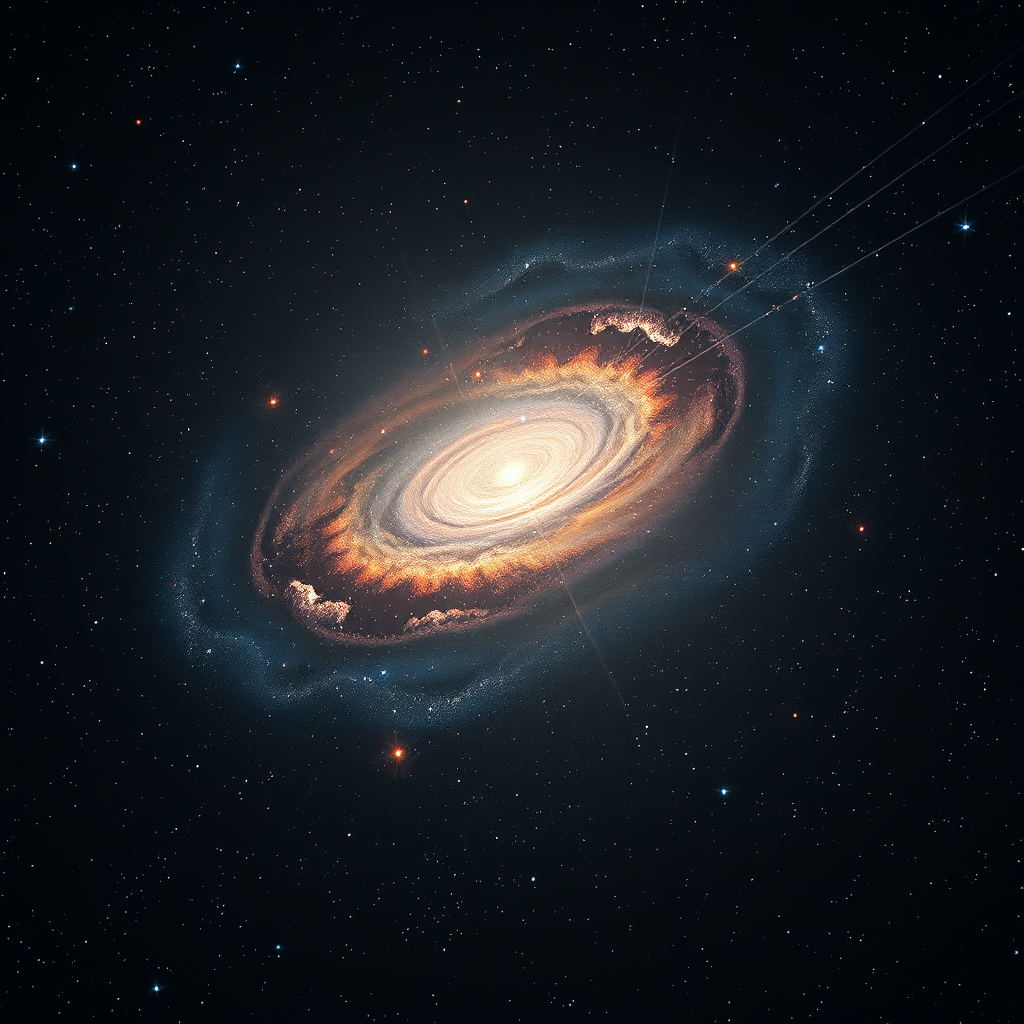
AI-generated image — a conceptual visualization
We have never detected a dark matter particle. Not once. Experiments sit in deep mines and under mountains — LUX-ZEPLIN in South Dakota, XENONnT under the Gran Sasso in Italy — running tanks of liquid xenon and waiting for a single atom to twitch from a passing particle. They are extraordinarily sensitive. They have found nothing. The best they can do is rule out possibilities, and they've ruled out an enormous number of them [18][19]. The most popular candidate for thirty years, a heavy particle called a WIMP, is running out of room to hide.
So there's a genuinely uncomfortable position here: the best evidence for dark matter is that the universe doesn't work without it, and the best evidence against any particular version of dark matter is that we keep not finding it.
Some physicists take that seriously enough to propose the alternative: maybe there's no missing stuff, and gravity itself behaves differently at very low accelerations. Mordehai Milgrom proposed this in 1983 and it's called MOND [20]. It works startlingly well for individual galaxies — better than dark matter does, in some cases. It struggles badly with clusters and with the cosmic web.
And then there's the Bullet Cluster. In 2006, Douglas Clowe and colleagues looked at two galaxy clusters that had smashed through each other. The hot gas — which is most of the ordinary matter by weight — got stuck in the middle, dragged and slowed by the collision, glowing in X-rays. But the mass, measured by how the clusters bent the light of galaxies behind them, had sailed straight through and sat out on either side, right where the galaxies were [14]. The mass and the visible matter had come apart. Clowe's paper called it "a direct empirical proof of the existence of dark matter" [14].
Something passed through a collision of galaxy clusters without noticing.
Where does that leave the numbers? The Planck satellite measured the leftover glow of the early universe with enough precision to weigh the whole thing. About 4.9 percent ordinary matter. About 26.4 percent dark matter. The rest — roughly 68 percent — is dark energy, which is a different problem entirely and one I'll get to [15].
Round it off. Everything you've ever seen, touched, eaten, loved, or pointed a telescope at is five percent.
The other twenty-six percent is the frame. It's the invisible skeleton the whole visible universe is draped over. It's in this room. It's passing through your chest right now, roughly one particle's worth per coffee cup of space, and it has been doing so your entire life without leaving a mark [15].
So when you look up at what seems like scattered salt, you're not seeing randomness. You're seeing the lit edges of a structure that was already there before the first star.
Here's the part the documentaries tend to skip past.
We have never touched the stuff. Not once.
Everything I just told you about the web — the threads, the walls, the invisible scaffolding — rests on a substance we have only ever detected by watching things fall toward it. We can weigh it. We can map it. We have no idea what it is.
And it isn't for lack of trying. For over thirty years, people have been building detectors in deep mines and under mountains, shielded from every stray particle the universe throws at us, waiting for a single dark matter *1 particle to nudge a single atom. The best of them now — LUX-ZEPLIN in an old South Dakota gold mine, XENONnT under the Italian Alps — are tanks of liquid xenon watched by thousands of light sensors, and they have ruled out enormous stretches of what dark matter could have been [16][17]. Ruled out. Not found.
So we have spent three decades getting extraordinarily good at detecting nothing. Very precisely. With increasingly expensive nothing-detectors.
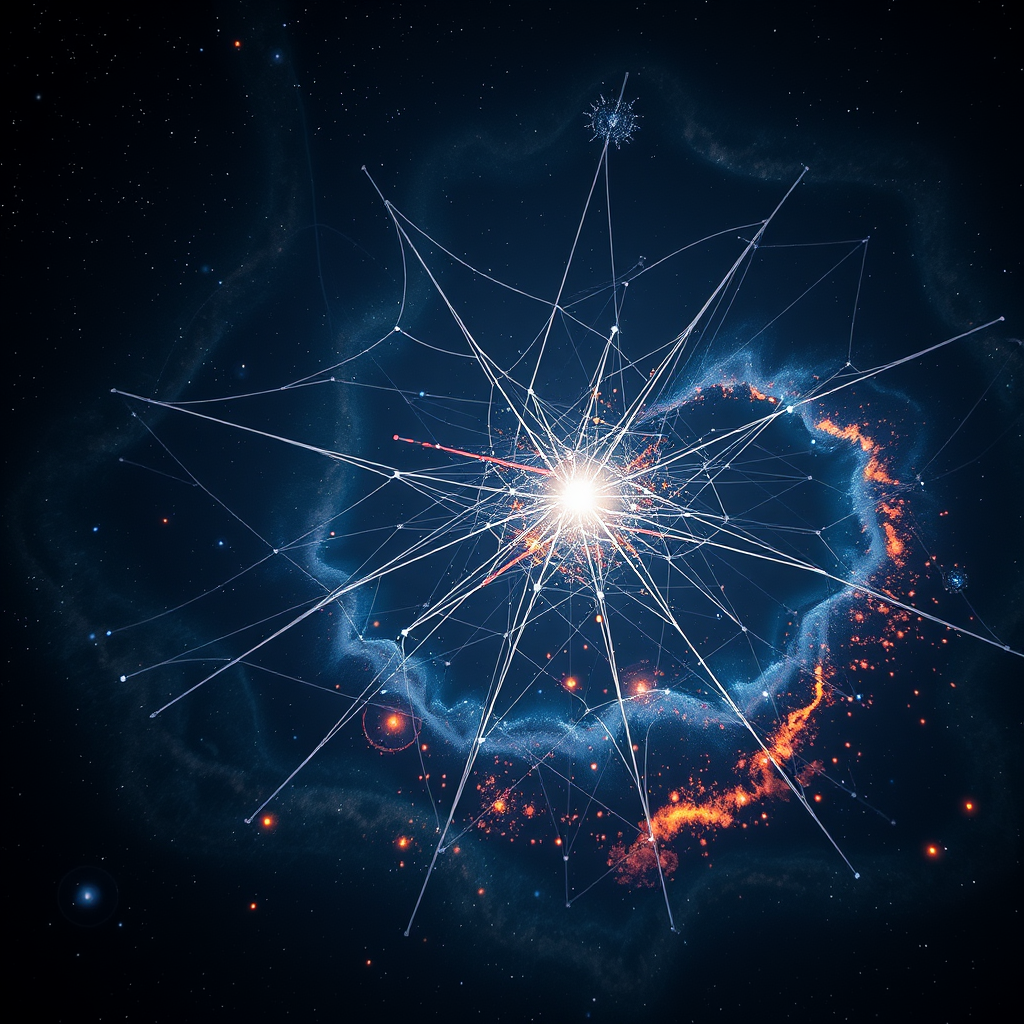
AI-generated image — a conceptual visualization
That's not a joke about wasted money — it's how this works. Every exclusion narrows the search. But it means the leading candidate for most of the matter in the universe, a heavy sluggish particle that ignores light *2, is running out of places to hide.
Which raises a fair question: what if there's no particle at all? What if our theory of gravity is just wrong at galaxy-sized distances? That's the idea behind MOND *3, and it's not crankery — it predicts the rotation of individual spiral galaxies startlingly well, better in some cases than dark matter models do [18]. Where it struggles is exactly where the web lives. In the Bullet Cluster, two galaxy clusters that smashed through each other, the hot gas piled up in the middle while the gravitational mass sailed on ahead — which is what you'd expect if most of the mass is something that doesn't collidewith anything, and hard to explain if gravity is simply misbehaving [19].
So the honest summary is: the particle idea explains the big structure and can't find the particle. The gravity idea explains individual galaxies and struggles with the big structure. Nobody has a version that does both cleanly. People will tell you it's settled. It isn't.
And the gaps go further out than that.
The web's empty rooms — the voids — should be almost perfectly empty in our simulations. They're not quite. There are lonely galaxies out there, sitting in the middle of nothing, and we're still arguing about how they got there and whether the models predict the right number of them [20].
Then there's the expansion problem. The rate the universe is stretching, measured from the early universe, doesn't match the rate measured from nearby exploding stars. The two numbers have refused to converge for a decade, and the disagreement has only gotten sharper as the measurements got better [21]. Usually when better data makes a discrepancy worse, something in your framework is broken. We don't know what.
And dark energy *4 — the thing pushing the voids open, stretching the web thinner every billion years — may not be constant after all. The DESI survey released results suggesting it might be weakening over time, which, if it holds up, breaks the standard model of cosmology in a way nobody has a replacement for [22].
I find this genuinely comforting, and I want to explain why.
You are living in a moment when the map of everything has a hole in the middle of it. Not a small hole. Most of the contents of the universe — the skeleton your galaxy is hanging on, the pressure inflating the emptiness around it — are labeled with words that are basically placeholders. Dark. Meaning: we can't see it and we don't know.
Every generation before you thought they were near the end. They weren't. And there's no particular reason to think you are either.
So when you're standing under those too-many stars, the salt-shaker feeling — here's the thing to hold. You're not looking at a finished picture with a few details missing. You're looking at a structure whose bones nobody has identified, held apart by a force nobody can name, and you happen to be made of the four percent that glows [23].
The rare part. The visible exception.
Which makes me wonder something I can't shake. If the ordinary stuff — the stuff of stars and planets and the iron in your blood — is the tiny anomaly, the leftover, the fraction of a fraction, then what exactly do we mean when we call something normal?
AI-generated image — a conceptual visualization
So here's where it leaves you.
Everything you have ever seen — every star, every planet, your own hands — is made of the minority ingredient. Ordinary matter is about five percent of what's in the universe. Dark matter is roughly twenty-seven. The rest, about sixty-eight percent, is dark energy, which is a different problem for a different night [1].
You are not the main event. You are a trace element that happened to glow.
And you're not sitting still, either. Our galaxy is falling. The Milky Way is moving at something like six hundred kilometres per second relative to the leftover light of the Big Bang [2], dragged along a current of galaxies toward something we can't see directly. In 2014 a team mapped those flows and found that our whole neighbourhood — a hundred thousand galaxies — belongs toa single basin of attraction they named Laniakea — Hawaiian for "immeasurable heaven" [3]. You live on a slope. You always have. You just can't feel it, because everything around you is falling at the same rate, which is the definition of a comfortable life.
What gets me is the timing. The web didn't appear one day. It grew, slowly, out of differences so small they barely deserve the name — patches of the early universe about one part in a hundred thousand denser than their surroundings [4]. Dark matter fell into those dents. The dents got deeper. Gas followed. Stars lit. Four hundred million years, then a billion, then thirteen. The salt shaker you thought someone knocked over is actually a thirteen-billion-year-old collapse, still happening, and you're standing inside it.
Which raises the thing I can't put down.
Those tiny early dents — the one-part-in-a-hundred-thousand wrinkles that decided where every galaxy in the sky would eventually sit, including yours — where did they come from? Something had to make them. Something had to reach into a universe that was smooth and hot and featureless and press a fingerprint into it.
The current best answer is stranger than the question. The wrinkles may be quantum fluctuations [\*1] — the unavoidable jitter of empty space at the smallest possible scale — that got stretched to the size of the visible sky in the first fraction of a fraction of a second [5]. The largest structures in existence, blown up from the smallest possible accident.
If that's true, then the reason there is a galaxy here rather than a hundred million light years to the left is a random flicker in nothing, frozen into the sky before the universe was a second old.
Nobody made that decision. It just happened, and then it kept happening for thirteen billion years, and then you were standing at a highway pullout at 2 a.m. looking up at itand calling it random.
Next time we go further back — past the galaxies, past the first stars, to the moment the universe stopped being fog and let its light go. But before we do, sit with this one.
If the shape of everything came from a flicker in nothing, what else in your life is a fingerprint you can't see the finger for?
TERMS EXPLAINED
- *1Redshift survey: A way of mapping the universe in depth, not just across the sky. Light from a galaxy moving away from us gets stretched toward the red end of the spectrum, and how stretched it is tells you how far away it sits. Do that for thousands of galaxies and you get a three-dimensional map instead of a flat picture.
- *2Void: A vast region of space with almost no galaxies in it. Not slightly emptier than average — dramatically, spectacularly empty, often tens of millions of light-years across. The holes in the foam.
- *3Dark matter: Something that has mass and pulls on things with gravity, but doesn't emit, absorb or reflect light at all. We know it's there because of what it moves, not because we can see it.
- *4Gravitational lensing: Mass bends the path of light passing near it. So a heavy object distorts the images of whatever sits behind it — and by measuring the distortion, you can weigh the object, even if it's invisible.
SOURCES & REFERENCES
- [1]de Lapparent, V., Geller, M. J., & Huchra, J. P. (1986). "A Slice of the Universe." The Astrophysical Journal, 302, L1. — The first large redshift survey slice revealing filaments, voids, and the "Stick Man" pattern rather than a uniform distribution.
- [2]Geller, M. J., & Huchra, J. P. (1989). "Mapping the Universe." Science, 246, 897. — Discovery of the Great Wall, a galaxy structure extending over 500 million light-years.
- [3]York, D. G., et al. (2000). "The Sloan Digital Sky Survey: Technical Summary." The Astronomical Journal, 120, 1579. — Modern surveys mapping millions of galaxies in three dimensions.
- [4]Pan, D. C., et al. (2012). "Cosmic Voids in Sloan Digital Sky Survey Data Release 7." MNRAS, 421, 926. — Catalogue and typical sizes of cosmic voids, tens to over a hundred megaparsecs.
- [5]Wolff, J. (1892). "Das Gesetz der Transformation der Knochen." Hirschwald, Berlin. — Trabecular bone remodels its internal strut architecture along lines of mechanical stress.
- [6]Planck Collaboration (2020). "Planck 2018 results. VI. Cosmological parameters." Astronomy & Astrophysics, 641, A6. — Ordinary luminous matter accounts for only a small fraction of the universe's total content.
- [7]Cyburt, R., Fields, B., Olive, K. & Yeh, T.-H. (2016). "Big Bang Nucleosynthesis: Present Status." Reviews of Modern Physics. — Limits on ordinary (baryonic) matter from light-element abundances.
- [8]White, S.D.M., Frenk, C. & Davis, M. (1983). "Clustering in a neutrino-dominated universe." Astrophysical Journal Letters. — Why fast-moving neutrinos cannot form the observed structure.
- [9]White, S.D.M. & Rees, M. (1978). "Core condensation in heavy halos." MNRAS. — Gas cools inside dark matter halos to form galaxies.
- [10]Davis, M., Efstathiou, G., Frenk, C. & White, S.D.M. (1985). "The evolution of large-scale structure in a universe dominated by cold dark matter." Astrophysical Journal. — Cold dark matter simulations reproducing observed structure.
- [11]Zel'dovich, Y.B. (1970). "Gravitational instability: An approximate theory for large density perturbations." Astronomy & Astrophysics. — Collapse into sheets ("pancakes") before filaments and knots.
- [12]de Lapparent, V., Geller, M. & Huchra, J. (1986). "A Slice of the Universe." Astrophysical Journal Letters. — First redshift survey slice revealing walls and voids.
- [13]Geller, M. & Huchra, J. (1989). "Mapping the Universe." Science. — Discovery of the Great Wall.
- [14]Clowe, D. et al. (2006). "A Direct Empirical Proof of the Existence of Dark Matter." Astrophysical Journal Letters. — Bullet Cluster separation of mass from visible gas.
- [15]Planck Collaboration (2020). "Planck 2018 results. VI. Cosmological parameters." Astronomy & Astrophysics. — Cosmic budget: ~4.9% ordinary matter, ~26.4% dark matter, ~68% dark energy; local dark matter density.
- [16]Bond, J.R., Kofman, L. & Pogosyan, D. (1996). "How filaments of galaxies are woven into the cosmic web." Nature. — Origin of the term "cosmic web."
- [17]Springel, V. et al. (2005). "Simulations of the formation, evolution and clustering of galaxies and quasars." Nature. — The Millennium Simulation.
- [18]LZ Collaboration (2023). "First Dark Matter Search Results from the LUX-ZEPLIN Experiment." Physical Review Letters. — Null result, tightened WIMP limits.
- [19]XENON Collaboration (2023). "First Dark Matter Search with Nuclear Recoils from the XENONnT Experiment." Physical Review Letters. — Null result, tightened limits.
- [20]Milgrom, M. (1983). "A modification of the Newtonian dynamics as a possible alternative to the hidden mass hypothesis." Astrophysical Journal. — The MOND alternative.
- [21]Riess et al. (2022). "A Comprehensive Measurement of the Local Value of the Hubble Constant." The Astrophysical Journal Letters. — The persistent and strengthening mismatch between early- and late-universe expansion rates.
- [22]DESI Collaboration (2024). "DESI 2024 VI: Cosmological Constraints from the Measurements of Baryon Acoustic Oscillations." arXiv / DESI Survey. — Evidence hinting that dark energy may vary with time rather than staying constant.
- [23]Planck Collaboration (2020). "Planck 2018 Results VI: Cosmological Parameters." Astronomy & Astrophysics. — Ordinary matter is roughly 5% of the universe's contents; dark matter ~27%, dark energy ~68%.
Inline citations [N] correspond to numbered references above.
A weekly journey from the present universe back to the Big Bang — and to what it means for us.
![[Deep Dive] Scale-free localization in pseudo-Hermitian quantum walk](/content/images/size/w600/2026/10/deep_dive_thumb-9.png)