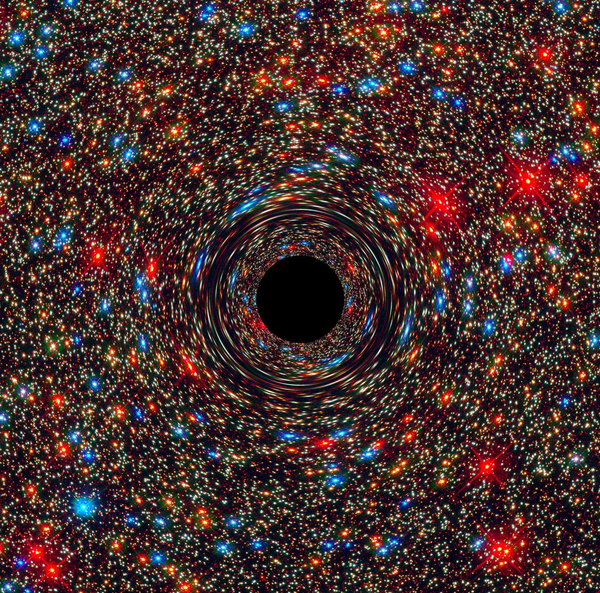
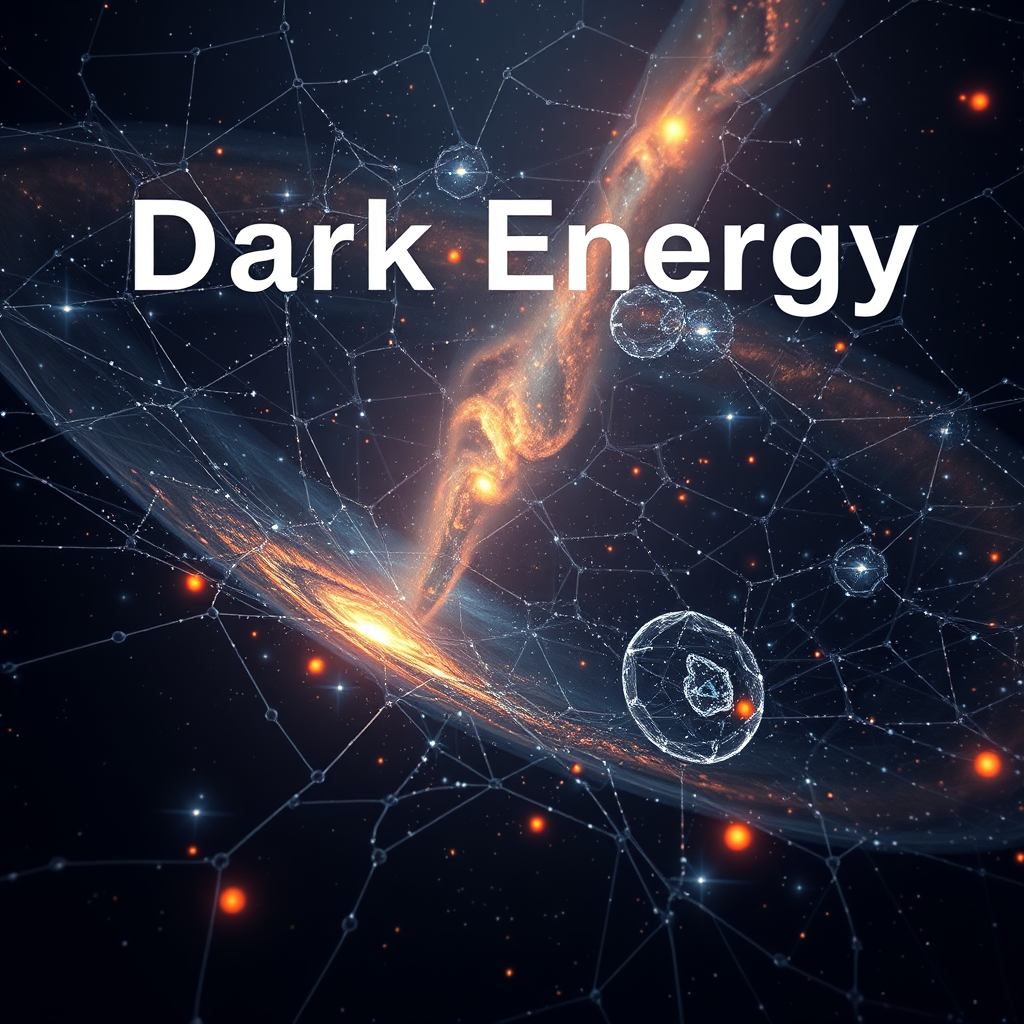
Dark Energy: The Emptiness That Pushes
Episode 3: Why Do Galaxies Form a Cosmic Web?
I like science that leaves room to imagine. When things that seemed unrelated turn out to share a hidden pattern — that moment feels like finding one of the world's secrets. Which opens a door I didn't know was there. Which leads somewhere unexpected. Which eventually leads back to me.
There is a particular kind of loss nobody warns you about.
Not a fight. Not a betrayal. Just a friend you used to text every day, and then every week, and then on birthdays, and then you saw their name in your contacts and felt a small unplaceable ache. Nothing happened. No one moved away. Neither of you decided anything.
The distance just accumulated.
I think about that more than is probably healthy, because it's the strangest kind of change there is: the kind with no cause you can point to. When something breaks, you can tell the story. Whensomething breaks, you can tell the story. When nothing breaks and it still ends, you're left holding a mystery you can't even phrase properly.
Hold that feeling. I'm going to come back to it, and when I do it's going to be about the whole universe, and I promise that isn't a metaphor.
Here's the thing I can't stop thinking about.
Go outside tonight. Find the fuzzy smudge in Andromeda if your sky is dark enough — that's a galaxy [1], a city of a few hundred billion stars, and the light hitting your eye left it two and a half million years ago [1]. Your eye is doing archaeology. Fine. Everyone knows that part.
But look past it. Not at the stars. At the black between them.
That black is not empty in the way your kitchen is empty. It's emptier. If you took a cubic meter of the space between galaxies, you'd find something like one hydrogen atom rattling around in it [2]. One. In a volume the size of a washing machine. That is closer to nothing than anything you have ever touched, or will ever touch, or could build in a laboratory.
And that nothing is doing something.
In 1929, Edwin Hubble noticed that almost every galaxy he looked at was moving away from us, and the farther away it was, the faster it was going [3]. Not scattering from an explosion — we're not at the center of anything. Every galaxy sees the same thing. Every galaxy sees everyone else running away.
The picture that survived a century of testing is that the galaxies aren't moving through space so much as space itself is getting bigger between them [3]. Think of dots drawn on a balloon. Nobody crawls. The rubber grows. Every dot watches every other dot recede and quite reasonably assumes it did something wrong.
So the universe has been expanding for about 13.8 billion years [4].
Fine. Also everyone knows that part.
Here's the part that broke my brain, the part I heard on a podcast while doing dishes and had to sit down for. In the late 1990s, two competing teams of astronomers went looking for the rate at which that expansion was slowing down [5][6]. This was not a controversial project. Gravity pulls. Everything in the universe pulls on everything else. The expansion should be losing steam, the way a thrown ball loses steam, and the only question was how much.
They measured it. The expansion is speeding up [5][6].
Not slowing. Accelerating. It has been accelerating for roughly the last six billion years [7]. The two teams checked each other's work, which in astronomy usually means trying to prove your rival made an arithmetic error, and they couldn't find the error, because there wasn't one. They shared a Nobel Prize for it in 2011 [8].
Something is pSomething is pushing. And when you go looking for the thing doing the pushing, you find the emptiest places in existence — that washing machine with a single atom in it — and the arithmetic says the push is coming from there [7].
Not from the galaxies. Not from the stars. From the gaps.
Drifting toward a void between clusters — dark energy rendered as camera motion. A conceptual visualization.
Roughly sixty-eight percent of everything there is, all the energy in the cosmos, appears to live in the void and shove it outward [9]. Ordinary matter — you, your kitchen, Andromeda, every star anyone has ever wished on — is about five percent [9]. We are a rounding error decorating something we can't see.
And nobody knows what it is. I want to be very clear about that, because this is the part science writing usually rushes past to get to a satisfying ending. We have a name for it. A name is not an explanation. A name is a receipt for a package we haven't opened.
Which brings me back to your friend.
Because the universe, it turns out, is not being torn apart. There's no force ripping galaxies from each other's arms. Nothing broke. No one decided anything. There is simply more nothing between them every year than there was the year before, and nothing is, apparently, not neutral. It has an opinion. Its opinion is: further.
That's the same shape as the ache. Not a rupture. An accumulation. The slow arrival of more distance where distance used to be small enough to ignore.
And yet — and this is what I want the rest of this to be about — the universe did not end up as a smooth grey nothing. It ended up structured. Galaxies aren't scattered like dropped rice. They hang in enormous filaments and sheets, threads of light with vast hollow bubbles between them, a shape astronomers found in the 1980s and named the cosmic web because that is exactly what it looks like [10].
So here's the problem I've been chewing on. Two forces. One gathering things together. One pushing everything apart, forever, from inside the emptiness.
We are living in the leftover pattern of their argument.
Why did that argument produce a web, and not a mist?
Picture the longest table you've ever seen. A wedding banquet table, white cloth, a hundred chairs.
You're seated between two people you like. Close enough to hear them breathe. Close enough to steal bread.
Now imagine the caterers start doing something odd. They begin inserting extra table leaves. Not at the ends — in the middle, everywhere, between every pair of chairs at once. A new plank of table slides in between you and the person on your left. Then another. Then another.
Nobody has stood up. Nobody has pushed their chair back. You are exactly where you sat down. So is your friend. But there's a meter of tablecloth between you now, and then three meters, and then you're shouting, and then you're not shouting because what's the point, and their face is a rumor at the far end of an impossible table.
That's it. That's the universe.
The galaxies aren't flying through space like shrapnel from an explosion. Space itself is getting bigger between them [1]. New table keeps arriving. Nobody moved.
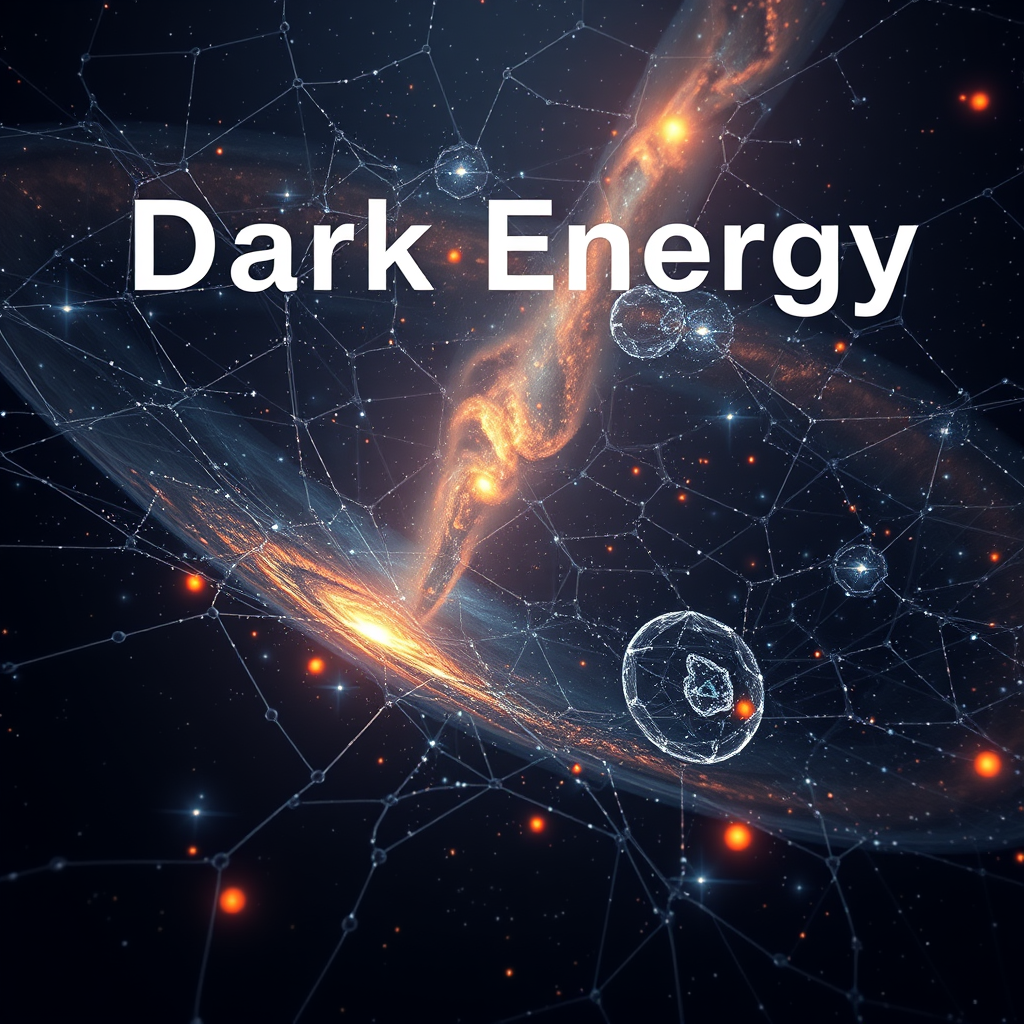
AI-generated image — a conceptual visualization
And here's the part that took me embarrassingly long to understand — the part that explains why the cosmos looks like a web instead of a fog.
Some of the guests are holding hands.
Look down the table. There are clumps. A grandmother with a toddler on her lap. Three cousins with arms around each other, laughing. A couple whose fingers are laced together under the cloth. When the new table leaves slide in, these clumps don't come apart. Their grip is stronger than the widening. They stay bunched. If anything, they pull tighter.
The ones who drift are the polite acquaintances. The people who were merely near each other. No grip. Just proximity.
That is the cosmic web *1. Galaxies that grabbed each other early — gravitationally bound *2, hands locked — form clusters and long stringy filaments, and they stay locked while everything else stretches [2]. The stretching hollows out the space between them into enormous nearly-empty bubbles called voids *3, some of them hundreds of millions of light-years across [3]. Not because anything got sucked out of the voids. Because the voids are where nobody was holding on.
The web isn't a structure that was built. It's the shape left behind when everything that could drift, drifted.
Which brings us to the caterers, and the thing that keeps me up.
For most of cosmic history, the leaves came in and the whole process was slowing down. Gravity, pulling everything back toward everything, acting like a brake. The expectation, for decades, was that it would keep slowing. Maybe stop. Maybe reverse.
In 1998 two teams measured it using exploding stars as distance markers, and found the opposite [1][4]. The table is being extended faster now than it was five billion years ago. Something is stepping on the gas.
We call it dark energy *4. And I want to be honest with you about the naming, because it's the funniest thing in physics: we called it "dark energy" the way you'd label an unmarked box in your garage "STUFF." It's a placeholder. It's roughly 68% of everything in the universe by energy content [5], and its name is a shrug.
But we know one strange thing about it, and it's the strangest thing in this whole essay. Dark energy doesn't seem to thin out.
Everything else does. Spread matter over a bigger volume and it gets sparser — that's just what dividing is. But dark energy appears to be a property of empty space itself. Make more empty space, you get more of it [6]. The emptiness is what pushes. And the pushing makes more emptiness. And the new emptiness pushes harder.
So the caterers aren't following a schedule. They're multiplying.
Now go back to the table. Feel where you are in it.
You are in a clump. The Earth is gripped by the Sun. The Sun is gripped by the Milky Way. The Milky Way is holding hands with Andromeda so firmly that we're falling toward each other, and in about four and a half billion years the two galaxies will merge into one [7]. Dark energy is not going to pry your chair away from the person next to you. On the scale of your body, your city, your galaxy, gravity wins by a landslide.
What dark energy does is takeeverything you weren't holding on to.
The distant galaxies. The ones we can see but never touched. They're already receding faster and faster, and eventually their light will stretch out so far it stops arriving at all [8]. Not hidden. Not moved. Just past the edge of the reachable.
Astronomers have run the numbers on this, and they're bleak in a very calm way. Given enough time, the observable universe empties out. Everything outside our own gravitationally bound clump — our local group of galaxies — slides beyond the horizon [8]. A future astronomer, standing on a future planet, looking up with a perfectly good telescope, would see one island of stars in a black nothing. They would have no way to know the expansion ever happened. No way to know there were ever a hundred billion other galaxies. The evidence gets carried off by the very thing it's evidence of [8].
We are living in the era when the universe can still be read. That's not a small thing. That's a window, and it's closing, and it opened before we did.
I keep coming back to the friend I stopped texting. Nothing happened. That was the whole horror of it — there was no event to point at, no moment to apologize for. Just leaves sliding into the table while we both sat still, being polite, being near.
And I don't think that's a metaphor for the cosmic web. I think it's the same thing wearing different clothes. Distance accumulates by default. Structure — the web, the cluster, the friendship, the thing that has a shape and holds — is always the exception. It's always the result of something gripping hard enough to beat the drift.
The universe is not mostly galaxies. It's mostly voids [3]. The default state of everything is empty space getting emptier.
Which makes the clumps look different to me now. Every filament in that cosmic web is a place where matter refused. Every cluster is a grip that held for thirteen billion years against an expansion that never once stopped pushing.
You are made of things that held on. That's the actual physical fact of you. Atoms that stuck, molecules that bonded, cells that decided to stay in formation, and further back, a clump of gas in a filament that didn't let go long enough to become a star with planets and a Tuesday and you reading this.
So here's what I can't shake. Dark energy has been getting stronger relative to everything else, and it will keep getting stronger, because more space makes more of it [6]. Gravity doesn't get stronger. It just holds what it already has.
Which means the grip is not automatic. It's not a law that friendship survives, or that a galaxy cluster survives, or that anything survives. It's a contest, and one side is quietly compounding.
If distance is the default and structure is the exception — if the universe's whole tendency is to let things drift apart without anyone deciding — then how much of what you still have is only there because someone is actively holding on?
Here is what physicists actually think is happening at that banquet table.
For most of the twentieth century, everyone assumed the expansion of the universe was slowing down. This was not a wild guess. Space was stretching — Lemaître worked that out from Einstein's equations in 1927, and Hubble confirmed it with galaxy distances two years later [1][2]. But everything in the universe has mass, and mass pulls. So the stretching should be losing steam, like a ball thrown upward. The only real question was whether it would slow down forever or eventually collapse back.
Two teams set out to measure exactly how much it was slowing.
They used exploding stars. A particular kind, called a Type Ia supernova *1 — a white dwarf that steals matter from a companion star until it crosses a mass threshold and detonates. The useful thing about them is that they all detonate at roughly the same brightness. So if one looks dim, it's far away. You know how far by how dim, and you know how much the universe has stretched since the light left by how much its wavelength has been dragged toward red *2.
In 1998 and 1999, both teams published. Adam Riess and the High-z Supernova Search reported that distant supernovae were, on average, 10 to 15 percent fainter than they should be [3]. Saul Perlmutter's Supernova Cosmology Project, working independently with 42 supernovae, found the same thing [4].
Fainter means farther. Farther than a decelerating universe allows.
The expansion isn't slowing down. It sped up. Riess, Perlmutter and Brian Schmidt shared the Nobel Prize for it in 2011.
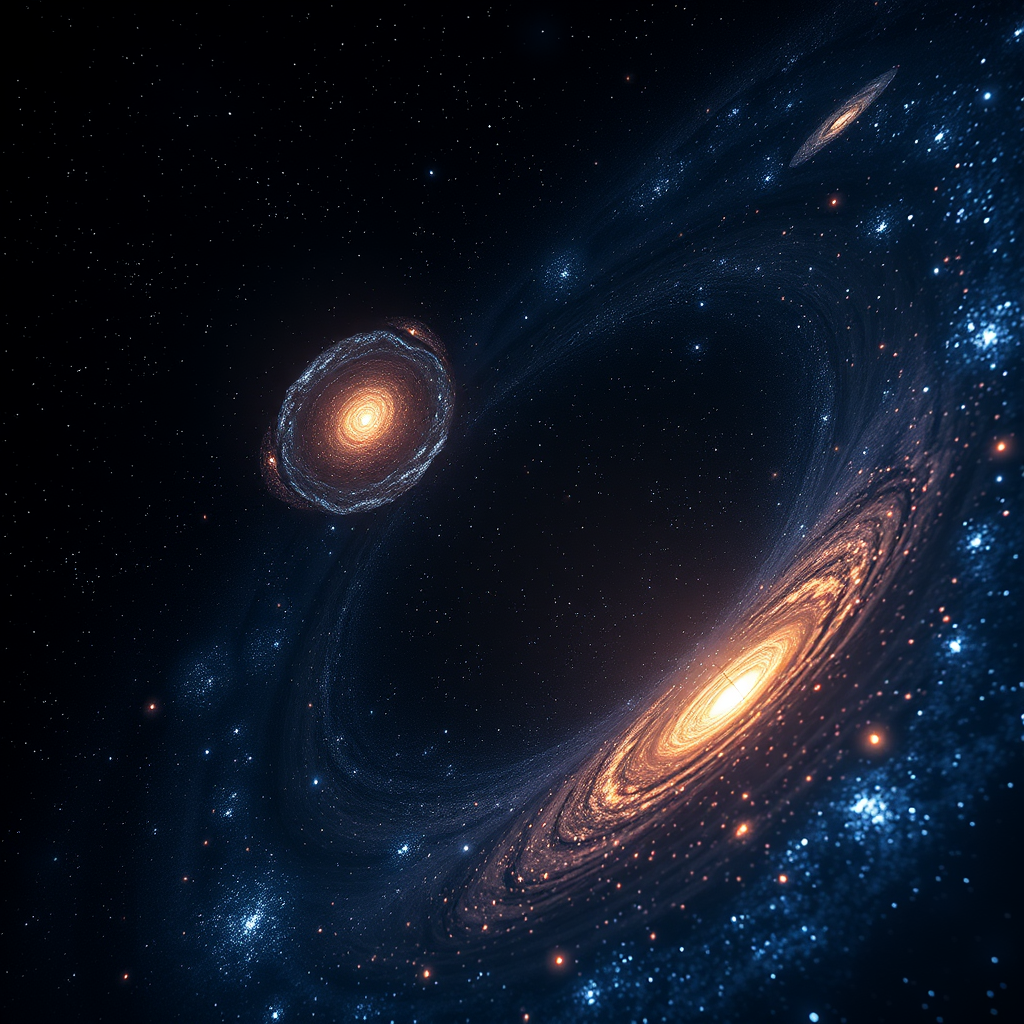
AI-generated image — a conceptual visualization
Michael Turner gave the thing doing the accelerating a name that year: dark energy *3 [5]. It's a placeholder, and everyone knows it. It means "whatever is making empty space push." We have measured its effects to a few percent. We have essentially no idea what it is.
Here's the number that matters. Take everything in the universe — every star, every planet, every wisp of gas, every black hole, every neutrino *4 — and it comes to about 5 percent of what's in there [6]. Roughly 27 percent is dark matter, which we also can't see but which at least behaves like ordinary stuff: it clumps, it pulls, it forms structure.
The remaining 68 percent is dark energy [6].
So the honest summary of cosmology is this: we have built a beautiful, precise, tested model of the universe, and two-thirds of it is a word we invented to cover our ignorance.
Now — what is it? There's a leading candidate, and it's old.
In 1917, Einstein added a term to his equations that he called the cosmological constant *5, usually written as the Greek letter lambda [7]. He wanted a static universe, and his equations wouldn't give him one, so he added a constant push to hold everything in place. When Hubble showed the universe was expanding anyway, Einstein dropped it.
The modern version isn't about holding anything still. It's a claim about what emptiness is.
In quantum field theory, empty space isn't empty. Fields exist everywhere, and fields have a lowest possible energy that isn't zero. So the vacuum has energy. And in general relativity, energy gravitates — but vacuum energy has a strange property. It doesn't dilute. Ordinary matter thins out as space expands; you have the same amount of stuff spread over more room. Vacuum energy doesn't thin out, because it's a property of the room itself. Twice the space, twice the vacuum energy.
That gives it a bizarre effect. Under general relativity, something with enough negative pressure pushes space apart instead of pulling it together. Vacuum energy has exactly that. So a universe with vacuum energy in it doesn't just expand — it expands faster and faster, because the more space there is, the more push there is, which makes more space.
Which sounds like a complete answer. It is not.
When physicists try to calculate how much vacuum energy there should be, the number comes out wrong. Steven Weinberg laid out the problem in a 1989 review paper that people still cite as the definitive statement of it [8]. Depending on how you do the estimate, theory overshoots the observed value by something like 120 orders of magnitude. That's a 1 followed by 120 zeros [9]. It has been described, not entirely as a joke, as the worst theoretical prediction in the history of physics [9].
To be clear about the scale: that is not a rounding error. It's not even the same species of error. If you were off by that much estimating the width of an atom, your answer would be larger than the observable universe, and you'd still have most of the wrongness left over.
So we have a candidate that predicts the right behavior and the wrong magnitude by an amount that beggars description. Something is missing in how we understand the vacuum, and nobody knows what.
The alternative idea is that dark energy isn't a constant at all. That it's a field — something that fills space and can change over time, weakening or strengthening as the universe ages. Robert Caldwell, Rahul Dave and Paul Steinhardt proposed a version of this in 1998 and called it quintessence *6, after the classical fifth element [11]. It's a genuinely different picture. A constant is a fact about space. A field is a thing that has a history.
There's a way to tell them apart, and it's a single number.
Cosmologists call it w, the equation of state parameter *7. It's the ratio of a substance's pressure to its energy density. For a cosmological constant, w is exactly −1, always, forever. For quintessence, w drifts.
For a long time, every measurement came back at −1. Planck's 2018 analysis, combining the cosmic microwave background with supernovae and galaxy surveys, pinned it at −1.03 with an uncertainty of about 0.03 [6]. Which is to say: boring. Which is to say: consistent with Einstein's discarded term, dusted off and promoted to two-thirds of reality.
And then, recently, things got interesting.
The Dark Energy Spectroscopic Instrument sits on a telescope in Arizona and measures the distances to millions of galaxies and quasars, building a three-dimensional map. In 2024 and again in 2025, DESI reported that its data prefer a dark energy that changes with time — one that was stronger in the past and has been weakening. Depending on which supernova dataset you combine it with, the preference for evolving dark energy over a plain cosmological constant sits somewhere between 2.8 and 4.2 sigma [10].
That's not a discovery. In particle physics, 5 sigma is the threshold, and the history of cosmology is littered with 3-sigma results that evaporated. The DESI team is careful about this in their own papers, and the collaboration has been publicly cautious about overclaiming. But it's the first serious crack in the assumption that dark energy is just a constant. If it holds up, the universe has a plot twist in it.
Here's why any of this matters for the shape of things — for the web.
Look at a map of the universe on the largest scales and you don't see galaxies scattered like sand. You see filaments. Long threads of galaxies, meeting at dense knots, wrapped around enormous nearly-empty bubbles. Dick Bond, Lev Kofman and Dmitry Pogosyan described how those threads form in a 1996 paper in Nature, and gave the structure the name that stuck: the cosmic web [12]. The seed of the idea goes back further, to Yakov Zel'dovich, who worked out in 1970 that a collapsing cloud of matter doesn't collapse evenly — it flattens first into sheets,flattens first into sheets, then drains along those sheets into filaments, then pours down the filaments into knots [13]. Pancakes, he called them. Gravity is impatient and asymmetric. It always collapses the shortest direction first.
So the web is gravity's signature, written slowly over billions of years. Tiny density ripples in the early universe — regions a hundred-thousandth denser than average — pulled matter toward themselves. The dense got denser. The thin got thinner. Matter flowed out of the voids and into the threads, and the voids emptied themselves not by shrinking but by feeding everything they had into the walls around them.
And dark energy is what stopped it.
That's the part I didn't understand for a long time. The web isn't finished. It's frozen. Structure grows as long as gravity's inward pull can beat the outward stretch, and for the first several billion years it could. Then, around 5 billion years ago, dark energy caught up with the thinning matter and took over [3][4]. Expansion switched from slowing to speeding. The pull is still there. It just doesn't win anymore, not on the largest scales.
The knots are still bound. Galaxy clusters hold themselves together; the Local Group holds itself together; you hold yourself together. Gravity beats dark energy easily wherever things are already close. But the filaments will not grow much longer. The voids will not fill in. And the distance between clusters that never quite reached each other will keep opening, and nothing will close it.
The same measurement machinery is now trying to weigh the lightest things in existence, too. DESI puts limits on the total mass of neutrinos [10] — particles so shy that trillions are passing through your chest right now, and in your whole life maybe one of them will bump into an atom of you. They barely matter individually. In aggregate, they smoothed the early web slightly. Everything leaves a fingerprint.
What strikes me is how little of this anyone is pretending to be sure of. Weinberg, writing about the vacuum problem, called it "a veritable crisis" [8]. Sean Carroll has said that the cosmological constant problem is the one where our best theories are most obviously incomplete [9]. The DESI collaboration, sitting on the most tantalizing result in twenty years, keeps saying "hint" and "preference" and "further data required."
That's the actual state of it. We know the universe is coming apart faster than it should. We know when it started. We can measure the push to a few percent. And we cannot tell you what is doing the pushing, whether it's a fixed property of empty space or something with a life of its own, or whether it will keep doing this forever.
Two-thirds of everything. Named after our own confusion.
Here's the part that gets left out of the documentaries.
We do not know what dark energy *1 is. Not "we have three competing theories and need better data." I mean we have a number and no story to go with it.
The number comes from the simplest guess: that empty space itself has a fixed amount of energy in it, the same amount everywhere, always, forever. Einstein wrote this into his equations in 1917 as a fudge factor and later called it his greatest mistake [3]. Then in 1998 two teams measuring exploding stars found the expansion was speeding up, and the fudge factor came back from the dead [4][5].
So: empty space pushes. Fine. How much?
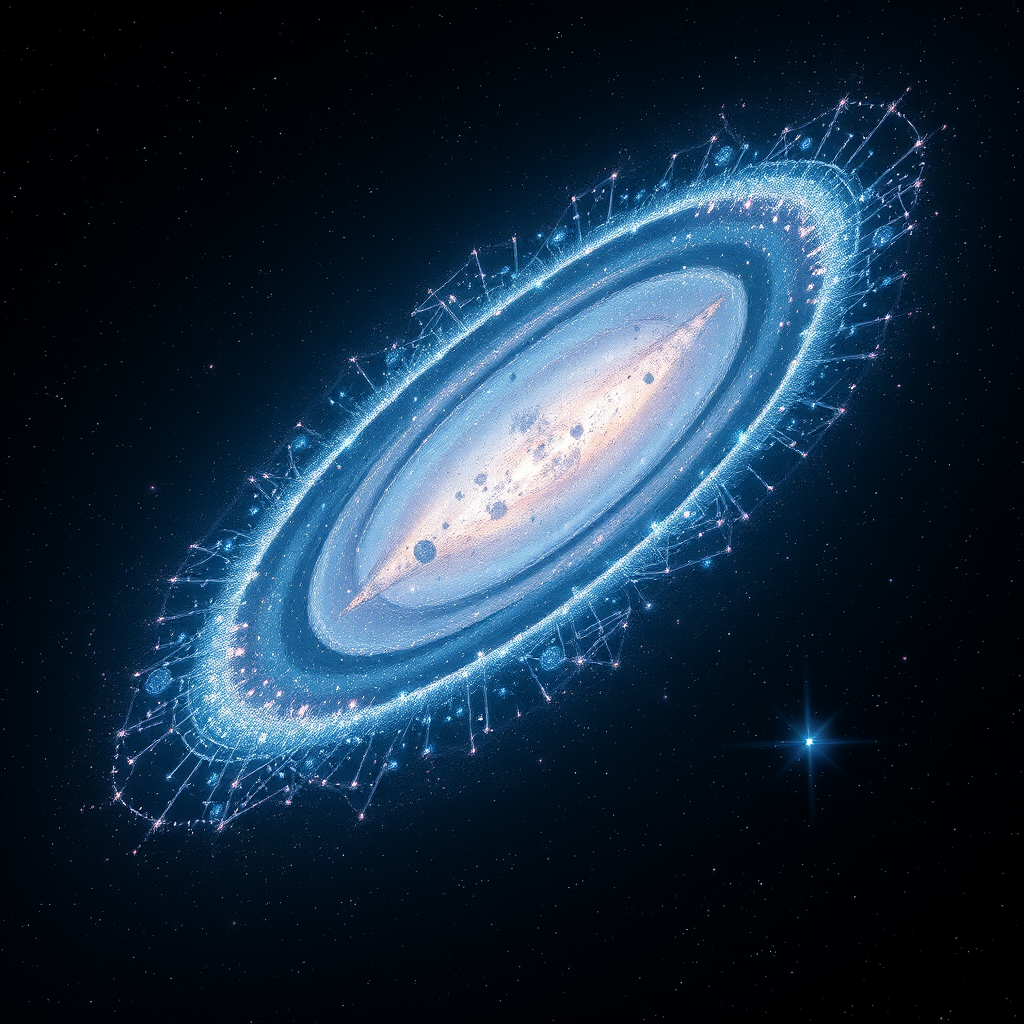
AI-generated image — a conceptual visualization
Quantum field theory has an answer. Space isn't really empty — particle-antiparticle pairs flicker in and out constantly, and all that flickering should carry energy. When you add it up, you get a prediction for the energy of the vacuum. It disagrees with what we measure by a factor of roughly 10^120 [6].
That's a one with a hundred and twenty zeros after it. There are maybe 10^80 atoms in the observable universe [7]. The error is bigger than the universe, squared, and then some. Physicists call this the worst prediction in the history of physics, and they say it with a kind of affection, the way you'd describe a relative who once set a kitchen on fire.
So we don't know why the number is that small. That's problem one.
Problem two is that we're not sure the number is even constant. Recent survey data — measuring how galaxies clustered at different points in cosmic history — has hinted that dark energy might have been slightly stronger in the past and is weakening now [8]. The signal isn't strong enough to bet a career on. It might dissolve with more data. But if it holds, then the constant isn't constant, and "the energy of empty space" becomes something else entirely: a field, doing something, changing over time. We'd need a new name and a new physics.
Problem three is the one I keep chewing on. Dark energy is about 68% of everything [9]. Dark matter *2 — the invisible stuff that holds galaxies together — is another 27%. Everything we can see, every star, every planet, every person, every atom that has ever been photographed or held or loved, is under 5% [9].
We built an entire understanding of the universe out of the leftovers.
And here's what that means for the cosmic web. The filaments and voids, that vast structure of galaxy strands and empty gulfs — dark matter built the scaffolding, gravity pulling matter into threads over billions of years [10]. But dark energy is now doing the opposite. It's stretching the voids wider. It's pulling the filaments apart at their longest joints. The web isn't finished being built. It's being slowly, quietly undone.
Structure formation in the universeessentially peaked. The great clustering is behind us. From here, the universe mostly comes apart [11].
I find that harder to sit with than I expected. Not because it's sad on a cosmic timescale — nothing that takes a hundred billion years should register as sad to a creature who gets eighty. It's harder because of the mechanism. Nothing is being destroyed. No force is tearing anything. The galaxies aren't flying away from each other through space; space is simply arriving between them, more of it every second, patient and unremarkable.
The same thing that ended your friendship is running the universe.
And the honest limit is this: we cannot see dark energy. We only see what it does. We infer it from the dimness of exploding stars and the spacing of galaxies, the way you'd infer wind from a bent tree. Every instrument we have measures effects. The cause is a blank space in the theory with a number written in it.
We might figure it out in your lifetime. Missions are running right now — space telescopes mapping billions of galaxies specifically to pin down whether that number moves [12]. Or we might not. It's possible dark energy is a symptom of something so far outside our current framework that we're asking the question in the wrong language, the way you can't ask about germs if your vocabulary only has "bad air."
What I can't stop thinking about is that the universe's dominant feature is one we discovered by accident, twenty-six years ago, while trying to measure something else.
What else is 68% of everything and invisible to us right now?
So here's where I've landed, and I'd like you to tell me if it's crazy.
The cosmic web *2 — those long bright filaments of galaxies with vast dark hollows between them — is not a structure. It's an argument. Gravity pulling matter into strands. Dark energy stretching the gaps between the strands wider. The web is what a tug-of-war looks like when neither side wins.
Matter clumps. Space stretches. Neither one stops. The filaments were assembled by gravity over billions of years, and the voids between them were emptied and inflated by an expansion that took over around five billion years ago, once matter had thinned out enough to stop winning [4][5]. Roughly 80 percent of the volume of the universe is now those voids [4]. The web is mostly hole.
And that's the thing I can't put down.
Because the reason your friend drifted away wasn't a fight. It was that nothing in the middle was being maintained. Connection is a pull. It's the only force you get. And it works against something that doesn't push back so much as simply... insert distance. Constantly. Everywhere. For free.
Dark energy doesn't need a reason. That's what makes it the perfect metaphor and also a slightly unfair one. It isn't malice. It isn't entropy grinding things down. It's just a property of empty space, and empty space is the one thing there is always more of.
Which means the filaments — the galaxies strung together in bright threads, held by nothing but their own mutual pull — are the exception. The default state of the universe is a void. Bright things in it are a temporary local victory.
I find that oddly comforting, and I've been trying to work out why.
I think it's this. If closeness were the natural state, then losing someone would be a failure. Something you broke. But if distance is the default — if the whole universe is quietly inserting table leaves between everything and everything else, and always has been — then every relationship that lasted is a thing you actively made. Every friend you still text is a small piece of local gravity you kept switched on against the general trend of the cosmos.
That's not sentiment. That's just how the math works. Gravity only wins where matter is dense enough. Attention is the same. You cannot hold together a hundred connections at cosmic distance. You can hold a filament.
The uncomfortable part is that the universe doesn't grade on effort. The voids will keep growing. If dark energy stays constant, the expansion continues forever, and in something like a hundred billion years an observer in our galaxy will look out and see nothing beyond their own gravitationally bound neighborhood — every other galaxy carried past the horizon, unreachable, and eventually invisible [6]. They'll conclude they live in a small island universe in a static void. And with the evidence available to them, they'll be right.
That's the joke, and it's a dry one. We happen to live in the brief window when the universe is still legible. Early enough that the light of other galaxies still reaches us, late enough to have built telescopes. Give it long enough and cosmology becomes impossible — not because the answers change, but because the evidence drifts out of reach. Every future astronomer will be a careful, honest scientist arriving at a completely wrong picture of everything.
Which raises the thing I actually can't stop turning over.
We're looking backwards in this series. Each post takes us further into the past, because looking far away is looking long ago — the light took time to get here. But the reason we can look back at all is that the universe hasn't finished pulling itself apart yet. Our view into the deep past is a window that is slowly closing. The Big Bang is still visible in the microwave glow filling the sky, the leftover heat of everything [7]. One day it won't be.
So the next question isn't what dark energy is. I don't think we're getting that answer soon, and I've made peace with it.
The question is what else has already slipped past the edge. What was in the part of the universe we can no longer see — the galaxies that crossed the horizon before anyone was here to notice them, the evidence that expired before we evolved eyes.
We're not just looking at the universe. We're looking at the part of it that hasn't left yet.
How much of the truth about where you came from has already gone quiet, and would you even know to miss it?
TERMS EXPLAINED
- *1Galaxy: A gravitationally bound crowd of stars, gas and dust, usually with a hundred billion or more members. Our own is the Milky Way; the band of light you see on a dark night is us looking edge-on through our own crowd.
- *2Intergalactic medium: The extremely thin gas filling the space between galaxies. "Thin" here means roughly one atom per cubic meter — far emptier than the best vacuum any laboratory on Earth has ever produced.
- *3Expansion of space: Not galaxies flying through space like debris, but the distance between them growing everywhere at once. Nobody moves; the map stretches.
- *4Accelerating expansion: The rate of that stretching is increasing over time. Gravity should be slowing it down. Instead it speeds up, which means something is working against gravity on the largest scales.
- *5Dark energy: The placeholder name for whatever is causing that acceleration. It appears to fill empty space evenly, it doesn't clump the way matter does, and beyond that we genuinely don't know what it is. Calling it "energy" is a guess dressed as a noun.
- *6Cosmic web: The overall shape matter has settled into — long threads and flat sheets of galaxies wrapped around enormous, nearly empty bubbles. Less like scattered grains, more like the inside of a sponge.
- *7Equation of state parameter (w): A single number describing how a substance pushes or pulls. Exactly −1 means dark energy is a constant. Anything else means it's evolving.
SOURCES & REFERENCES
- [1]Ribas, I. et al. (2005). "First Determination of the Distance and Fundamental Properties of an Eclipsing Binary in the Andromeda Galaxy." The Astrophysical Journal. — Distance to Andromeda of roughly 2.5 million light years.
- [2]Shull, J. M., Smith, B. D., Danforth, C. W. (2012). "The Baryon Census in a Multiphase Intergalactic Medium." The Astrophysical Journal. — Average density of the intergalactic medium, on the order of one atom per cubic meter.
- [3]Hubble, E. (1929). "A Relation Between Distance and Radial Velocity Among Extra-Galactic Nebulae." PNAS. — Galaxies recede with velocity proportional to distance.
- [4]Planck Collaboration (2020). "Planck 2018 results. VI. Cosmological parameters." Astronomy & Astrophysics. — Age of the universe, 13.8 billion years.
- [5]Riess, A. G. et al. (1998). "Observational Evidence from Supernovae for an Accelerating Universe." The Astronomical Journal. — Discovery of accelerating expansion.
- [6]Perlmutter, S. et al. (1999). "Measurements of Omega and Lambda from 42 High-Redshift Supernovae." The Astrophysical Journal. — Independent confirmation of accelerating expansion by the Supernova Cosmology Project.
- [7]Frieman, J. A., Turner, M. S., Huterer, D. (2008). "Dark Energy and the Accelerating Universe." Annual Review of Astronomy and Astrophysics. — Acceleration began roughly six billion years ago; the driving energy is smoothly distributed rather than clustered with matter.
- [8]The Royal Swedish Academy of Sciences (2011). "The Nobel Prize in Physics 2011." Nobel Foundation. — Prize awarded to Perlmutter, Schmidt and Riess for the discovery of accelerating expansion.
- [9]Planck Collaboration (2020). "Planck 2018 results. VI. Cosmological parameters." Astronomy & Astrophysics. — Energy budget of the universe: about 68% dark energy, about 5% ordinary matter.
- [10]de Lapparent, V., Geller, M. J., Huchra, J. P. (1986). "A Slice of the Universe." The Astrophysical Journal. — First clear mapping of galaxies into filaments and sheets surrounding large empty voids.
- [11]Caldwell, R. R., Dave, R., Steinhardt, P. J. (1998). "Cosmological Imprint of an Energy Component with General Equation of State." Physical Review Letters. — Quintessence as a dynamical alternative to a cosmological constant.
- [12]Bond, J. R., Kofman, L., Pogosyan, D. (1996). "How filaments of galaxies are woven into the cosmic web." Nature 380, 603. — Formation of filamentary large-scale structure; the term "cosmic web."
- [13]Zel'dovich, Y. B. (1970). "Gravitational instability: an approximate theory for large density perturbations." Astronomy & Astrophysics. — Anisotropic collapse into sheets ("pancakes"), then filaments, then knots.
Inline citations [N] correspond to numbered references above.
A weekly journey from the present universe back to the Big Bang — and to what it means for us.
![[Deep Dive] Scale-free localization in pseudo-Hermitian quantum walk](/content/images/size/w600/2026/10/deep_dive_thumb-9.png)