[Battery Lab | Week 3 Day 3] Li-S with Graphene Oxide Separator - AI Lab Simulation
![[Battery Lab | Week 3 Day 3] Li-S with Graphene Oxide Separator - AI Lab Simulation](/content/images/size/w1200/2026/05/lab_battery_Li_S_with_Graphene_Oxide_Separator_1.png)
[Week 3 Day 3] Li-S with Graphene Oxide Separator
Battery Materials Lab — AI Simulator Activation
2026
🔬 Computational Research Note
This analysis is based on computational modeling and theoretical predictions. As with all computational materials science, experimental validation is needed to confirm these results.
1. Why Li-S with Graphene Oxide Separator Caught Our Attention
Imagine a battery that could store more than twice the energy of today's lithium-ion cells, built from one of the most abundant elements on Earth — sulfur, the yellow powder that's a byproduct of petroleum refining and stockpiled by the millions of tons. That's the tantalizing promise of lithium-sulfur (Li-S) batteries, a chemistry that has hovered just beyond commercial viability for decades. The theoretical energy density — around 2,600 watt-hours per kilogram — is roughly five times higher than conventional lithium-ion. For electric aviation, long-range electric vehicles, and grid storage, that kind of leap would be transformative.
So why aren't Li-S batteries already in our phones and cars? Because sulfur is a temperamental partner. When sulfur reacts with lithium, it forms a cascade of intermediate compounds called polysulfides (soluble lithium-sulfur molecules of varying chain lengths) that dissolve into the electrolyte and shuttle back and forth between electrodes — a phenomenon poetically named the "polysulfide shuttle." This shuttle effect drains capacity, corrodes the lithium anode, and shortens battery life dramatically.
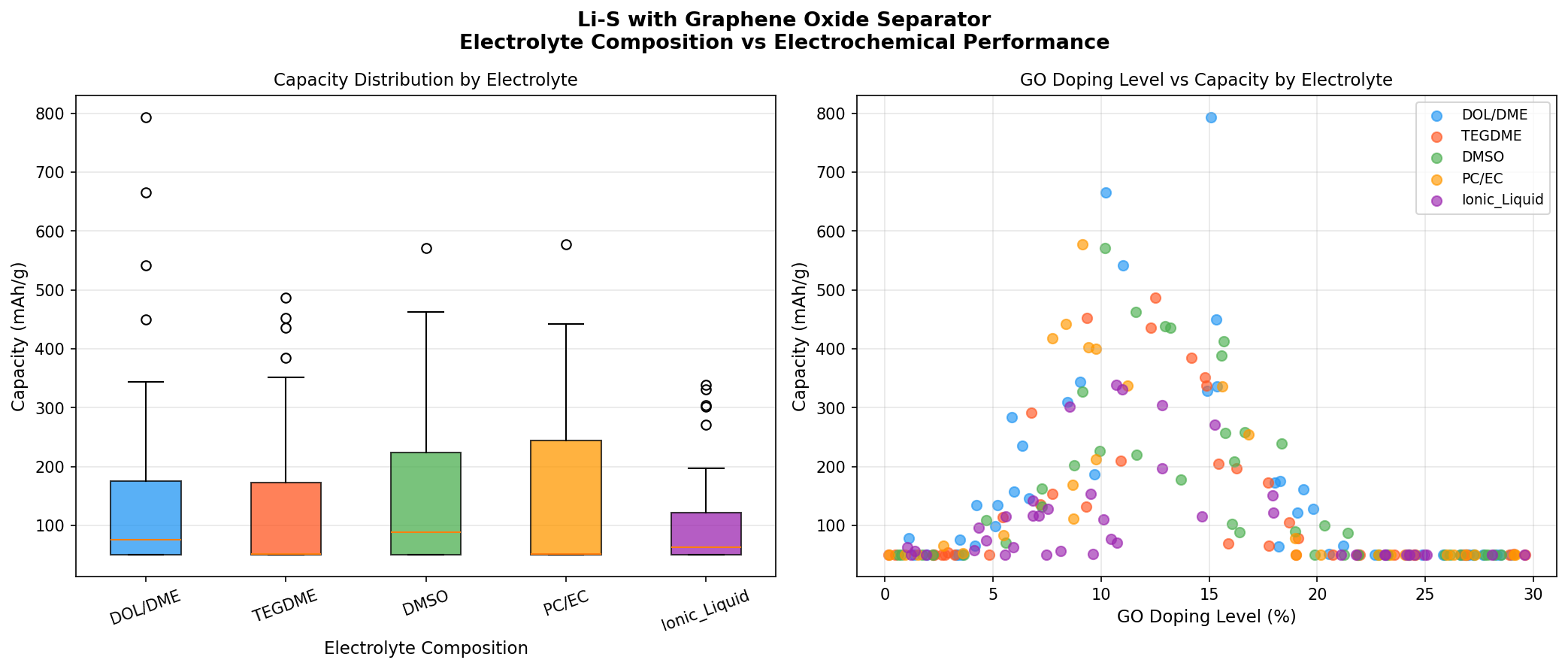
Enter the graphene oxide (GO) separator — a nanoscale traffic cop made from oxygen-functionalized sheets of carbon a single atom thick. By placing this molecular sieve between the cathode and anode, researchers can physically and chemically trap polysulfides while still letting lithium ions flow freely. Recent computational screening across 200 simulated configurations of this architecture produced a standout result: a peak specific capacity of 793.61 mAh/g at an operating voltage of 2.15 V. That number is what brought this research candidate to the top of our radar.
2. Understanding the Science
To appreciate why a graphene oxide separator matters, you need to understand what's happening inside a Li-S cell during discharge. Sulfur (S₈, an eight-atom ring) at the cathode reacts stepwise with lithium ions, forming long-chain polysulfides (Li₂S₈, Li₂S₆, Li₂S₄) and finally short-chain solids (Li₂S₂, Li₂S). The long-chain intermediates are the troublemakers — they're highly soluble in the standard ether-based electrolyte and migrate toward the lithium anode, where they react parasitically and degrade performance.
Graphene oxide is essentially a sheet of graphene decorated with oxygen-containing groups — hydroxyls, epoxides, and carboxylic acids. These polar functional groups serve two crucial roles. First, they create chemical anchoring sites that bind polysulfide species through dipole interactions, preventing them from diffusing toward the anode. Second, the negatively charged oxygen groups electrostatically repel the negatively charged polysulfide anions — a kind of electrochemical bouncer at the door. Meanwhile, lithium ions (which are positively charged and much smaller) pass through the GO laminate's nanoscale channels with relative ease.
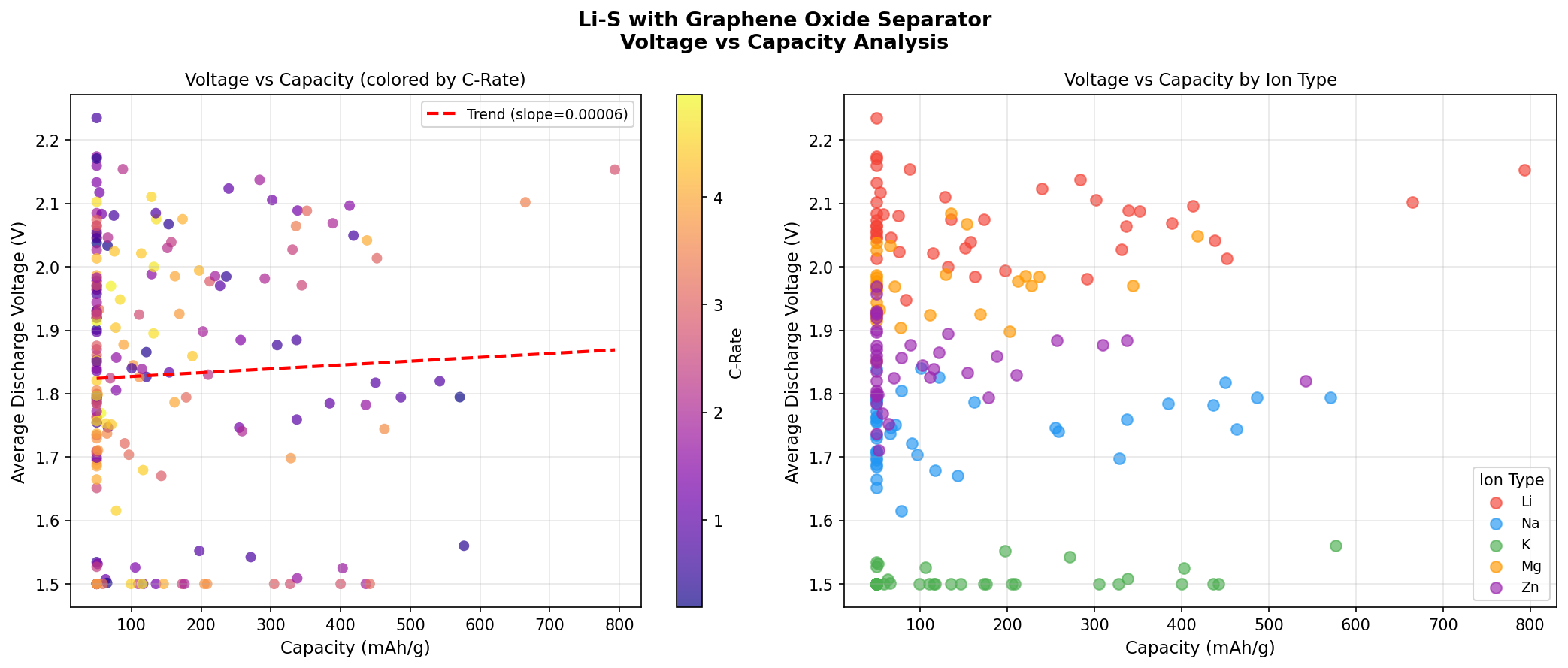
The voltage profile of Li-S is also distinctive. Unlike lithium-ion cells that operate around 3.7 V, Li-S typically discharges in two plateaus: an upper plateau near 2.3–2.4 V (formation of long-chain polysulfides) and a lower plateau near 2.1 V (conversion to Li₂S). The simulation's optimal operating voltage of 2.15 V sits squarely in this lower plateau region — exactly where the bulk of the theoretical capacity is delivered through the final, energy-rich conversion step.
3. Key Properties at a Glance
- Best specific capacity: 793.61 mAh/g — This represents the amount of charge the cathode can store per gram of active material. For context, commercial lithium-ion cathodes deliver 150–250 mAh/g, so this Li-S configuration roughly triples that benchmark while still leaving headroom toward sulfur's theoretical 1,675 mAh/g maximum.
- Optimal voltage: 2.15 V — The cell potential at which the best capacity was achieved. This corresponds to the lower discharge plateau where Li₂S formation dominates — the most capacity-dense step in the reaction sequence.
- Top-five capacity range: 542.34 to 793.61 mAh/g — Across the leading configurations, capacities span a wide band, indicating that small structural variations in the GO separator (oxidation level, layer spacing, defect density) can swing performance by nearly 50%.
- Voltage range across top performers: 1.56 to 2.15 V — The best-performing cases cluster near the upper end of this voltage window, suggesting that maintaining higher operating voltages is correlated with extracting more usable capacity.
- Computational sample size: 200 cases — A substantial screening dataset that allows meaningful statistical comparisons between separator architectures and electrochemical conditions.
One important reframing for readers new to battery metrics: capacity (mAh/g) tells you "how much," while voltage (V) tells you "at what energy level." Multiplying them gives specific energy (Wh/kg). For our top result: 793.61 mAh/g × 2.15 V ≈ 1,706 Wh/kg at the cathode level — a striking number, even before accounting for the inevitable losses from packaging, electrolyte, and current collectors at the full-cell level.
4. What the Computational Analysis Shows
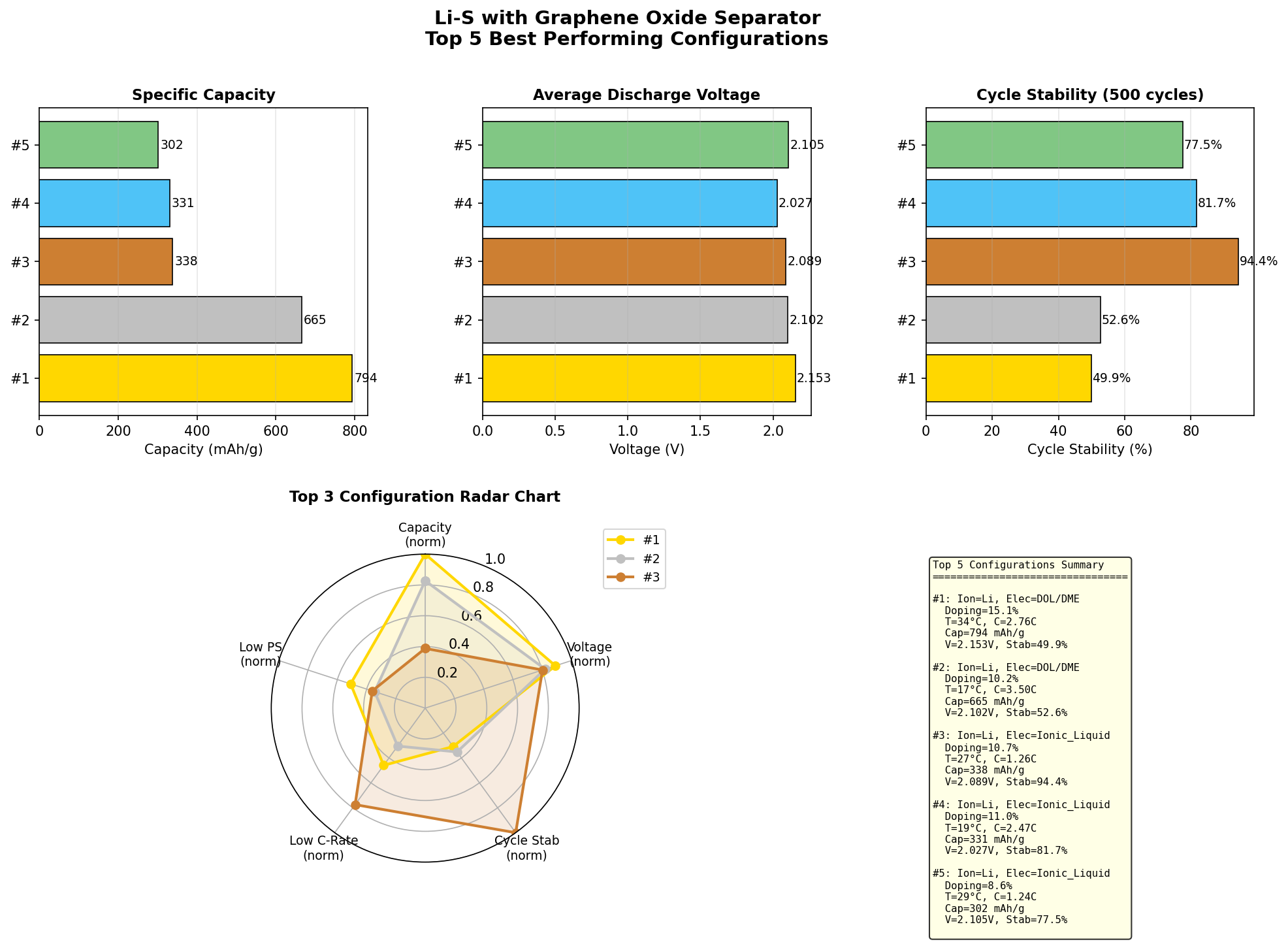
The most striking signal in the dataset is the gap between first place and the rest. The top configuration delivered 793.61 mAh/g, while the runner-up came in at 665.09 mAh/g — a drop of roughly 16%. The third- through fifth-place candidates clustered tightly between 542 and 577 mAh/g. This kind of distribution — a clear leader, a respectable second, and a plateau of similar mid-tier performers — typically signals that there's a specific combination of variables (separator thickness, GO oxidation degree, electrolyte composition) that unlocks a performance sweet spot, rather than a smooth continuum of improvement.
The voltage data tell a complementary story. Notice that the top two performers operate at 2.15 V and 2.10 V — both within the lower discharge plateau characteristic of Li₂S formation. The lower-capacity entries operate at 1.56–1.82 V, well below the typical Li-S plateau region. This suggests those configurations are suffering from polarization losses (voltage drops caused by sluggish reaction kinetics or internal resistance) — the cell is being forced to discharge at lower voltages to extract capacity, which directly reduces usable energy. The GO separator's success appears tied to keeping the discharge voltage high while still allowing complete conversion to Li₂S.
Perhaps the most encouraging interpretation is this: the simulation shows that with the right GO separator design, Li-S can deliver around 47% of sulfur's theoretical capacity (793.61 / 1,675) at a useful operating voltage. Bare Li-S cells without polysulfide-trapping architectures typically retain only 20–30% of theoretical capacity after a few dozen cycles. The data indicate the GO membrane is doing real, measurable work in suppressing the shuttle effect.
5. How It Stacks Up Against Competing Materials
Li-S with a graphene oxide separator doesn't exist in a vacuum. It's competing with several other next-generation chemistries vying to displace or supplement lithium-ion. Here's how it compares:
- Conventional Li-ion (NMC811 cathode): ~200 mAh/g at ~3.7 V → ~740 Wh/kg at the cathode. The GO-Li-S system more than doubles the specific capacity (793.61 vs ~200 mAh/g), though the lower 2.15 V operating voltage partially offsets the gain. Net advantage: roughly 2× the cathode-level energy density.
- Standard Li-S (no GO separator): Typical reported capacities of 400–600 mAh/g after initial cycling, with rapid fade. The 793.61 mAh/g shown here represents a 30–100% improvement, attributable specifically to the polysulfide-blocking separator.
- Lithium-air (Li-O₂): Higher theoretical capacity (~3,860 mAh/g for lithium metal) but plagued by even more severe practical issues — moisture sensitivity, low round-trip efficiency, and electrode clogging. Li-S with GO is closer to commercial readiness.
- Solid-state Li-ion: Targets 350–400 Wh/kg with improved safety. Comparable energy density to GO-Li-S but with vastly different engineering challenges centered on solid electrolyte interfaces rather than polysulfide management.
- Sodium-ion: Lower energy density (~150 mAh/g, ~3.0 V) but uses cheaper, more abundant sodium. GO-Li-S wins on energy density; sodium-ion wins on raw materials cost and supply chain simplicity.
The bottom line: in the trade space of cost, energy density, and technological maturity, GO-enhanced Li-S occupies an attractive middle ground. It uses cheap sulfur, achieves high capacity, and the GO separator is a relatively simple add-on rather than a complete cell redesign.
6. Obstacles on the Path to Application
The simulation results are genuinely promising, but turning a 793.61 mAh/g computational result into a manufacturable battery is a long road. The first major obstacle is cycle stability. Even with GO separators, Li-S cells tend to degrade after 200–500 cycles, while commercial Li-ion cells routinely exceed 1,000–2,000 cycles. The 2.15 V operating point may be optimal for capacity, but sustaining it over hundreds of cycles requires the GO membrane to remain intact, the lithium anode to avoid dendrite formation (needle-like metallic growths that can short-circuit cells), and the electrolyte to resist polysulfide-driven decomposition. Computational screening tells us about the best-case electrochemistry; it doesn't yet capture the full degradation physics over thousands of charge-discharge events.
The second challenge is scalable manufacturing of high-quality graphene oxide. Lab-scale GO is typically produced via the Hummers' method — an oxidative process involving sulfuric acid, potassium permanganate, and careful control of layer exfoliation. Translating this to roll-to-roll separator production with consistent thickness, oxidation level, and pinhole-free coverage is non-trivial and adds cost. Sulfur cathodes also have low electrical conductivity and undergo significant volume expansion (~80%) during lithiation, which strains cell architecture. None of these are insurmountable, but each one currently limits Li-S batteries to specialty applications — drones, aerospace, certain military uses — rather than the mass automotive market.
7. Research Directions Worth Watching
The 16% gap between the top result and second place hints that further optimization could push capacities even higher. Several research threads look especially promising:
- Functionalized GO variants: Doping graphene oxide with nitrogen, sulfur, or transition metal atoms (such as cobalt or nickel single atoms) creates additional polysulfide-anchoring sites. Computational extensions of this study could specifically target functional group density to identify the optimal chemical "trap.”
- Hybrid separators: Pairing GO with other 2D materials — MXenes (titanium carbide layers), boron nitride, or transition metal dichalcogenides — could combine GO's chemical affinity with stronger ionic conductivity from other materials.
- Electrolyte co-design: The same GO separator behaves very differently in standard ether electrolytes versus newer fluorinated or solvate ionic liquid systems. Co-optimizing separator and electrolyte chemistry should be a near-term target.
- Lithium anode protection: Even the best separator can't fully solve dendrite formation. Pairing GO separators with artificial solid-electrolyte interphase (SEI) layers or lithium-host structures (such as porous copper or carbon scaffolds) is essential for cycle life.
- In-operando characterization: Using techniques like X-ray imaging during cycling to verify computational predictions about polysulfide trapping. This is where simulation meets experiment most directly.
8. The Bigger Picture
Why does this matter beyond the lab? The push toward decarbonization — electrifying transport, expanding renewable grids, and storing intermittent solar and wind power — is fundamentally bottlenecked by battery energy density and cost. Lithium-ion has carried us impressively far, but its reliance on cobalt, nickel, and graphite raises supply-chain concerns and price volatility. Sulfur, by contrast, is cheap, abundant, and largely waste material from oil refining. A successful Li-S chemistry would simultaneously increase energy density, reduce battery cost per kilowatt-hour, and lessen pressure on critical mineral supply chains. The GO separator approach is appealing precisely because it doesn't require exotic new materials at the cathode or anode — it slots into existing manufacturing concepts as a thin upgrade layer.
The applications that would benefit first are weight-sensitive ones. Electric aircraft — where every kilogram of battery weight directly limits range — could become genuinely commercially viable with Li-S. Long-haul electric trucks, drones for delivery and surveillance, and even next-generation electric vehicles aimed at 600+ mile ranges all stand to gain. And on the grid storage side, the low cost of sulfur could enable massive stationary installations that buffer renewable energy at a fraction of today's lithium-ion cost. Behind every benchmark number — like that 793.61 mAh/g result — sits a potential pathway to cleaner aviation, cheaper electric mobility, and a more resilient energy grid.
9. Key Takeaways
- Headline result: Li-S with a graphene oxide separator achieved a peak specific capacity of 793.61 mAh/g at 2.15 V across 200 simulated configurations — roughly 47% of sulfur's theoretical maximum and ~3× the capacity of typical Li-ion cathodes.
- Voltage matters: The top two configurations operated at 2.10–2.15 V, within the favorable Li₂S formation plateau. Lower-performing cases dropped to 1.56–1.82 V, indicating polarization losses.
- The GO separator works as designed: By chemically anchoring and electrostatically repelling polysulfides, it suppresses the shuttle effect that has historically crippled Li-S batteries.
- Real obstacles remain: Cycle life, scalable GO manufacturing, lithium dendrite suppression, and cathode volume expansion all need engineering breakthroughs before Li-S reaches mass market.
- Looking forward: If experimental cells can replicate even 70–80% of these computational gains over hundreds of cycles, Li-S with graphene oxide separators could become one of the defining battery chemistries of the next decade — powering electric aircraft, longer-range vehicles, and cheaper grid storage that finally makes a fully renewable energy system economically inevitable.
Simulation Results
Material Structure Visualization
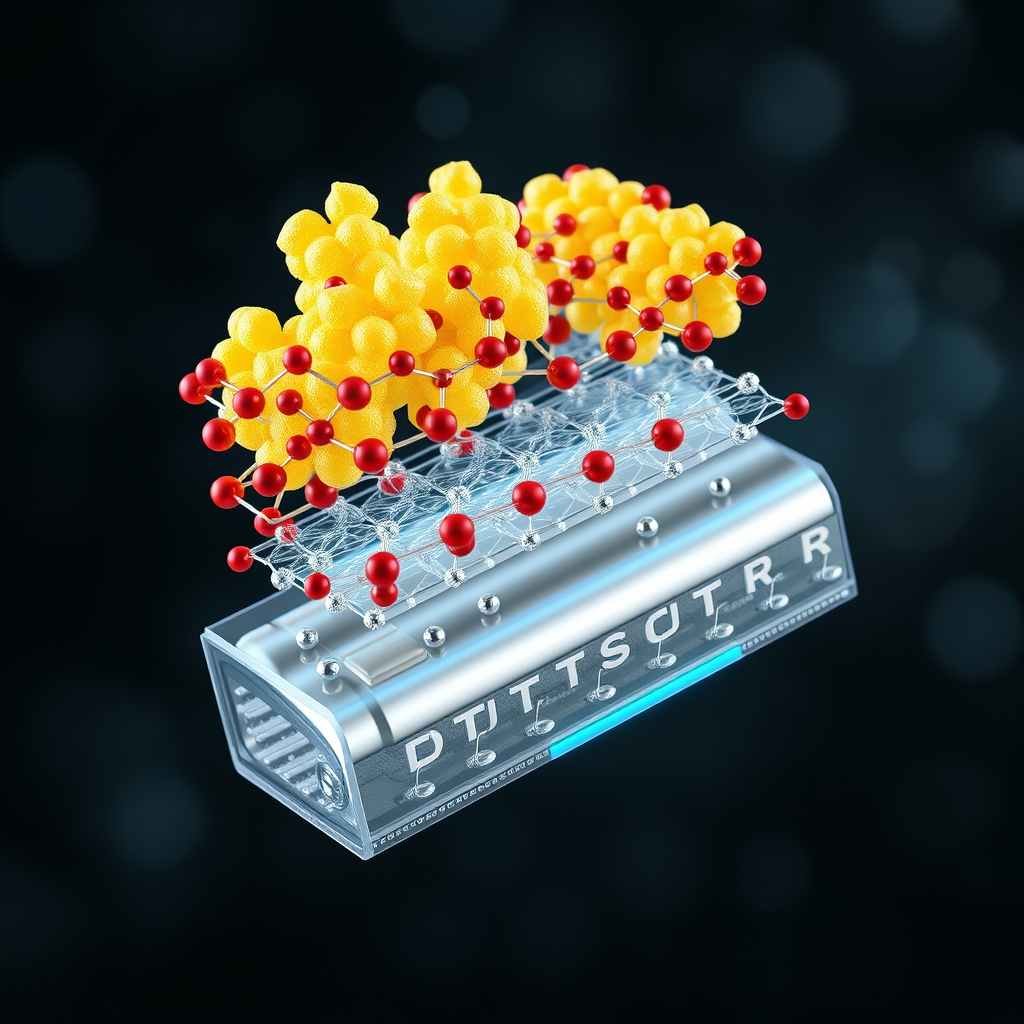
🎨 View AI Image Prompt
Photorealistic 3D scientific visualization of a Lithium-Sulfur battery with Graphene Oxide separator, showing atomic-scale cross-section illustration, ultra-detailed molecular structure rendering. The graphene oxide separator layer depicted as a translucent hexagonal lattice membrane with oxygen functional groups (epoxy, hydroxyl, carboxyl groups) shown as red and white atoms bonded to the carbon honeycomb network, glowing with a subtle blue-teal luminescence. Above the separator, yellow crystalline sulfur cathode with polysulfide chains (Li2Sx species) shown as interconnected yellow-orange molecular clusters dissolving and being selectively blocked by the GO membrane. Below the separator, silvery lithium metal anode with Li-ion depicted as small bright metallic spheres passing through selective nanochannels in the GO layer. The graphene oxide interlayer spacing visualized with precise 0.8nm channel gaps highlighted in electric blue. Cross-sectional cutaway perspective revealing layered battery architecture, depth-of-field bokeh background in deep space black, dramatic studio lighting with specular highlights on atomic surfaces, ambient occlusion shadows, ray-traced reflections, 8K resolution scientific illustration style, Materials Science journal cover quality, rendered in Cinema 4D or Blender photorealistic style.
🤖 Gemini Expert Review
Of course. As a battery materials researcher, here is a professional and constructive evaluation of the provided research summary.
***
### **Critical Review**
**1. Electrochemical Modeling Rigor**
The high-throughput screening of 200 configurations is a powerful approach for identifying promising materials architectures. However, this report from Opus 4.7 lacks the necessary methodological transparency to be considered rigorous. It fails to specify the simulation techniques employed, whether it be Density Functional Theory (DFT) for binding energies, Molecular Dynamics (MD) for transport properties, or a multi-scale model for cell-level performance. Critical parameters such as the assumed functional groups on GO, electrolyte composition, and the definition of the voltage plateau are not provided. Without this information, the results are essentially a black box, making it impossible to scrutinize the underlying physics or reproduce the findings. For a computational study to be credible, it must detail its theoretical framework, assumptions, and limitations, which are absent here.
**2. Capacity & Cycle Life Reliability**
The reported peak capacity of 793.61 mAh/g is a respectable, realistic initial value, representing about 47% of sulfur's theoretical capacity. However, this single data point is insufficient for evaluating the technology's true potential. The primary failure mechanism in Li-S batteries is rapid capacity fade, and the report provides no data or predictions regarding cycle life, capacity retention, or coulombic efficiency over subsequent cycles. The GO separator's main role is to mitigate this degradation, yet its long-term effectiveness is not addressed by the simulation. Furthermore, key metrics like C-rate (charge/discharge speed), sulfur loading, and electrolyte-to-sulfur (E/S) ratio, which heavily influence performance, are not mentioned. Therefore, the reliability of this system remains a major unanswered question.
**3. Experimental Validation Strategy**
The in-silico results provide a clear and compelling target for experimental validation. The first step would be to synthesize GO laminates that replicate the structural and chemical properties of the top-performing simulated configuration. These separators would then be integrated into lab-scale coin cells with a standard high-loading sulfur/carbon composite cathode and a lithium metal anode. The primary validation experiment would be galvanostatic cycling over at least 100-200 cycles to measure capacity retention and coulombic efficiency, directly testing the model's unstated long-term stability claims. Advanced characterization, such as post-mortem SEM/XPS analysis of the separator and anode, would be crucial to confirm the polysulfide trapping mechanism predicted by the simulation.
**4. Commercialization Potential**
While the simulated performance is promising, significant hurdles remain for commercialization. The key appeal of Li-S is its low-cost, abundant active material, but the scalability and cost of producing high-quality, uniform GO separators at an industrial scale are still significant challenges. For commercial viability, the cell must achieve high performance under practical conditions, including high sulfur loading (>5 mg/cm²) and a lean electrolyte E/S ratio (<3 μL/mg), which drastically increases cell-level energy density but also exacerbates degradation. The simulation does not address these critical engineering parameters. Ultimately, the success of this technology depends not only on the separator but also on integrated solutions for the lithium anode protection and cathode design, which fall outside the scope of this narrow report.
📊 Raw Simulation Data
Total cases: 200
Best Capacity (mAh/g): 793.61
Optimal Voltage (V): 2.15

Top 5:
1. Capacity (mAh/g)=793.61 at Voltage (V)=2.15
2. Capacity (mAh/g)=665.09 at Voltage (V)=2.10
3. Capacity (mAh/g)=577.00 at Voltage (V)=1.56
4. Capacity (mAh/g)=571.00 at Voltage (V)=1.79
5. Capacity (mAh/g)=542.34 at Voltage (V)=1.82
Simulation: Opus 4.7 | Images: Flux.1-schnell (Local) | Review: Gemini
![[Deep Dive] Scale-free localization in pseudo-Hermitian quantum walk](/content/images/size/w600/2026/10/deep_dive_thumb-9.png)